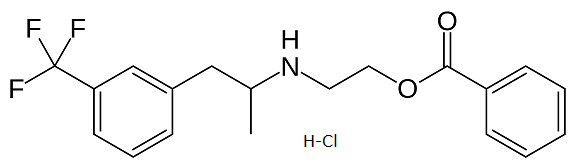
Benfluorex (Mediator) is an anorectic and hypolipidemic agent that is structurally related to fenfluramine. It may improve glycemic control and decrease insulin resistance in people with poorly controlled type-2 diabetes.
Physicochemical Properties
| Molecular Formula | C19H21CLF3NO2 |
| Molecular Weight | 387.82374 |
| Exact Mass | 387.121 |
| CAS # | 23642-66-2 |
| Related CAS # | Benfluorex;23602-78-0 |
| PubChem CID | 198015 |
| Appearance | White to off-white solid powder |
| Density | 1.183g/cm3 |
| Boiling Point | 420.5ºC at 760mmHg |
| Melting Point | 158-159?C |
| Flash Point | 208.1ºC |
| Vapour Pressure | 2.81E-07mmHg at 25°C |
| LogP | 5.275 |
| Hydrogen Bond Donor Count | 2 |
| Hydrogen Bond Acceptor Count | 6 |
| Rotatable Bond Count | 8 |
| Heavy Atom Count | 26 |
| Complexity | 408 |
| Defined Atom Stereocenter Count | 0 |
| InChi Key | NLOALSPYZIIXEO-UHFFFAOYSA-N |
| InChi Code | InChI=1S/C19H20F3NO2.ClH/c1-14(12-15-6-5-9-17(13-15)19(20,21)22)23-10-11-25-18(24)16-7-3-2-4-8-16/h2-9,13-14,23H,10-12H2,1H31H |
| Chemical Name | 2-((1-(3-(trifluoromethyl)phenyl)propan-2-yl)amino)ethyl benzoate hydrochloride |
| Synonyms | Benfluorex hydrochloride Lipophoral Mediator JP 992 EINECS 245-801-8 Mediaxal Balans EINECS 245-020-2 |
| HS Tariff Code | 2934.99.9001 |
| Storage |
Powder-20°C 3 years 4°C 2 years In solvent -80°C 6 months -20°C 1 month |
| Shipping Condition | Room temperature (This product is stable at ambient temperature for a few days during ordinary shipping and time spent in Customs) |
Biological Activity
| ln Vitro | Benfluex hydrochloride increases the amount of GFP-positive cells, a sustainable way to stimulate insulin promoter activity. In a dose-dependent manner, benfluex hydrochloride raises endogenous insulin mRNA levels and the quantity of GFP-positive cells. Benfluex hydrochloride increases the expression of HNF4α, which is consistent with its role as an activator of HNF4α. HNF4α protease's sensitivity is altered by benfluex hydrochloride, but not by an inert control drug [1]. In oleic acid, benfluex hydrochloride decreases the synthesis of ketone bodies and acid lysates in a concentration-dependent manner, but it dramatically increases the amount of 14CO2 that enters the citric acid cycle. In a dose-dependent way, benfluex hydrochloride reduces the rate of gluconeogenesis from lactate/pyruvate (10/1 nM) [2]. |
| References |
[1]. Identification of alverine and benfluorex as HNF4α activators. ACS Chem Biol. 2013 Aug 16;8(8):1730-6. [2]. Effects of benfluorex on fatty acid and glucose metabolism in isolated rat hepatocytes: from metabolic fluxes to gene expression. Diabetes. 2002 Aug;51(8):2363-8. |
Solubility Data
| Solubility (In Vitro) |
DMSO : ≥ 100 mg/mL (~257.85 mM) H2O : ~2.27 mg/mL (~5.85 mM) |
| Solubility (In Vivo) |
Solubility in Formulation 1: ≥ 2.5 mg/mL (6.45 mM) (saturation unknown) in 10% DMSO + 40% PEG300 + 5% Tween80 + 45% Saline (add these co-solvents sequentially from left to right, and one by one), clear solution. For example, if 1 mL of working solution is to be prepared, you can add 100 μL of 25.0 mg/mL clear DMSO stock solution to 400 μL PEG300 and mix evenly; then add 50 μL Tween-80 to the above solution and mix evenly; then add 450 μL normal saline to adjust the volume to 1 mL. Preparation of saline: Dissolve 0.9 g of sodium chloride in 100 mL ddH₂ O to obtain a clear solution. Solubility in Formulation 2: ≥ 2.5 mg/mL (6.45 mM) (saturation unknown) in 10% DMSO + 90% (20% SBE-β-CD in Saline) (add these co-solvents sequentially from left to right, and one by one), clear solution. For example, if 1 mL of working solution is to be prepared, you can add 100 μL of 25.0 mg/mL clear DMSO stock solution to 900 μL of 20% SBE-β-CD physiological saline solution and mix evenly. Preparation of 20% SBE-β-CD in Saline (4°C,1 week): Dissolve 2 g SBE-β-CD in 10 mL saline to obtain a clear solution. Solubility in Formulation 3: ≥ 2.5 mg/mL (6.45 mM) (saturation unknown) in 10% DMSO + 90% Corn Oil (add these co-solvents sequentially from left to right, and one by one), clear solution. For example, if 1 mL of working solution is to be prepared, you can add 100 μL of 25.0 mg/mL clear DMSO stock solution to 900 μL of corn oil and mix evenly. Solubility in Formulation 4: 5.88 mg/mL (15.16 mM) in PBS (add these co-solvents sequentially from left to right, and one by one), clear solution; with ultrasonication (<60°C). (Please use freshly prepared in vivo formulations for optimal results.) |
| Preparing Stock Solutions | 1 mg | 5 mg | 10 mg | |
| 1 mM | 2.5785 mL | 12.8926 mL | 25.7852 mL | |
| 5 mM | 0.5157 mL | 2.5785 mL | 5.1570 mL | |
| 10 mM | 0.2579 mL | 1.2893 mL | 2.5785 mL |