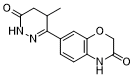
Physicochemical Properties
| Molecular Formula | C13H13N3O3 |
| Molecular Weight | 259.26 |
| Exact Mass | 259.096 |
| Elemental Analysis | C, 60.23; H, 5.05; N, 16.21; O, 18.51 |
| CAS # | 112018-01-6 |
| PubChem CID | 5362399 |
| Appearance | Solid powder |
| LogP | 0.78 |
| Hydrogen Bond Donor Count | 2 |
| Hydrogen Bond Acceptor Count | 4 |
| Rotatable Bond Count | 1 |
| Heavy Atom Count | 19 |
| Complexity | 435 |
| Defined Atom Stereocenter Count | 0 |
| SMILES | O=C1NN=C(C2C=CC3NC(COC=3C=2)=O)C(C)C1 |
| InChi Key | XZPGINPFWXLYNW-UHFFFAOYSA-N |
| InChi Code | InChI=1S/C13H13N3O3/c1-7-4-11(17)15-16-13(7)8-2-3-9-10(5-8)19-6-12(18)14-9/h2-3,5,7H,4,6H2,1H3,(H,14,18)(H,15,17) |
| Chemical Name | 7-(4-methyl-6-oxo-1,4,5,6-tetrahydropyridazin-3-yl)-2H-benzo[b][1,4]oxazin-3(4H)-one |
| Synonyms | Bemoradan; (±)-Bemoradan; ORF 22867; ORF-22867; ORF22867; RWJ 22867; RWJ-22867; RWJ22867; |
| HS Tariff Code | 2934.99.9001 |
| Storage |
Powder-20°C 3 years 4°C 2 years In solvent -80°C 6 months -20°C 1 month |
| Shipping Condition | Room temperature (This product is stable at ambient temperature for a few days during ordinary shipping and time spent in Customs) |
Biological Activity
| References | 1: Wu WN, Caldwell GW, Masucci JA, Gauthier AD. Evaluation of the excretion, and metabolism of the cardiotonic agent bemoradan in male rats and female beagle dogs. Eur J Drug Metab Pharmacokinet. 2001 Oct-Dec;26(4):263-71. doi: 10.1007/BF03226381. PMID: 11808869. 2: Derian CK, Santulli RJ, Rao PE, Solomon HF, Barrett JA. Inhibition of chemotactic peptide-induced neutrophil adhesion to vascular endothelium by cAMP modulators. J Immunol. 1995 Jan 1;154(1):308-17. PMID: 7995950. 3: Huang SM, Brusser L, Chien SC, Simon D, Smith IL, Abrams LS, Lasseter K. Pharmacokinetics and bioavailability of bemoradan, a long-acting inodilator in healthy males. Int J Clin Pharmacol Ther. 1994 Feb;32(2):62-4. PMID: 8004360. 4: Huang SM, Falotico R, Haertlein B, Smith IL. Simultaneous monitoring of bemoradan pharmacokinetics and hemodynamics in mongrel dogs. Biopharm Drug Dispos. 1992 Oct;13(7):539-47. doi: 10.1002/bdd.2510130707. PMID: 1489944. 5: Combs DW, Rampulla MS, Demers JP, Falotico R, Moore JB. Heteroatom analogues of bemoradan: chemistry and cardiotonic activity of 1,4-benzothiazinylpyridazinones. J Med Chem. 1992 Jan;35(1):172-6. doi: 10.1021/jm00079a023. PMID: 1732525. 6: Moore JB Jr, Combs DW, Tobia AJ. Bemoradan--a novel inhibitor of the rolipram-insensitive cyclic AMP phosphodiesterase from canine heart tissue. Biochem Pharmacol. 1991 Jul 15;42(3):679-83. doi: 10.1016/0006-2952(91)90331-x. PMID: 1650219. 7: Huang SM, Chien SC, Flor SC. A sensitive high performance liquid chromatography microassay for bemoradan, a novel cardiotonic agent, in plasma/serum using a semi-automatic liquid/solid extraction sample preparation system--AASP. Biomed Chromatogr. 1990 Mar;4(2):52-5. doi: 10.1002/bmc.1130040203. PMID: 2350597. 8: Combs DW, Rampulla MS, Bell SC, Klaubert DH, Tobia AJ, Falotico R, Haertlein B, Lakas-Weiss C, Moore JB. 6-Benzoxazinylpyridazin-3-ones: potent, long-acting positive inotrope and peripheral vasodilator agents. J Med Chem. 1990 Jan;33(1):380-6. doi: 10.1021/jm00163a061. PMID: 2153210. |
Solubility Data
| Solubility (In Vitro) | May dissolve in DMSO (in most cases), if not, try other solvents such as H2O, Ethanol, or DMF with a minute amount of products to avoid loss of samples |
| Solubility (In Vivo) |
Note: Listed below are some common formulations that may be used to formulate products with low water solubility (e.g. < 1 mg/mL), you may test these formulations using a minute amount of products to avoid loss of samples. Injection Formulations (e.g. IP/IV/IM/SC) Injection Formulation 1: DMSO : Tween 80: Saline = 10 : 5 : 85 (i.e. 100 μL DMSO stock solution → 50 μL Tween 80 → 850 μL Saline) *Preparation of saline: Dissolve 0.9 g of sodium chloride in 100 mL ddH ₂ O to obtain a clear solution. Injection Formulation 2: DMSO : PEG300 :Tween 80 : Saline = 10 : 40 : 5 : 45 (i.e. 100 μL DMSO → 400 μLPEG300 → 50 μL Tween 80 → 450 μL Saline) Injection Formulation 3: DMSO : Corn oil = 10 : 90 (i.e. 100 μL DMSO → 900 μL Corn oil) Example: Take the Injection Formulation 3 (DMSO : Corn oil = 10 : 90) as an example, if 1 mL of 2.5 mg/mL working solution is to be prepared, you can take 100 μL 25 mg/mL DMSO stock solution and add to 900 μL corn oil, mix well to obtain a clear or suspension solution (2.5 mg/mL, ready for use in animals). Injection Formulation 4: DMSO : 20% SBE-β-CD in saline = 10 : 90 [i.e. 100 μL DMSO → 900 μL (20% SBE-β-CD in saline)] *Preparation of 20% SBE-β-CD in Saline (4°C,1 week): Dissolve 2 g SBE-β-CD in 10 mL saline to obtain a clear solution. Injection Formulation 5: 2-Hydroxypropyl-β-cyclodextrin : Saline = 50 : 50 (i.e. 500 μL 2-Hydroxypropyl-β-cyclodextrin → 500 μL Saline) Injection Formulation 6: DMSO : PEG300 : castor oil : Saline = 5 : 10 : 20 : 65 (i.e. 50 μL DMSO → 100 μLPEG300 → 200 μL castor oil → 650 μL Saline) Injection Formulation 7: Ethanol : Cremophor : Saline = 10: 10 : 80 (i.e. 100 μL Ethanol → 100 μL Cremophor → 800 μL Saline) Injection Formulation 8: Dissolve in Cremophor/Ethanol (50 : 50), then diluted by Saline Injection Formulation 9: EtOH : Corn oil = 10 : 90 (i.e. 100 μL EtOH → 900 μL Corn oil) Injection Formulation 10: EtOH : PEG300:Tween 80 : Saline = 10 : 40 : 5 : 45 (i.e. 100 μL EtOH → 400 μLPEG300 → 50 μL Tween 80 → 450 μL Saline) Oral Formulations Oral Formulation 1: Suspend in 0.5% CMC Na (carboxymethylcellulose sodium) Oral Formulation 2: Suspend in 0.5% Carboxymethyl cellulose Example: Take the Oral Formulation 1 (Suspend in 0.5% CMC Na) as an example, if 100 mL of 2.5 mg/mL working solution is to be prepared, you can first prepare 0.5% CMC Na solution by measuring 0.5 g CMC Na and dissolve it in 100 mL ddH2O to obtain a clear solution; then add 250 mg of the product to 100 mL 0.5% CMC Na solution, to make the suspension solution (2.5 mg/mL, ready for use in animals). Oral Formulation 3: Dissolved in PEG400 Oral Formulation 4: Suspend in 0.2% Carboxymethyl cellulose Oral Formulation 5: Dissolve in 0.25% Tween 80 and 0.5% Carboxymethyl cellulose Oral Formulation 6: Mixing with food powders Note: Please be aware that the above formulations are for reference only. InvivoChem strongly recommends customers to read literature methods/protocols carefully before determining which formulation you should use for in vivo studies, as different compounds have different solubility properties and have to be formulated differently. (Please use freshly prepared in vivo formulations for optimal results.) |
| Preparing Stock Solutions | 1 mg | 5 mg | 10 mg | |
| 1 mM | 3.8571 mL | 19.2857 mL | 38.5713 mL | |
| 5 mM | 0.7714 mL | 3.8571 mL | 7.7143 mL | |
| 10 mM | 0.3857 mL | 1.9286 mL | 3.8571 mL |