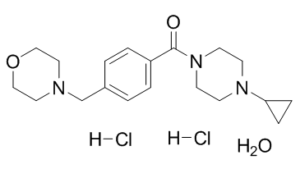
Bavisant dihydrochloride hydrate (also known as JNJ-31001074 dihydrochloride hydrate) is a novel, highly selective, orally bioactive antagonist of the human H3 receptor with a novel mechanism of action which involves wakefulness and cognition. It might be applied as an ADHD treatment. Non-histamine neurons contain histamine H3 receptors, which control other neurotransmitters like acetylcholine and norepinephrine. This suggests that H3 antagonists may be able to reduce impulsivity and enhance attention. According to research, H3 receptor antagonists may have a special therapeutic effect and provide a significant alternative for the treatment of ADHD because of their novel mechanism of action.
Physicochemical Properties
| Molecular Formula | C19H31CL2N3O3 |
| Molecular Weight | 420.37374329567 |
| Exact Mass | 419.174 |
| Elemental Analysis | C, 54.29; H, 7.43; Cl, 16.87; N, 10.00; O, 11.42 |
| CAS # | 1103522-80-0 |
| Related CAS # | Bavisant; 929622-08-2; Bavisant dihydrochloride; 929622-09-3 |
| PubChem CID | 56843503 |
| Appearance | White to pink solid powder |
| LogP | 2.792 |
| Hydrogen Bond Donor Count | 3 |
| Hydrogen Bond Acceptor Count | 5 |
| Rotatable Bond Count | 4 |
| Heavy Atom Count | 27 |
| Complexity | 418 |
| Defined Atom Stereocenter Count | 0 |
| SMILES | O=C(N1CCN(C2CC2)CC1)C(C=C3)=CC=C3CN4CCOCC4.[H]Cl.[H]Cl.O |
| InChi Key | BLFBQJUVAGIUBL-UHFFFAOYSA-N |
| InChi Code | InChI=1S/C19H27N3O2.2ClH.H2O/c23-19(22-9-7-21(8-10-22)18-5-6-18)17-3-1-16(2-4-17)15-20-11-13-24-14-12-20;;;/h1-4,18H,5-15H2;2*1H;1H2 |
| Chemical Name | (4-cyclopropylpiperazin-1-yl)-[4-(morpholin-4-ylmethyl)phenyl]methanone;hydrate;dihydrochloride |
| Synonyms | Bavisant dihydrochloride hydrate; JNJ-31001074-AAC; JNJ 31001074-AAC; JNJ31001074-AAC |
| HS Tariff Code | 2934.99.9001 |
| Storage |
Powder-20°C 3 years 4°C 2 years In solvent -80°C 6 months -20°C 1 month Note: Please store this product in a sealed and protected environment, avoid exposure to moisture. |
| Shipping Condition | Room temperature (This product is stable at ambient temperature for a few days during ordinary shipping and time spent in Customs) |
Biological Activity
| Targets | H3 receptor |
| ln Vivo | Bavisant dihydrochloride hydrate raises the levels of acetylcholine in the rat frontal cortex[4]. |
| References |
[1]. Discovery and characterization of 6-{4-[3-(R)-2-methylpyrrolidin-1-yl)propoxy]phenyl}-2H-pyridazin-3-one (CEP-26401, irdabisant): a potent, selective histamine H3 receptor inverse agonist. J Med Chem. 2011 Jul 14;54(13):4781-92. [2]. Randomized clinical study of a histamine H3 receptor antagonist for the treatment of adults with attention-deficit hyperactivity disorder. CNS Drugs. 2012 May 1;26(5):421-34. [3]. Identification of novel β-lactams and pyrrolidinone derivatives as selective Histamine-3 receptor (H3R) modulators as possible anti-obesity agents. Eur J Med Chem. 2018 May 25;152:148-159. [4]. Histamine H3 receptor antagonists/inverse agonists: Where do they go? Pharmacol Ther. 2019 Aug;200:69-84. |
Solubility Data
| Solubility (In Vitro) |
H2O: ≥ 50 mg/mL (~118.9 mM) DMSO: ≥ 1 mg/mL (~2.4 mM) |
| Solubility (In Vivo) |
Solubility in Formulation 1: 50 mg/mL (118.94 mM) in PBS (add these co-solvents sequentially from left to right, and one by one), clear solution; with sonication. (Please use freshly prepared in vivo formulations for optimal results.) |
| Preparing Stock Solutions | 1 mg | 5 mg | 10 mg | |
| 1 mM | 2.3789 mL | 11.8943 mL | 23.7886 mL | |
| 5 mM | 0.4758 mL | 2.3789 mL | 4.7577 mL | |
| 10 mM | 0.2379 mL | 1.1894 mL | 2.3789 mL |