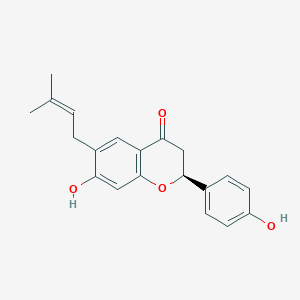
Physicochemical Properties
| Molecular Formula | C₂₀H₂₀O₄ |
| Molecular Weight | 324.37 |
| Exact Mass | 324.136 |
| CAS # | 19879-32-4 |
| PubChem CID | 14236566 |
| Appearance | White to light yellow solid powder |
| Density | 1.2±0.1 g/cm3 |
| Boiling Point | 558.3±50.0 °C at 760 mmHg |
| Flash Point | 202.1±23.6 °C |
| Vapour Pressure | 0.0±1.6 mmHg at 25°C |
| Index of Refraction | 1.622 |
| LogP | 4.85 |
| Hydrogen Bond Donor Count | 2 |
| Hydrogen Bond Acceptor Count | 4 |
| Rotatable Bond Count | 3 |
| Heavy Atom Count | 24 |
| Complexity | 474 |
| Defined Atom Stereocenter Count | 1 |
| SMILES | CC(=CCC1=CC2=C(C=C1O)O[C@@H](CC2=O)C3=CC=C(C=C3)O)C |
| InChi Key | OAUREGNZECGNQS-IBGZPJMESA-N |
| InChi Code | InChI=1S/C20H20O4/c1-12(2)3-4-14-9-16-18(23)11-19(24-20(16)10-17(14)22)13-5-7-15(21)8-6-13/h3,5-10,19,21-22H,4,11H2,1-2H3/t19-/m0/s1 |
| Chemical Name | (2S)-2,3-dihydro-7-hydroxy-2-(4-hydroxyphenyl)-6-(3-methyl-2-butenyl)-4H-1-benzopyran-4-one |
| Synonyms | CorylifolinBavachin |
| HS Tariff Code | 2934.99.9001 |
| Storage |
Powder-20°C 3 years 4°C 2 years In solvent -80°C 6 months -20°C 1 month |
| Shipping Condition | Room temperature (This product is stable at ambient temperature for a few days during ordinary shipping and time spent in Customs) |
Biological Activity
| Targets |
1. Monoamine oxidase A (MAO-A, Ki=1.42 μM), Monoamine oxidase B (MAO-B, Ki=5.26 μM)[3] 2. Estrogen receptor (ER, showed agonistic activity with EC50 of 2.2 μM in reporter gene assay)[4] 3. Insulin signaling pathway-related proteins (IRS-1, Akt), AMP-activated protein kinase (AMPK)[2] 4. Melanogenesis-related targets (MITF, tyrosinase (TYR), tyrosinase-related protein 1 (TRP-1), tyrosinase-related protein 2 (TRP-2))[1] |
| ln Vitro |
Melanin synthesis and TYR activity are both markedly suppressed by bevacichin. In A375 cells, bevacichin (10 µM) suppresses the expression of TYR and JNK proteins as well as TYR, TRP-1, TRP-2, ERK1, ERK2, and JNK2 mRNA. Following psoralen dihydroflavone treatment, ICI182780 and U0126 cAN substantially reduced the protein expression levels and mRNA expression of TYR, TRP-1, TRP-2, ERK1, ERK2, and JNK2 [1]. In ORO staining tests, bevacicol accumulates lipids in a dose-dependent manner. When compared to control cells, Bavachin at 10 µM dramatically boosted preadipocyte proliferation in the MTT experiment. Moreover, during preadipocyte proliferation, bevacichin can enhance BrdU's binding to freshly produced DNA. Insulin improved BrdU incorporation; this effect was further amplified when insulin and tonic hydroflavone were administered together at 2 µM and 10 µM. In differentiated adipocytes, bevacichin stimulates PPARγ transcriptional activity and activates adipogenic factors. Bavachin increases the absorption of glucose induced by insulin by means of the GLUT4 translocation of the AMPK and Akt pathways [2]. The activities of hMAO-A and hMAO-B are considerably increased by BVN [3]. In recombinant ER, bavacin competitively displaces [3H]E2 to demonstrate ER ligand-binding activity. Using ERα or ERβ and estrogen-responsive luciferase plasmids, the estrogenic activity of Bavachin was assessed in CV-1 cells by a transient transfection technique; the EC50 values were 320 nM and 680 nM, respectively. Bavachin increases the mRNA levels of estrogen-responsive genes (such as pS2 and PR) and decreases the protein level of ERα through the proteasome pathway [4]. 1. In A375 melanoma cells: Treatment with Bavachin at concentrations of 2.5, 5, 10 μM for 48 h dose-dependently reduced melanin content (by 13.1%, 24.8%, 42.1% respectively compared with control); significantly downregulated mRNA and protein expression levels of MITF, TYR, TRP-1 and TRP-2; also inhibited the phosphorylation of p38 MAPK and ERK1/2, which are upstream regulators of MITF[1] 2. In differentiated 3T3-L1 adipocytes: Bavachin (0.1, 1, 10 μM) dose-dependently enhanced insulin-dependent glucose uptake (maximal 1.9-fold increase at 10 μM); upregulated phosphorylation of IRS-1 (Tyr632), Akt (Ser473) and AMPK (Thr172); increased GLUT4 translocation to the plasma membrane; the glucose uptake-promoting effect was abolished by AMPK inhibitor compound C and PI3K inhibitor LY294002[2] 3. In MAO enzyme activity assays: Bavachin exhibited selective inhibitory effect on MAO-A with Ki of 1.42 μM, and weaker inhibition on MAO-B with Ki of 5.26 μM; it showed competitive inhibition against MAO-A and non-competitive inhibition against MAO-B[3] 4. In ER activity assays: Bavachin activated ERα-dependent reporter gene expression with EC50 of 2.2 μM in MCF-7 cells; promoted ERα nuclear translocation; upregulated mRNA expression of ER target genes (pS2, cyclin D1) in a dose-dependent manner (0.1-10 μM); did not activate ERβ reporter gene activity, showing subtype selectivity for ERα[4] |
| Enzyme Assay |
1. MAO activity assay: Prepare reaction mixture containing MAO-A/MAO-B enzyme, substrate (tyramine for MAO-A, benzylamine for MAO-B) and different concentrations of Bavachin (0.01-100 μM); incubate the mixture at 37℃ for a certain time; terminate the reaction with perchloric acid; detect the product concentration by high-performance liquid chromatography with fluorescence detection; calculate enzyme activity and inhibition rate, then determine Ki values and inhibition types via Lineweaver-Burk plots[3] 2. ER reporter gene assay: Transfect MCF-7 cells with ERα/ERβ expression plasmids and ERE-luciferase reporter plasmid; after transfection, treat cells with Bavachin (0.001-10 μM) or positive control (17β-estradiol) for 24 h; lyse cells and detect luciferase activity using a luminometer; normalize the activity to protein concentration to evaluate ER activation capacity[4] |
| Cell Assay |
1. A375 cell melanogenesis assay: Seed A375 cells in culture plates and culture to logarithmic phase; treat cells with Bavachin (2.5, 5, 10 μM) or α-MSH (positive control for melanin induction) for 48 h; collect cells and determine melanin content by measuring absorbance at 405 nm after lysis and centrifugation; extract total RNA and protein from cells, then detect mRNA levels of MITF, TYR, TRP-1, TRP-2 by RT-PCR and protein levels by Western blot; analyze phosphorylation levels of p38 MAPK and ERK1/2 by Western blot[1] 2. 3T3-L1 adipocyte glucose uptake assay: Induce 3T3-L1 preadipocytes to differentiate into mature adipocytes using standard induction protocol; treat differentiated adipocytes with Bavachin (0.1, 1, 10 μM) with or without insulin (100 nM), and some groups with compound C (AMPK inhibitor) or LY294002 (PI3K inhibitor); after incubation, add 2-NBDG (fluorescent glucose analog) to the medium; detect intracellular fluorescence intensity by flow cytometry to evaluate glucose uptake; extract cell proteins and detect phosphorylation levels of IRS-1, Akt, AMPK and GLUT4 expression/location by Western blot[2] |
| Animal Protocol |
1. Bavachin is a natural flavonoid compound isolated from the seeds of Psoralea corylifolia L.[2][3][4] 2. Its inhibitory effect on melanin synthesis in A375 cells is mediated by downregulating the MAPK signaling pathway and subsequent MITF-dependent expression of melanogenic enzymes[1] 3. The promotion of glucose uptake in 3T3-L1 adipocytes by Bavachin is dependent on both insulin/PI3K/Akt signaling pathway and AMPK activation, with GLUT4 translocation being the key downstream event[2] 4. The selective MAO-A inhibition of Bavachin suggests its potential for treating neurological disorders related to monoamine neurotransmitter imbalance[3] 5. Bavachin acts as a selective ERα agonist, which may contribute to its estrogen-like beneficial effects and potential application in postmenopausal syndrome treatment, while avoiding ERβ-related side effects[4] |
| References |
[1]. Effects of bavachin and its regulation of melanin synthesis in A375 cells. Biomed Rep. 2016 Jul;5(1):87-92. Epub 2016 May 20. [2]. Bavachin from Psoralea corylifolia Improves Insulin-Dependent Glucose Uptake through Insulin Signaling and AMPK Activation in 3T3-L1 Adipocytes. Int J Mol Sci. 2016 Apr 8;17(4):527. [3]. Evaluation of the Inhibitory Effects of Bavachinin and Bavachin on Human Monoamine Oxidases A and B. Evid Based Complement Alternat Med. 2015;2015:852194. [4]. Activation of Estrogen Receptor by Bavachin from Psoralea corylifolia. Biomol Ther (Seoul). 2012 Mar;20(2):183-8. |
| Additional Infomation | Bavachin has been reported in Lespedeza floribunda, Lespedeza cyrtobotrya, and other organisms with data available. |
Solubility Data
| Solubility (In Vitro) | DMSO : ~100 mg/mL (~308.29 mM) |
| Solubility (In Vivo) |
Solubility in Formulation 1: ≥ 2.08 mg/mL (6.41 mM) (saturation unknown) in 10% DMSO + 40% PEG300 + 5% Tween80 + 45% Saline (add these co-solvents sequentially from left to right, and one by one), clear solution. For example, if 1 mL of working solution is to be prepared, you can add 100 μL of 20.8 mg/mL clear DMSO stock solution to 400 μL PEG300 and mix evenly; then add 50 μL Tween-80 to the above solution and mix evenly; then add 450 μL normal saline to adjust the volume to 1 mL. Preparation of saline: Dissolve 0.9 g of sodium chloride in 100 mL ddH₂ O to obtain a clear solution. Solubility in Formulation 2: ≥ 2.08 mg/mL (6.41 mM) (saturation unknown) in 10% DMSO + 90% (20% SBE-β-CD in Saline) (add these co-solvents sequentially from left to right, and one by one), clear solution. For example, if 1 mL of working solution is to be prepared, you can add 100 μL of 20.8 mg/mL clear DMSO stock solution to 900 μL of 20% SBE-β-CD physiological saline solution and mix evenly. Preparation of 20% SBE-β-CD in Saline (4°C,1 week): Dissolve 2 g SBE-β-CD in 10 mL saline to obtain a clear solution. Solubility in Formulation 3: ≥ 2.08 mg/mL (6.41 mM) (saturation unknown) in 10% DMSO + 90% Corn Oil (add these co-solvents sequentially from left to right, and one by one), clear solution. For example, if 1 mL of working solution is to be prepared, you can add 100 μL of 20.8 mg/mL clear DMSO stock solution to 900 μL of corn oil and mix evenly. (Please use freshly prepared in vivo formulations for optimal results.) |
| Preparing Stock Solutions | 1 mg | 5 mg | 10 mg | |
| 1 mM | 3.0829 mL | 15.4145 mL | 30.8290 mL | |
| 5 mM | 0.6166 mL | 3.0829 mL | 6.1658 mL | |
| 10 mM | 0.3083 mL | 1.5414 mL | 3.0829 mL |