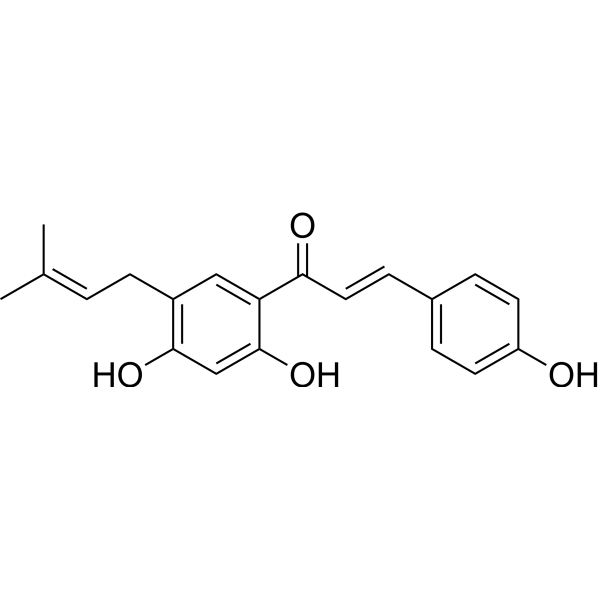
Physicochemical Properties
| Molecular Formula | C20H20O4 |
| Molecular Weight | 324.3704 |
| Exact Mass | 324.136 |
| CAS # | 28448-85-3 |
| PubChem CID | 6450879 |
| Appearance | Yellow to orange solid powder |
| Density | 1.2±0.1 g/cm3 |
| Boiling Point | 549.6±50.0 °C at 760 mmHg |
| Melting Point | 168-169℃ |
| Flash Point | 300.2±26.6 °C |
| Vapour Pressure | 0.0±1.5 mmHg at 25°C |
| Index of Refraction | 1.658 |
| LogP | 5.21 |
| Hydrogen Bond Donor Count | 3 |
| Hydrogen Bond Acceptor Count | 4 |
| Rotatable Bond Count | 5 |
| Heavy Atom Count | 24 |
| Complexity | 470 |
| Defined Atom Stereocenter Count | 0 |
| SMILES | CC(=CCC1=CC(=C(C=C1O)O)C(=O)/C=C/C2=CC=C(C=C2)O)C |
| InChi Key | BLZGPHNVMRXDCB-UXBLZVDNSA-N |
| InChi Code | InChI=1S/C20H20O4/c1-13(2)3-7-15-11-17(20(24)12-19(15)23)18(22)10-6-14-4-8-16(21)9-5-14/h3-6,8-12,21,23-24H,7H2,1-2H3/b10-6+ |
| Chemical Name | (E)-1-[2,4-dihydroxy-5-(3-methylbut-2-enyl)phenyl]-3-(4-hydroxyphenyl)prop-2-en-1-one |
| HS Tariff Code | 2934.99.9001 |
| Storage |
Powder-20°C 3 years 4°C 2 years In solvent -80°C 6 months -20°C 1 month |
| Shipping Condition | Room temperature (This product is stable at ambient temperature for a few days during ordinary shipping and time spent in Customs) |
Biological Activity
| Targets |
- Nuclear factor of activated T-cells cytoplasmic 1 (NFATc1) [1] - β-Secretase 1 (BACE-1) (IC50 = 28.6 ± 2.3 μM) [2] - UDP-glucuronosyltransferases (UGTs): UGT1A1 (IC50 = 35.2 ± 3.1 μM), UGT1A3 (IC50 = 42.5 ± 2.8 μM), UGT1A6 (IC50 = 51.7 ± 3.5 μM), UGT1A9 (IC50 = 48.3 ± 3.2 μM), UGT2B7 (IC50 = 68.4 ± 4.1 μM) [3] |
| ln Vitro |
- Bavachalcone inhibited RANKL-induced osteoclast differentiation in mouse bone marrow macrophages (BMMs) in a dose-dependent manner. At concentrations of 5, 10, and 20 μM, it reduced the number of tartrate-resistant acid phosphatase (TRAP)-positive multinucleated osteoclasts by 32±4%, 58±5%, and 75±6%, respectively [1] - It downregulated the expression of osteoclast-specific genes and proteins: 20 μM Bavachalcone reduced NFATc1 and c-Fos mRNA levels by 68±5% and 59±4%, and protein levels by 72±6% and 65±5%, respectively [1] - The compound inhibited BACE-1 activity, with an IC50 value of 28.6 ± 2.3 μM, and showed no significant inhibitory effect on trypsin or chymotrypsin at 100 μM [2] - It exhibited selective inhibitory effects on UGT isoforms: strongly inhibiting UGT1A1, 1A3, 1A6, 1A9, and 2B7, while showing no significant inhibition on UGT2B4 even at 100 μM [3] - No significant cytotoxicity was observed in BMMs at concentrations up to 20 μM [1] |
| Enzyme Assay |
- BACE-1 activity assay: Recombinant BACE-1 was incubated with a fluorogenic substrate and Bavachalcone (10–100 μM) at 37°C for 1 hour. The fluorescence intensity of the cleaved substrate was measured at excitation/emission wavelengths of 320/405 nm to calculate inhibition efficiency and IC50 value [2] - UGT activity assay: Human liver microsomes or recombinant UGT isoforms were mixed with Bavachalcone (10–100 μM), UDP-glucuronic acid (cofactor), and 4-methylumbelliferone (substrate). After incubation at 37°C for 60 minutes, the reaction was terminated, and the fluorescence of the glucuronidated product was measured at 365/450 nm to determine IC50 values [3] |
| Cell Assay |
- Osteoclast differentiation assay: Mouse BMMs were seeded in 96-well plates and cultured with M-CSF (30 ng/mL) and RANKL (50 ng/mL) in the presence of Bavachalcone (5, 10, 20 μM) for 5 days. Cells were fixed, stained for TRAP, and multinucleated (≥3 nuclei) TRAP-positive cells were counted as osteoclasts [1] - Gene and protein expression assay: BMMs were treated with Bavachalcone (20 μM) and RANKL for 3–5 days. Total RNA was extracted for RT-PCR to detect NFATc1 and c-Fos mRNA levels; cell lysates were prepared for Western blot analysis of the corresponding proteins [1] - Cell viability assay: BMMs were seeded in 96-well plates, treated with Bavachalcone (5, 10, 20, 40 μM) for 5 days, and cell viability was measured by MTT assay [1] |
| References |
[1]. Bavachalcone inhibits osteoclast differentiation through suppression of NFATc1 induction by RANKL. Biochem Pharmacol. 2008 Jun 1;75(11):2175-82. [2]. In vitro BACE-1 inhibitory phenolic components from the seeds of Psoralea corylifolia. Planta Med. 2008 Sep;74(11):1405-8. [3]. Comparison of the Inhibitory Potential of Bavachalcone and Corylin against UDP-Glucuronosyltransferases. Evid Based Complement Alternat Med. 2014;2014:958937. |
| Additional Infomation |
Bavachalcone is a member of chalcones. Bavachalcone has been reported in Cullen corylifolium, Broussonetia papyrifera, and Sophora prostrata with data available. - Bavachalcone is a phenolic chalcone compound isolated from the seeds of Psoralea corylifolia [1][2][3] - Its anti-osteoclastogenic mechanism involves suppressing RANKL-induced NFATc1 and c-Fos expression, key transcription factors for osteoclast differentiation [1] - The BACE-1 inhibitory activity suggests potential application in the treatment of Alzheimer's disease by reducing amyloid-β peptide production [2] - Inhibition of UGT isoforms indicates potential drug-drug interaction risks, as UGTs are key enzymes in drug metabolism and detoxification [3] |
Solubility Data
| Solubility (In Vitro) | DMSO : ≥ 34 mg/mL (~104.82 mM) |
| Solubility (In Vivo) |
Note: Listed below are some common formulations that may be used to formulate products with low water solubility (e.g. < 1 mg/mL), you may test these formulations using a minute amount of products to avoid loss of samples. Injection Formulations (e.g. IP/IV/IM/SC) Injection Formulation 1: DMSO : Tween 80: Saline = 10 : 5 : 85 (i.e. 100 μL DMSO stock solution → 50 μL Tween 80 → 850 μL Saline) *Preparation of saline: Dissolve 0.9 g of sodium chloride in 100 mL ddH ₂ O to obtain a clear solution. Injection Formulation 2: DMSO : PEG300 :Tween 80 : Saline = 10 : 40 : 5 : 45 (i.e. 100 μL DMSO → 400 μLPEG300 → 50 μL Tween 80 → 450 μL Saline) Injection Formulation 3: DMSO : Corn oil = 10 : 90 (i.e. 100 μL DMSO → 900 μL Corn oil) Example: Take the Injection Formulation 3 (DMSO : Corn oil = 10 : 90) as an example, if 1 mL of 2.5 mg/mL working solution is to be prepared, you can take 100 μL 25 mg/mL DMSO stock solution and add to 900 μL corn oil, mix well to obtain a clear or suspension solution (2.5 mg/mL, ready for use in animals). Injection Formulation 4: DMSO : 20% SBE-β-CD in saline = 10 : 90 [i.e. 100 μL DMSO → 900 μL (20% SBE-β-CD in saline)] *Preparation of 20% SBE-β-CD in Saline (4°C,1 week): Dissolve 2 g SBE-β-CD in 10 mL saline to obtain a clear solution. Injection Formulation 5: 2-Hydroxypropyl-β-cyclodextrin : Saline = 50 : 50 (i.e. 500 μL 2-Hydroxypropyl-β-cyclodextrin → 500 μL Saline) Injection Formulation 6: DMSO : PEG300 : castor oil : Saline = 5 : 10 : 20 : 65 (i.e. 50 μL DMSO → 100 μLPEG300 → 200 μL castor oil → 650 μL Saline) Injection Formulation 7: Ethanol : Cremophor : Saline = 10: 10 : 80 (i.e. 100 μL Ethanol → 100 μL Cremophor → 800 μL Saline) Injection Formulation 8: Dissolve in Cremophor/Ethanol (50 : 50), then diluted by Saline Injection Formulation 9: EtOH : Corn oil = 10 : 90 (i.e. 100 μL EtOH → 900 μL Corn oil) Injection Formulation 10: EtOH : PEG300:Tween 80 : Saline = 10 : 40 : 5 : 45 (i.e. 100 μL EtOH → 400 μLPEG300 → 50 μL Tween 80 → 450 μL Saline) Oral Formulations Oral Formulation 1: Suspend in 0.5% CMC Na (carboxymethylcellulose sodium) Oral Formulation 2: Suspend in 0.5% Carboxymethyl cellulose Example: Take the Oral Formulation 1 (Suspend in 0.5% CMC Na) as an example, if 100 mL of 2.5 mg/mL working solution is to be prepared, you can first prepare 0.5% CMC Na solution by measuring 0.5 g CMC Na and dissolve it in 100 mL ddH2O to obtain a clear solution; then add 250 mg of the product to 100 mL 0.5% CMC Na solution, to make the suspension solution (2.5 mg/mL, ready for use in animals). Oral Formulation 3: Dissolved in PEG400 Oral Formulation 4: Suspend in 0.2% Carboxymethyl cellulose Oral Formulation 5: Dissolve in 0.25% Tween 80 and 0.5% Carboxymethyl cellulose Oral Formulation 6: Mixing with food powders Note: Please be aware that the above formulations are for reference only. InvivoChem strongly recommends customers to read literature methods/protocols carefully before determining which formulation you should use for in vivo studies, as different compounds have different solubility properties and have to be formulated differently. (Please use freshly prepared in vivo formulations for optimal results.) |
| Preparing Stock Solutions | 1 mg | 5 mg | 10 mg | |
| 1 mM | 3.0829 mL | 15.4145 mL | 30.8290 mL | |
| 5 mM | 0.6166 mL | 3.0829 mL | 6.1658 mL | |
| 10 mM | 0.3083 mL | 1.5414 mL | 3.0829 mL |