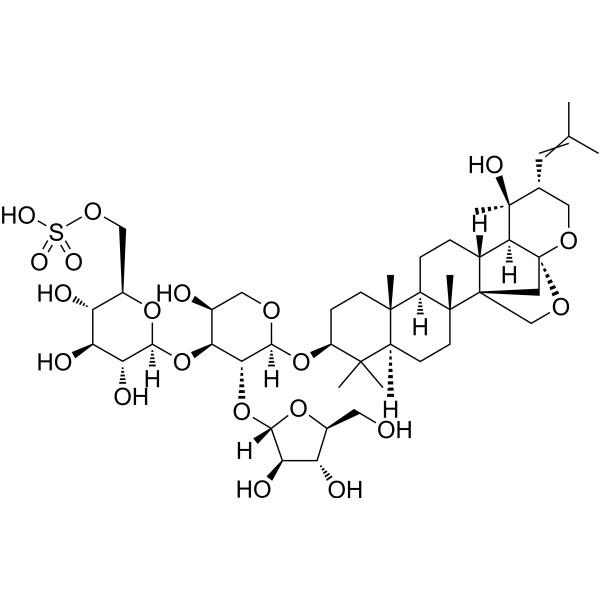
Physicochemical Properties
| Molecular Formula | C46H74O20S |
| Molecular Weight | 979.1328 |
| Exact Mass | 978.449 |
| CAS # | 382148-47-2 |
| PubChem CID | 21599442 |
| Appearance | Off-white to light yellow solid powder |
| Density | 1.48±0.1 g/cm3 (20 ºC 760 Torr) |
| LogP | 1.371 |
| Hydrogen Bond Donor Count | 9 |
| Hydrogen Bond Acceptor Count | 20 |
| Rotatable Bond Count | 11 |
| Heavy Atom Count | 67 |
| Complexity | 1970 |
| Defined Atom Stereocenter Count | 24 |
| SMILES | CC(=C[C@@H]1CO[C@]23C[C@]4(CO2)[C@@H]([C@H]3[C@@]1(C)O)CC[C@H]5[C@]4(CC[C@@H]6[C@@]5(CC[C@@H](C6(C)C)O[C@H]7[C@@H]([C@H]([C@H](CO7)O)O[C@H]8[C@@H]([C@H]([C@@H]([C@H](O8)COS(=O)(=O)O)O)O)O)O[C@H]9[C@@H]([C@H]([C@@H](O9)CO)O)O)C)C)C |
| InChi Key | SKFWOYHZBNAJGA-YAOMZRCFSA-N |
| InChi Code | InChI=1S/C46H74O20S/c1-21(2)14-22-16-59-46-19-45(20-60-46)23(37(46)44(22,7)54)8-9-28-42(5)12-11-29(41(3,4)27(42)10-13-43(28,45)6)64-40-36(66-38-33(52)30(49)25(15-47)62-38)35(24(48)17-58-40)65-39-34(53)32(51)31(50)26(63-39)18-61-67(55,56)57/h14,22-40,47-54H,8-13,15-20H2,1-7H3,(H,55,56,57)/t22-,23-,24+,25+,26-,27+,28-,29+,30+,31-,32+,33-,34-,35+,36-,37+,38+,39+,40+,42+,43-,44+,45+,46-/m1/s1 |
| Chemical Name | [(2R,3S,4S,5R,6S)-6-[(2S,3R,4S,5S)-3-[(2S,3R,4R,5S)-3,4-dihydroxy-5-(hydroxymethyl)oxolan-2-yl]oxy-5-hydroxy-2-[[(1S,2R,5R,7S,10R,11R,14R,15S,16S,17R,20R)-16-hydroxy-2,6,6,10,16-pentamethyl-17-(2-methylprop-1-enyl)-19,21-dioxahexacyclo[18.2.1.01,14.02,11.05,10.015,20]tricosan-7-yl]oxy]oxan-4-yl]oxy-3,4,5-trihydroxyoxan-2-yl]methyl hydrogen sulfate |
| HS Tariff Code | 2934.99.9001 |
| Storage |
Powder-20°C 3 years 4°C 2 years In solvent -80°C 6 months -20°C 1 month Note: This product requires protection from light (avoid light exposure) during transportation and storage. |
| Shipping Condition | Room temperature (This product is stable at ambient temperature for a few days during ordinary shipping and time spent in Customs) |
Biological Activity
| ln Vivo |
Antidepressant-like effect in mice: Male ICR mice were used, divided into control group (0.5% carboxymethyl cellulose sodium, CMC-Na), Bacopaside I treatment groups (10 mg/kg, 20 mg/kg, 40 mg/kg), and positive control group (imipramine 15 mg/kg). Behavioral tests and biochemical analyses were conducted after 7 days of administration: 1. Behavioral test results: - Forced Swim Test (FST): Bacopaside I dose-dependently reduced immobility time. The 40 mg/kg group had the most significant effect, with immobility time reduced by 42.3 ± 3.5% compared to the control group [2] - Tail Suspension Test (TST): The 20 mg/kg and 40 mg/kg groups showed reduced immobility time; the 40 mg/kg group had a 38.6 ± 2.8% reduction vs control [2] 2. Interaction with noradrenergic system: - Co-administration of Bacopaside I (20 mg/kg) with yohimbine (α2-adrenergic antagonist, 1 mg/kg) enhanced the antidepressant effect, further reducing FST immobility time by 25.1 ± 2.1% vs Bacopaside I alone [2] - Co-administration with propranolol (β-adrenergic antagonist, 10 mg/kg) reversed the antidepressant effect of Bacopaside I (20 mg/kg), increasing FST immobility time by 31.4 ± 2.3% vs Bacopaside I alone [2] 3. Oxidative stress indicators: - Bacopaside I (40 mg/kg) reduced malondialdehyde (MDA) level in mouse brain tissue by 35.2 ± 3.1% and increased glutathione peroxidase (GSH-Px) activity by 41.5 ± 3.6% compared to the control group [2] |
| Animal Protocol |
Antidepressant experiment in mice: 1. Animal preparation: Male ICR mice (20-22 g) were housed in a controlled environment (23±1°C, 12-hour light/dark cycle) with free access to food and water. They were acclimated for 7 days before the experiment [2] 2. Drug preparation and administration: - Bacopaside I was dissolved in 0.5% CMC-Na to prepare solutions of 1 mg/mL, 2 mg/mL, and 4 mg/mL [2] - Mice in treatment groups received intraperitoneal injection of Bacopaside I at 10 mg/kg, 20 mg/kg, or 40 mg/kg (0.1 mL/10 g body weight) once daily for 7 consecutive days [2] - The control group received 0.5% CMC-Na (equal volume), and the positive control group received imipramine (15 mg/kg, intraperitoneal injection) [2] 3. Behavioral tests: - FST: Mice were placed in a cylindrical tank (25 cm diameter, 30 cm height, water depth 15 cm, 25±1°C) for 6 minutes; immobility time was recorded in the last 4 minutes [2] - TST: Mice were suspended by the tail (1 cm from the tip) for 6 minutes; immobility time was recorded in the last 4 minutes [2] 4. Biochemical detection: After behavioral tests, mice were sacrificed, and brain tissues were collected. MDA level and GSH-Px activity were detected using corresponding assay kits [2] |
| References |
[1]. Bacopaside I and II: two pseudojujubogenin glycosides from Bacopa monniera. Phytochemistry. 2001 Oct;58(4):553-6. [2]. The antidepressant-like effect of bacopaside I: possible involvement of the oxidative stress system and the noradrenergic system. Pharmacol Biochem Behav. 2013 Sep;110:224-30. |
| Additional Infomation |
Bacopaside I has been reported in Bacopa monnieri with data available. 1. Background of Bacopaside I: Bacopaside I is a pseudojujubogenin glycoside isolated from the aerial parts of the medicinal plant Bacopa monniera (Scrophulariaceae family) [1] 2. Antidepressant mechanism: The antidepressant-like effect of Bacopaside I may involve two pathways: (1) Modulating the noradrenergic system (evidenced by interaction with α2/β-adrenergic antagonists); (2) Alleviating oxidative stress in brain tissue (by reducing MDA and increasing GSH-Px activity) [2] 3. Research significance: This study provides experimental evidence for the antidepressant potential of Bacopaside I, supporting its further development as a candidate for treating depressive disorders [2] |
Solubility Data
| Solubility (In Vitro) | DMSO : ~100 mg/mL (~102.13 mM) |
| Solubility (In Vivo) |
Solubility in Formulation 1: ≥ 2.5 mg/mL (2.55 mM) (saturation unknown) in 10% DMSO + 40% PEG300 + 5% Tween80 + 45% Saline (add these co-solvents sequentially from left to right, and one by one), clear solution. For example, if 1 mL of working solution is to be prepared, you can add 100 μL of 25.0 mg/mL clear DMSO stock solution to 400 μL PEG300 and mix evenly; then add 50 μL Tween-80 to the above solution and mix evenly; then add 450 μL normal saline to adjust the volume to 1 mL. Preparation of saline: Dissolve 0.9 g of sodium chloride in 100 mL ddH₂ O to obtain a clear solution. Solubility in Formulation 2: ≥ 2.5 mg/mL (2.55 mM) (saturation unknown) in 10% DMSO + 90% (20% SBE-β-CD in Saline) (add these co-solvents sequentially from left to right, and one by one), clear solution. For example, if 1 mL of working solution is to be prepared, you can add 100 μL of 25.0 mg/mL clear DMSO stock solution to 900 μL of 20% SBE-β-CD physiological saline solution and mix evenly. Preparation of 20% SBE-β-CD in Saline (4°C,1 week): Dissolve 2 g SBE-β-CD in 10 mL saline to obtain a clear solution. Solubility in Formulation 3: ≥ 2.5 mg/mL (2.55 mM) (saturation unknown) in 10% DMSO + 90% Corn Oil (add these co-solvents sequentially from left to right, and one by one), clear solution. For example, if 1 mL of working solution is to be prepared, you can add 100 μL of 25.0 mg/mL clear DMSO stock solution to 900 μL of corn oil and mix evenly. (Please use freshly prepared in vivo formulations for optimal results.) |
| Preparing Stock Solutions | 1 mg | 5 mg | 10 mg | |
| 1 mM | 1.0213 mL | 5.1066 mL | 10.2131 mL | |
| 5 mM | 0.2043 mL | 1.0213 mL | 2.0426 mL | |
| 10 mM | 0.1021 mL | 0.5107 mL | 1.0213 mL |