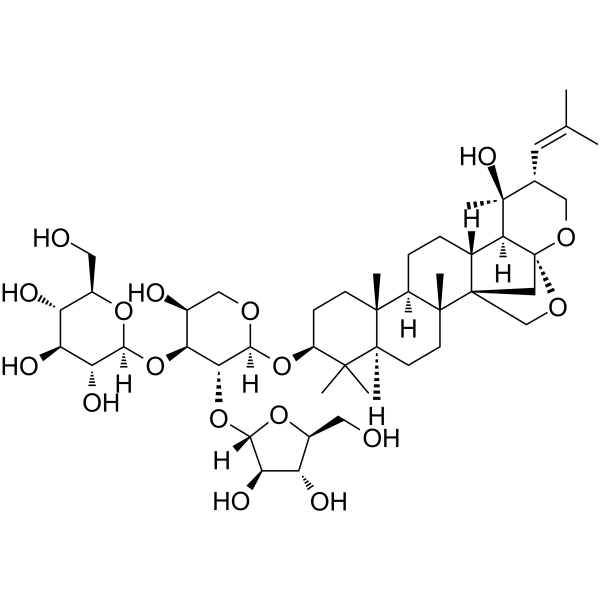
Physicochemical Properties
| Molecular Formula | C46H74O17 |
| Molecular Weight | 899.0696 |
| Exact Mass | 898.492 |
| CAS # | 178064-13-6 |
| PubChem CID | 21599443 |
| Appearance | White to off-white solid powder |
| Density | 1.4±0.0 g/cm3 |
| Index of Refraction | 1.621 |
| LogP | 3.87 |
| Hydrogen Bond Donor Count | 9 |
| Hydrogen Bond Acceptor Count | 17 |
| Rotatable Bond Count | 9 |
| Heavy Atom Count | 63 |
| Complexity | 1710 |
| Defined Atom Stereocenter Count | 24 |
| SMILES | CC(=C[C@@H]1CO[C@]23C[C@]4(CO2)[C@@H]([C@H]3[C@@]1(C)O)CC[C@H]5[C@]4(CC[C@@H]6[C@@]5(CC[C@@H](C6(C)C)O[C@H]7[C@@H]([C@H]([C@H](CO7)O)O[C@H]8[C@@H]([C@H]([C@@H]([C@H](O8)CO)O)O)O)O[C@H]9[C@@H]([C@H]([C@@H](O9)CO)O)O)C)C)C |
| InChi Key | ZOFQVMPJZHCDBS-MUUHSGPCSA-N |
| InChi Code | InChI=1S/C46H74O17/c1-21(2)14-22-17-57-46-19-45(20-58-46)23(37(46)44(22,7)55)8-9-28-42(5)12-11-29(41(3,4)27(42)10-13-43(28,45)6)61-40-36(63-38-33(53)31(51)26(16-48)60-38)35(24(49)18-56-40)62-39-34(54)32(52)30(50)25(15-47)59-39/h14,22-40,47-55H,8-13,15-20H2,1-7H3/t22-,23-,24+,25-,26+,27+,28-,29+,30-,31+,32+,33-,34-,35+,36-,37+,38+,39+,40+,42+,43-,44+,45+,46-/m1/s1 |
| Chemical Name | (2S,3R,4S,5S,6R)-2-[(2S,3R,4S,5S)-3-[(2S,3R,4R,5S)-3,4-dihydroxy-5-(hydroxymethyl)oxolan-2-yl]oxy-5-hydroxy-2-[[(1S,2R,5R,7S,10R,11R,14R,15S,16S,17R,20R)-16-hydroxy-2,6,6,10,16-pentamethyl-17-(2-methylprop-1-enyl)-19,21-dioxahexacyclo[18.2.1.01,14.02,11.05,10.015,20]tricosan-7-yl]oxy]oxan-4-yl]oxy-6-(hydroxymethyl)oxane-3,4,5-triol |
| HS Tariff Code | 2934.99.9001 |
| Storage |
Powder-20°C 3 years 4°C 2 years In solvent -80°C 6 months -20°C 1 month Note: This product requires protection from light (avoid light exposure) during transportation and storage. |
| Shipping Condition | Room temperature (This product is stable at ambient temperature for a few days during ordinary shipping and time spent in Customs) |
Biological Activity
| ln Vitro |
Bacopasaponin C exhibited cytotoxic activity against a panel of human tumor cell lines in the MTT assay, with IC₅₀ values of 34.9 μmol/L for MDA-MB-231 (breast cancer), 47.3 μmol/L for SHG-44 (glioma), 58.3 μmol/L for HCT-8 (ileocecal adenocarcinoma), 56.4 μmol/L for A-549 (lung adenocarcinoma), and 48.2 μmol/L for PC-3M (prostate cancer). However, its potency was noted to be much lower compared to compounds bacopaside E and bacopaside VII. [1] In cell adhesion assays using fibronectin-coated plates, Bacopasaponin C at concentrations ranging from 25 to 100 μmol/L did not show significant inhibitory effects on the adhesion of MDA-MB-231 breast cancer cells. [1] In Matrigel invasion assays using Transwell chambers, Bacopasaponin C at concentrations ranging from 25 to 100 μmol/L did not significantly inhibit the invasion of MDA-MB-231 breast cancer cells through the reconstituted basement membrane. [1] In scratch wound healing (migration) assays, Bacopasaponin C (at 50 μmol/L) did not show a significant inhibitory effect on the migration of MDA-MB-231 breast cancer cells over a 24-hour period compared to the more active compounds. [1] |
| ln Vivo |
Bacopasaponin C was tested in a mouse model implanted with sarcoma S180. At a dose of 50 μmol/kg administered intragastrically once daily for 7 days, it showed an average tumor weight inhibition ratio of 35.51%. However, this inhibition was not statistically significant compared to the blank control group (P > 0.05), indicating a much weaker in vivo antitumor effect compared to the positive control (5-Fu) and the more active compounds bacopaside E and bacopaside VII. [1] |
| Cell Assay |
Cytotoxicity (MTT) Assay: Tumor cells (MDA-MB-231, SHG-44, HCT-8, A-549, PC-3M) were washed and seeded into 96-well plates at a density of 5 × 10⁴ cells/mL in DMEM medium supplemented with 10% fetal bovine serum. Various dilutions of Bacopasaponin C in the same medium were added to the wells, with a final DMSO concentration not exceeding 0.2% (v/v). After 48 hours of incubation, 20 μL of MTT solution (5 mg/mL in PBS) was added to each well. Following an additional 4-hour incubation, the optical density was measured at 540 nm and 630 nm. The growth inhibition rate was calculated relative to vehicle-treated controls. [1] Cell Adhesion Assay: 96-well plates were coated with fibronectin (10 μg/mL) and then blocked with 1% bovine serum albumin (BSA). MDA-MB-231 cells (5 × 10⁴) were added to each well in the presence or absence of Bacopasaponin C at specified concentrations. After a 2-hour incubation at 37°C, non-adherent cells were removed by gentle washing with PBS. Adherent cells were fixed with methanol, stained with crystal violet, lysed, and the absorbance was measured at 590 nm. Uncoated, BSA-blocked wells served as negative controls. [1] Cell Migration (Scratch Wound Healing) Assay: MDA-MB-231 cells were grown to near confluence (>90%) in 12-well plates. A straight scratch (wound) was created in the monolayer using a pipette tip. The cells were then cultured in medium with or without Bacopasaponin C. Images were taken at the start (0 h) and after 6, 12, and 24 hours of incubation. Cell migration into the wound area was quantified. [1] Matrigel Invasion Assay: Polycarbonate filters (8 μm pore size) in Transwell chambers were pre-coated with fibronectin on the lower side. Matrigel was applied to the upper surface of the filter. After drying and rehydration, MDA-MB-231 cells (5 × 10⁵) were suspended in serum-free medium (RPMI 1640 with 0.1% BSA), pretreated with Bacopasaponin C on ice for 30 minutes, and then placed in the upper chamber. The lower chamber contained complete medium. After 12 hours of incubation, cells that invaded through the Matrigel and attached to the lower surface of the filter were stained and counted under a microscope. [1] |
| Animal Protocol |
Sarcoma S180 Tumor Model: Female balb/c mice (6-8 weeks old) were subcutaneously implanted with sarcoma S180 ascites cells (diluted 1:4 with saline, 0.2 mL per mouse). Mice were randomly divided into groups, including a blank control group, a positive control group (5-fluorouracil, 5-Fu), and a group treated with Bacopasaponin C. The treatment group received Bacopasaponin C at a dose of 50 μmol/kg body weight. The compound was administered intragastrically (oral gavage) once daily for 7 consecutive days, starting the day after tumor implantation. On the 10th day after implantation, mice were euthanized, tumors were excised and weighed, and the tumor inhibition ratio was calculated. [1] Note: The specific formulation/solvent used to dissolve Bacopasaponin C for in vivo administration is not described in the provided text. [1] |
| References |
[1]. Antitumor activities of dammarane triterpene saponins from Bacopa monniera. Phytother Res. 2010 Jun;24(6):864-8. [2]. Bacopasaponin C: critical evaluation of anti-leishmanial properties in various delivery modes. Drug Deliv. 2002 Jan-Mar;9(1):55-62. |
| Additional Infomation |
Bascopasaponin C has been reported in Bacopa monnieri with data available. Bacopasaponin C is a dammarane-type triterpene saponin isolated from the medicinal plant Bacopa monniera (L.) Wettst. [1] This study represents one of the early reports investigating the antitumor activity of purified monomeric saponins from Bacopa monniera. [1] Within the tested compounds from the plant, Bacopasaponin C demonstrated weaker in vitro cytotoxic activity and a non-significant in vivo antitumor effect against sarcoma S180 in mice compared to the more potent compounds bacopaside E and bacopaside VII. [1] |
Solubility Data
| Solubility (In Vitro) | DMSO : ~100 mg/mL (~111.23 mM) |
| Solubility (In Vivo) |
Solubility in Formulation 1: 2.5 mg/mL (2.78 mM) in 10% DMSO + 40% PEG300 + 5% Tween80 + 45% Saline (add these co-solvents sequentially from left to right, and one by one), suspension solution; with sonication. For example, if 1 mL of working solution is to be prepared, you can add 100 μL of 25.0 mg/mL clear DMSO stock solution to 400 μL PEG300 and mix evenly; then add 50 μL Tween-80 to the above solution and mix evenly; then add 450 μL normal saline to adjust the volume to 1 mL. Preparation of saline: Dissolve 0.9 g of sodium chloride in 100 mL ddH₂ O to obtain a clear solution. Solubility in Formulation 2: ≥ 2.5 mg/mL (2.78 mM) (saturation unknown) in 10% DMSO + 90% Corn Oil (add these co-solvents sequentially from left to right, and one by one), clear solution. For example, if 1 mL of working solution is to be prepared, you can add 100 μL of 25.0 mg/mL clear DMSO stock solution to 900 μL of corn oil and mix evenly. (Please use freshly prepared in vivo formulations for optimal results.) |
| Preparing Stock Solutions | 1 mg | 5 mg | 10 mg | |
| 1 mM | 1.1123 mL | 5.5613 mL | 11.1226 mL | |
| 5 mM | 0.2225 mL | 1.1123 mL | 2.2245 mL | |
| 10 mM | 0.1112 mL | 0.5561 mL | 1.1123 mL |