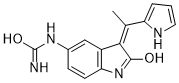
BX-517 (also known as PDK1 inhibitor 2) is a potent, ATP-competitive and selective PDK1 inhibitor with IC50 value of 6 nM.
Physicochemical Properties
| Molecular Formula | C15H14N4O2 |
| Molecular Weight | 282.29700 |
| Exact Mass | 282.112 |
| Elemental Analysis | C, 63.82; H, 5.00; N, 19.85; O, 11.33 |
| CAS # | 850717-64-5 |
| Related CAS # | 850717-64-5 |
| PubChem CID | 11161844 |
| Appearance | Light yellow to khaki solid powder |
| LogP | 3.299 |
| Hydrogen Bond Donor Count | 4 |
| Hydrogen Bond Acceptor Count | 2 |
| Rotatable Bond Count | 2 |
| Heavy Atom Count | 21 |
| Complexity | 488 |
| Defined Atom Stereocenter Count | 0 |
| SMILES | O=C(NC1C=C2C(NC(C2=C(C)C2NC=CC=2)=O)=CC=1)N |
| InChi Key | DFURSNCTQGJRRX-JYRVWZFOSA-N |
| InChi Code | InChI=1S/C15H14N4O2/c1-8(11-3-2-6-17-11)13-10-7-9(18-15(16)21)4-5-12(10)19-14(13)20/h2-7,17H,1H3,(H,19,20)(H3,16,18,21)/b13-8- |
| Chemical Name | [(3Z)-2-oxo-3-[1-(1H-pyrrol-2-yl)ethylidene]-1H-indol-5-yl]urea |
| Synonyms | BX-517; BX 517; BX517; PDK1 inhibitor2; PDK1 inhibitor 2; PDK1 inhibitor-2 |
| HS Tariff Code | 2934.99.9001 |
| Storage |
Powder-20°C 3 years 4°C 2 years In solvent -80°C 6 months -20°C 1 month |
| Shipping Condition | Room temperature (This product is stable at ambient temperature for a few days during ordinary shipping and time spent in Customs) |
Biological Activity
| Targets |
PDK1 (IC50 = 6 nM) Phosphoinositide-dependent kinase-1 (PDK1) (IC50: single-digit nM in cAKT2 assay; IC50: similar single-digit nM in direct PDK1 enzyme assay) Protein kinase A (PKA) (IC50: 1600 nM) [1] |
| ln Vitro |
BX-517 prevents tumor cells from activating Akt[2]. BX-517 exhibited potent inhibitory activity against PDK1 in a cell-free, PDK1-mediated AKT2 activation assay (cAKT2) with an IC50 in the single-digit nanomolar range. [1] BX-517 also directly inhibited PDK1 kinase activity in a filter-binding enzyme assay with comparable potency (single-digit nM IC50). [1] In PC-3 human prostate cancer cells, BX-517 inhibited PDK1-dependent phosphorylation of Akt at Thr308 (P-AKT) with submicromolar potency (IC50 ranging from 100 to 1000 nM). [1] BX-517 demonstrated excellent selectivity (320-fold) for PDK1 over the closely related kinase PKA. It was also highly selective (>100-fold) against a panel of seven additional serine/threonine and tyrosine kinases. [1] |
| ln Vivo | BX517 has poor pharmaceutical properties including short half-life (0.4 h in rat), low metabolic stability, and poor solubility[2]. |
| Enzyme Assay |
PDK1-mediated AKT2 Activation Assay (cAKT2): This is a coupled scintillation proximity assay (SPA). Inactive AKT2 is activated in situ by incubation with PDK1 and phosphatidylinositol-3,4-bisphosphate (PtdIns-3,4-P2) in the presence of the test compound, [γ-³²P]ATP, and a biotinylated peptide substrate specific for AKT2. The phosphorylated, biotinylated peptide product is then captured on streptavidin-coated SPA beads for radioactive detection. This assay can identify inhibitors of AKT2 activation, as well as direct inhibitors of PDK1 or AKT2. [1] Direct PDK1 Enzyme Assay: PDK1 inhibitory activity is measured directly. PDK1 enzyme is incubated with a peptide substrate, [γ-³²P]ATP, and the test compound. The reaction is stopped, and the phosphorylated peptide product is captured on P81 phosphocellulose filter paper. Radioactivity retained on the filter, corresponding to the level of phosphorylation, is quantified by phosphorimaging. [1] |
| Cell Assay |
Inhibition of Akt Phosphorylation in PC-3 Cells: PC-3 human prostate cancer cells are incubated with varying concentrations of the test compound. After the incubation period, cells are lysed. The cell lysates are then subjected to standard immunoblotting (Western blot) techniques. Phosphospecific antibodies against Akt phosphorylated at Thr308 (P-Thr308) are used to detect the level of Akt activation. The inhibition of this phosphorylation signal by the compound is measured to determine cellular potency. [1] |
| Animal Protocol |
Pharmacokinetic Study in Rats: For intravenous (iv) pharmacokinetic assessment, BX-517 was administered to three rats at a dose of 2 mg/kg via intravenous injection. For oral (po) bioavailability assessment, BX-517 was administered to three rats at a dose of 10 mg/kg orally. Blood samples were collected over time to determine plasma concentration profiles. [1] |
| ADME/Pharmacokinetics |
BX-517 displayed poor solubility in aqueous media, specifically 2 mg/L in phosphate-buffered saline (PBS). [1] In rats, after a 2 mg/kg intravenous dose, BX-517 had a short plasma half-life (t1/2) of 24 minutes. [1] The plasma clearance (Cl) in rats was high, at 31 mL/min/kg. [1] Oral bioavailability in rats was very low, at less than 1% following a 10 mg/kg oral dose. [1] |
| References |
[1]. Bioorg Med Chem Lett. 2007 Jul 15;17(14):3814-8. [2]. Bioorg Med Chem Lett. 2007 Jul 15;17(14):3819-25. |
| Additional Infomation |
Phosphoinositide-dependent kinase-1 (PDK1) is a key activator of Akt/PKB and other AGC family kinases (like PKC, SGK, S6K1), which are involved in tumor cell growth, survival, and angiogenesis. Inhibiting PDK1 is a strategy for cancer therapy. [1] BX-517 was optimized from a high-throughput screening hit (compound 1). The key optimization involved introducing a urea substituent at the 5-position of the indolinone core, which directly hydrogen-bonds with Lys111 and Thr222 in the PDK1 ATP-binding pocket, significantly enhancing potency and selectivity compared to earlier analogs like the 5-hydroxyl compound (2a). [1] An X-ray co-crystal structure of BX-517 bound to PDK1 (PDB: 2PE1) confirms the binding mode: the indolinone core makes three hydrogen bonds with the hinge region (backbone of Ser160 and Ala162), and the 5-urea group forms direct hydrogen bonds with the side chains of Lys111 and Thr222. [1] |
Solubility Data
| Solubility (In Vitro) | DMSO: 27~56 mg/mL (95.6~198.4 mM) |
| Solubility (In Vivo) |
Solubility in Formulation 1: ≥ 2.5 mg/mL (8.86 mM) (saturation unknown) in 10% DMSO + 40% PEG300 +5% Tween-80 + 45% Saline (add these co-solvents sequentially from left to right, and one by one), clear solution. For example, if 1 mL of working solution is to be prepared, you can add 100 μL of 25.0 mg/mL clear DMSO stock solution to 400 μL PEG300 and mix evenly; then add 50 μL Tween-80 + to the above solution and mix evenly; then add 450 μL normal saline to adjust the volume to 1 mL. Preparation of saline: Dissolve 0.9 g of sodium chloride in 100 mL ddH₂ O to obtain a clear solution. (Please use freshly prepared in vivo formulations for optimal results.) |
| Preparing Stock Solutions | 1 mg | 5 mg | 10 mg | |
| 1 mM | 3.5423 mL | 17.7117 mL | 35.4233 mL | |
| 5 mM | 0.7085 mL | 3.5423 mL | 7.0847 mL | |
| 10 mM | 0.3542 mL | 1.7712 mL | 3.5423 mL |