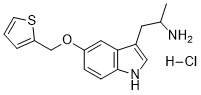
BW723C86 (BW-723C86; BW723-C86;) is a novel and potent 5-HT2B serotonin receptor agonist that exhibits anxiolytic-like actions and causes hyperphagia and reduced grooming in rats.
Physicochemical Properties
| Molecular Formula | C16H19CLN2OS |
| Molecular Weight | 322.85 |
| Exact Mass | 322.09 |
| Elemental Analysis | C, 59.52; H, 5.93; Cl, 10.98; N, 8.68; O, 4.96; S, 9.93 |
| CAS # | 160521-72-2 |
| PubChem CID | 5311036 |
| Appearance | White to light brown solid powder |
| Boiling Point | 488.4ºC at 760 mmHg |
| Melting Point | 203 - 205 °C |
| Flash Point | 249.2ºC |
| Vapour Pressure | 1.09E-09mmHg at 25°C |
| LogP | 5.2 |
| Hydrogen Bond Donor Count | 3 |
| Hydrogen Bond Acceptor Count | 3 |
| Rotatable Bond Count | 5 |
| Heavy Atom Count | 21 |
| Complexity | 315 |
| Defined Atom Stereocenter Count | 0 |
| InChi Key | PYJBJMIBANAOFJ-UHFFFAOYSA-N |
| InChi Code | InChI=1S/C16H18N2OS.ClH/c1-11(17)7-12-9-18-16-5-4-13(8-15(12)16)19-10-14-3-2-6-20-14;/h2-6,8-9,11,18H,7,10,17H2,1H3;1H |
| Chemical Name | 1-[5-(thiophen-2-ylmethoxy)-1H-indol-3-yl]propan-2-amine;hydrochloride |
| Synonyms | BW 723 C 86; BW-723-C-86; 160521-72-2; BW 723C86 hydrochloride; BW 723C86; BW-723C86; BW723C86; 8JMH6M2ELN; BW-723C86 hydrochloride; 1-(5-(Thiophen-2-ylmethoxy)-1H-indol-3-yl)propan-2-amine hydrochloride; BW723C86 |
| HS Tariff Code | 2934.99.9001 |
| Storage |
Powder-20°C 3 years 4°C 2 years In solvent -80°C 6 months -20°C 1 month Note: Please store this product in a sealed and protected environment, avoid exposure to moisture. |
| Shipping Condition | Room temperature (This product is stable at ambient temperature for a few days during ordinary shipping and time spent in Customs) |
Biological Activity
| Targets | 5-HT2B Receptor |
| ln Vitro | Previous research has indicated that high insulin affects vascular function. Equol is an active metabolite of daidzein, an isoflavone produced from soy by intestinal microbial flora, with beneficial effects on the vascular system. This study investigated whether equol was beneficial for vascular function under high insulin conditions. Using organ culture techniques, rat carotid arteries were treated for 23 ± 1 h with a vehicle, high insulin (100 nM), or equol (100 µM) plus high insulin (100 nM). Vascular isometric forces were measured by the organ bath technique. In each endothelium-intact ring, the contractions induced by high-K+, noradrenaline, or by serotonin (5-HT) were similar for the vehicle, insulin, and equol + insulin treatments. Contractions induced by a selective 5-HT2A receptor agonist (TCB2) increased with insulin treatment (vs. vehicle), but less so with equol + insulin. Under basal conditions, a selective 5-HT2B receptor agonist (BW723C86) did not induce contraction; following precontraction by a thromboxane analog, it induced contraction but not relaxation. These responses were similar across the three treatments. Acetylcholine-induced relaxations were also similar for the three treatments. In the endothelium-denuded preparations, 5-HT-induced contraction was augmented with insulin treatment (vs. vehicle) but less so by equol + insulin treatment. These differences in 5-HT-induced contractions were eliminated by iberiotoxin, a large-conductance calcium-activated K+ channel (BKCa) inhibitor. These results suggest that equol exerts a preventive effect on the enhancement of 5-HT-induced contraction by high insulin (possibly mediated by the 5-HT2A receptor), and that these effects may be attributed to the activation of BKCa channels in vascular smooth muscle. [3] |
| ln Vivo |
The 5-HT2B receptor agonist, BW723C86 (10 and 20 mg/kg s.c.), increased the time spent in feeding behaviour of freely-fed rats in observation cages over 15 min. BW 723C86 (20 and 50 mg/kg s.c. 30 min pre-test) also modestly increased food consumption of freely-fed rats over 1 and 2 hr, but not 4 hr, in their home cages. This action was at least partly mediated centrally, as it was reproduced by i.c.v. infusion of 1 and 10 micrograms in freely-fed rats. The effect is also likely to be 5-HT2B receptor-mediated, as no hyperphagic response to BW 723C86 (20 mg/kg s.c. 30 min pre-test) was observed in freely-fed rats pretreated with the 5-HT2C/2B receptor antagonist SB 206553 (1, 3, 20 or 40 mg/kg p.o. 1 hr pre-test) while the selective 5-HT1A receptor antagonist, WAY 100635 (0.1 or 0.3 mg/kg s.c. 30 min pre-test), had no effect. Systemic (1, 10 and 20 mg/kg s.c. 30 min pre-test) but not i.c.v. (1-30 micrograms) BW 723C86 also reduced the frequency of grooming bouts of rats in observation cages. BW 723C86 given either s.c. (1-20 mg/kg 30 min pre-test) or i.c.v. (1-30 micrograms) did not cause hypolocomotion, penile erection, oral dyskinesias or hyperthermia, behaviours associated with administration of the 5-HT2C/2B receptor agonist m-chlorophenylpiperazine (mCPP), and are thus likely to involve-5-HT2C receptor activation. [1] The 5-HT2B receptor agonist, BW723C86 (10, 30(mg/kg i.p. 30 min pre-test), increased the number of punishments accepted in a rat Vogel drinking conflict paradigm over 3 min, as did the benzodiazepine anxiolytics, chlordiazepoxide (2.5-10 mg/kg p.o. 1 h pre-test) and alprazolam (0.2-5 mg/kg p.o. 1 h pre-test), but not the 5-HT2C/2B receptor agonist, m-chlorophenylpiperazine (mCPP, 0.3-3 mg/kg i.p) or the 5-HT1A receptor agonist, buspirone (5-20 mg/kg p.o. 1 h pre-test). The effect of BW 723C86 was unlikely to be secondary to enhanced thirst, as BW 723C86 did not increase the time that rats with free access to water spent drinking, nor did it reduce sensitivity to shock in the apparatus. The anti-punishment effect of BW 723C86 was opposed by prior treatment with the 5-HT2/2B receptor antagonist, SB-206553 (10 and 20 mg/kg p.o. 1 h pre-test), and the selective 5-HT2B receptor antagonist, SB-215505 (1 and 3 mg/kg p.o. 1 h pre-test), but not by the selective 5-HT2C receptor antagonist, SB-242084 (5 mg/kg p.o.), or the 5-HT1A receptor antagonist, WAY 100635 (0.1 or 0.3 mg/kg s.c. 30 min pre-test). Thus, the anti-punishment action of BW 723C86 is likely to be 5-HT2B receptor mediated. This is consistent with previous reports that BW 723C86 exhibited anxiolytic-like properties in both the social interaction and Geller-Seifter conflict tests. [2] |
| Animal Protocol |
Behavioural observation [1] After a 5 day recovery period, rats were placed individually in clear Perspex observation cages (26 × 26 × 22 cm) with free access to water and a sawdust covered floor between 1230 and 1800 hr. After a 15-min habituation period, a cannula (Plastics One) was inserted into the guide cannula and 1 μl saline or BW723C86 was infused over 2 min using a Carnegie Medicin, CMA 100, Micro injection pump. After a further 2 min, the cannula was removed, three normal food pellets were placed on to the cage floor and subsequent behaviour scored for 15 min using a computerized score pad. Locomotion was assessed by the number of cage crossings, while other parameters were scored by frequency and, in the case of continuous behaviours, such as sniffing and grooming, by duration also. Rectal temperatures were measured, both immediately prior to, and 30 min after, infusion in a separate study using a Comark 9001 thermometer and rat rectal probe inserted 5 cm into the rectum. Alternatively, animals not subjected to surgery were injected with BW723C86 or saline s.c. 30 min pre-test, and placed in the observation cages 15 min pre-test as described above. Immediately prior to the behavioural assessment period, three food pellets were placed in the cage as above. Alternatively, intact animals were given BW723C86 or saline 30 min pre-test and placed in the observation cages to habituate for 15 min. Immediately prior to the initiation of scoring, three pellets were placed on the cage floor and scoring was then assessed as above. Free-feeding experiments[1] Rats which had not been subjected to surgery were housed singly in the test room on day 1. Between 1230 and 1330 hr on day 3, food was removed and they were dosed orally or subcutaneously with vehicle or antagonists. Thirty minutes later, they were given saline or BW723C86 s.c. in the nape of the neck. After a further 30 min, a weighed amount (typically 200 g) of their normal food was placed in the cage's food hopper and the amount consumed determined 1, 2 and 4 hr later. Drugs[1] BW723C86, 1-[5-(2-thienylmethoxy)-1H-3-indoyl] propan-2-amine hydrochloride and WAY 100635, were dissolved in saline. BW723C86 was maintained in solution using a hotplate. WAY 100635 and systemic injections of BW723C86 were given s.c. 30 min before testing in a 2 ml/kg volume in the nape of the neck. Central injections of BW723C86 were given in a 1 μl volume. SB 206553, 5-methyl-1-(3-pyridylcarbamoyl)-1,2,3,5-tetrahydrpyrrolo-[2,3-fr]indole, was administered orally 1 hr before testing as a suspension in 1% methyl cellulose using a 2 ml/kg dose volume. All drug doses refer to salt forms. Vogel conflict test[2] Rats were water deprived for 20 h on day 1, prior to being placed in a uniformly lit operant conditioning chamber (45×25×25 cm) with a metal barred floor, into which a water bottle spout protruded. Rats were allowed to explore the chamber freely and drink for 3 min, timed from the first lick of the spout which was automatically recorded by computer. The rat was then returned to the home cage and allowed access to water for 4 h and then again water deprived for 20 h. On the test day, rats were administered vehicle, chlordiazepoxide or antagonists orally, 1 h pre-test and saline, mCPP or BW723C86 i.p. 20 or 30 min pre-test. At test time, animals were placed in the conditioning chamber with free access to the water spout. After 30 s of continuous drinking, each subsequent 5 s cumulative drinking was punished by an electric shock (0.25 mA for 0.2 s) delivered through the water spout and the latency to begin licking and the number of shocks accepted over 3 min was recorded. In studies of the effect of BW723C86 on shock sensitivity in the apparatus, rats were treated as before and on the test day were administered BW723C86 i.p. 30 min pre-test and placed in the apparatus with access to water. However, after an initial 30 se of drinking had elapsed, further drinking was punished by increasing shock of 0.2 s duration (from 0.04 mA in 0.04 mA steps) until a visible flinching response of the head was recorded by an observer. In studies of the effect of BW723C86 on rat drinking behaviour, rats were water deprived for 20 h and familiarised with the conditioning box as before. However, they were subsequently given free access to water until the following day when they were administered BW723C86 i.p. 30 min pre-test and placed in the apparatus again at t=0. The amount of time spent drinking over 3 min from the time of the first lick was recorded as was the latency to drink. These conditions were selected to ensure a low basal level of drinking and hence optimise conditions for detecting increased water consumption, as increased thirst might be a reason for animals to accept greater punishment in the Vogel test. BW723C86 was dissolved in saline, maintained in solution at 30°C using a hotplate, and administered i.p. in a 2 ml/kg volume. |
| References |
[1]. BW 723C86, a 5-HT2B receptor agonist, causes hyperphagia and reduced grooming in rats. Neuropharmacology. 1997 Feb;36(2):233-9. [2]. Anxiolytic-like actions of BW 723C86 in the rat Vogel conflict test are 5-HT2B receptor mediated. Neuropharmacology. 1998 Dec;37(12):1603-10. [3]. Effect of Equol on Vasocontractions in Rat Carotid Arteries Treated with High Insulin. Biol Pharm Bull. 2019;42(6):1048-1053. |
| Additional Infomation |
In conclusion, BW 723C86 causes hyperphagia at least in part by a centrally mediated mechanism. This is likely to involve stimulation of the 5-HT2B receptor as the effect is attenuated by the 5-HT2B/2C receptor antagonist SB 206553. However, further evidence of this mechanism will require the development of more selective tools. BW 723C86 also reduces grooming behaviour by a peripheral mechanism. The failure of BW 723C86 to induce hypolocomotion, hypophagia, penile erections, oral dyskinesias or temperature changes in the present study suggests that these behavioural consequences of administration of the 5-HT2C/2B receptor agonist mCPP are likely to be 5-HT2C receptor-mediated. This is consistent with the opposite effects of mCPP and BW 723C86 in tests of anxiety (Kennett et al., 1994Kennett et al., 1996a). [1] In conclusion, BW 723C86 exerted a marked anti-punishment action in the rat Vogel conflict test. This could not be accounted for by increased thirst or reduced sensitivity to shock or sedation and so is consistent with the drug having an anxiolytic-like action similar to that previously reported in the rat social interaction and Geller Seifter tests. The anti-punishment action of BW 723C86 appears to be 5-HT2B and not 5-HT2C or 5-HT1A receptor mediated. The location of the receptors responsible is unclear, but is likely to differ from those mediating anxiolytic-like responses in the rat social interaction test (Duxon et al., 1997b). [2] |
Solubility Data
| Solubility (In Vitro) | DMSO : ~100 mg/mL (~309.74 mM) |
| Solubility (In Vivo) |
Solubility in Formulation 1: ≥ 5 mg/mL (15.49 mM) (saturation unknown) in 10% DMSO + 40% PEG300 + 5% Tween80 + 45% Saline (add these co-solvents sequentially from left to right, and one by one), clear solution. For example, if 1 mL of working solution is to be prepared, you can add 100 μL of 50.0 mg/mL clear DMSO stock solution to 400 μL PEG300 and mix evenly; then add 50 μL Tween-80 to the above solution and mix evenly; then add 450 μL normal saline to adjust the volume to 1 mL. Preparation of saline: Dissolve 0.9 g of sodium chloride in 100 mL ddH₂ O to obtain a clear solution. Solubility in Formulation 2: ≥ 5 mg/mL (15.49 mM) (saturation unknown) in 10% DMSO + 90% (20% SBE-β-CD in Saline) (add these co-solvents sequentially from left to right, and one by one), clear solution. For example, if 1 mL of working solution is to be prepared, you can add 100 μL of 50.0 mg/mL clear DMSO stock solution to 900 μL of 20% SBE-β-CD physiological saline solution and mix evenly. Preparation of 20% SBE-β-CD in Saline (4°C,1 week): Dissolve 2 g SBE-β-CD in 10 mL saline to obtain a clear solution. Solubility in Formulation 3: ≥ 5 mg/mL (15.49 mM) (saturation unknown) in 10% DMSO + 90% Corn Oil (add these co-solvents sequentially from left to right, and one by one), clear solution. For example, if 1 mL of working solution is to be prepared, you can add 100 μL of 50.0 mg/mL clear DMSO stock solution to 900 μL of corn oil and mix evenly. (Please use freshly prepared in vivo formulations for optimal results.) |
| Preparing Stock Solutions | 1 mg | 5 mg | 10 mg | |
| 1 mM | 3.0974 mL | 15.4871 mL | 30.9741 mL | |
| 5 mM | 0.6195 mL | 3.0974 mL | 6.1948 mL | |
| 10 mM | 0.3097 mL | 1.5487 mL | 3.0974 mL |