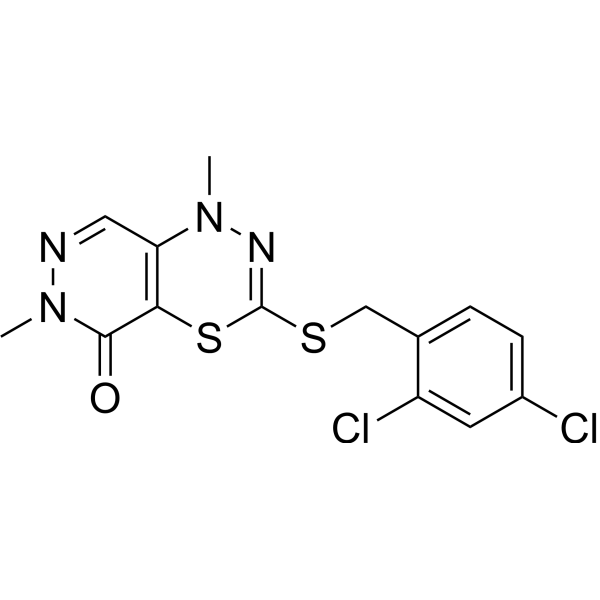
Physicochemical Properties
| Molecular Formula | C14H12CL2N4OS2 |
| Molecular Weight | 387.31 |
| Exact Mass | 385.982 |
| CAS # | 245728-44-3 |
| PubChem CID | 2801217 |
| Appearance | Yellow to orange solid powder |
| Density | 1.6±0.1 g/cm3 |
| Boiling Point | 500.6±60.0 °C at 760 mmHg |
| Flash Point | 256.6±32.9 °C |
| Vapour Pressure | 0.0±1.3 mmHg at 25°C |
| Index of Refraction | 1.733 |
| LogP | 1.82 |
| Hydrogen Bond Donor Count | 0 |
| Hydrogen Bond Acceptor Count | 6 |
| Rotatable Bond Count | 3 |
| Heavy Atom Count | 23 |
| Complexity | 595 |
| Defined Atom Stereocenter Count | 0 |
| SMILES | ClC1C=C(C=CC=1CSC1=NN(C)C2C=NN(C)C(C=2S1)=O)Cl |
| InChi Key | PIAWQVCBQLTEIY-UHFFFAOYSA-N |
| InChi Code | InChI=1S/C14H12Cl2N4OS2/c1-19-11-6-17-20(2)13(21)12(11)23-14(18-19)22-7-8-3-4-9(15)5-10(8)16/h3-6H,7H2,1-2H3 |
| Chemical Name | 3-[(2,4-dichlorophenyl)methylsulfanyl]-1,6-dimethylpyridazino[4,5-e][1,3,4]thiadiazin-5-one |
| HS Tariff Code | 2934.99.9001 |
| Storage |
Powder-20°C 3 years 4°C 2 years In solvent -80°C 6 months -20°C 1 month |
| Shipping Condition | Room temperature (This product is stable at ambient temperature for a few days during ordinary shipping and time spent in Customs) |
Biological Activity
| Targets | TDAG8/GPR65[1] |
| ln Vitro | In HEK293 cells transiently producing hTDAG8 and mTDAG8, BTB09089 (0-18 μM; 30 min) dramatically boosted cAMP buildup, but not in normal HEK293 cells. When HEK293 cells produce hGPR4, BTB09089 does not increase the accumulation of cAMP; similarly, when HEK293 cells express hOGR1, it does not increase the accumulation of inositol phosphate [1]. At pH 7.0–7.9, but not at pH 6.5, BTB09089 (0–18 μM; 30 min) dramatically increased cAMP buildup in a dose-dependent manner [1]. BTB09089 (1–5 μM; 20 h) does not impact cell viability and dose-dependently suppresses the generation of IL-2 in the splenocytes of WT mice but not TDAG8 KO mice [1]. In LPS-stimulated ethyl sulfonate-induced peritoneal effusion cells (TG-PEC), BTB09089 (1–5 μM; 18 h) increases IL-10 production and suppresses TNF-α and IL-6 production [1]. |
| ln Vivo | Six hours before MCAO, rats treated with BTB09089 (5–20 μM, 8 μL; icv) have less cerebral ischemia-reperfusion injury[2]. |
| Animal Protocol |
Animal/Disease Models: Adult male SD rats (270-280 g), middle cerebral artery occlusion (MCAO) model[2] Doses: 5, 10 and 20 μM, 8 μL Route of Administration: Intracerebroventricular injection, six hrs (hours) prior to MCAO Experimental Results: Up- regulated TDAG8 and Bcl-2 expression and down-regulated cleaved caspase-3 expression, while the infarction volume was decreased, and neurological deficits were ameliorated 24 and 72 h after MCAO. |
| References |
[1]. Onozawa Y, et al. Activation of T cell death-associated gene 8 regulates the cytokine production of T cells and macrophages in vitro. Eur J Pharmacol. 2012 May 15;683(1-3):325-31. [2]. Ma XD, et al. TDAG8 activation attenuates cerebral ischaemia-reperfusion injury via Akt signalling in rats. Exp Neurol. 2017 Jul;293:115-123. |
Solubility Data
| Solubility (In Vitro) | May dissolve in DMSO (in most cases), if not, try other solvents such as H2O, Ethanol, or DMF with a minute amount of products to avoid loss of samples |
| Solubility (In Vivo) |
Note: Listed below are some common formulations that may be used to formulate products with low water solubility (e.g. < 1 mg/mL), you may test these formulations using a minute amount of products to avoid loss of samples. Injection Formulations (e.g. IP/IV/IM/SC) Injection Formulation 1: DMSO : Tween 80: Saline = 10 : 5 : 85 (i.e. 100 μL DMSO stock solution → 50 μL Tween 80 → 850 μL Saline) *Preparation of saline: Dissolve 0.9 g of sodium chloride in 100 mL ddH ₂ O to obtain a clear solution. Injection Formulation 2: DMSO : PEG300 :Tween 80 : Saline = 10 : 40 : 5 : 45 (i.e. 100 μL DMSO → 400 μLPEG300 → 50 μL Tween 80 → 450 μL Saline) Injection Formulation 3: DMSO : Corn oil = 10 : 90 (i.e. 100 μL DMSO → 900 μL Corn oil) Example: Take the Injection Formulation 3 (DMSO : Corn oil = 10 : 90) as an example, if 1 mL of 2.5 mg/mL working solution is to be prepared, you can take 100 μL 25 mg/mL DMSO stock solution and add to 900 μL corn oil, mix well to obtain a clear or suspension solution (2.5 mg/mL, ready for use in animals). Injection Formulation 4: DMSO : 20% SBE-β-CD in saline = 10 : 90 [i.e. 100 μL DMSO → 900 μL (20% SBE-β-CD in saline)] *Preparation of 20% SBE-β-CD in Saline (4°C,1 week): Dissolve 2 g SBE-β-CD in 10 mL saline to obtain a clear solution. Injection Formulation 5: 2-Hydroxypropyl-β-cyclodextrin : Saline = 50 : 50 (i.e. 500 μL 2-Hydroxypropyl-β-cyclodextrin → 500 μL Saline) Injection Formulation 6: DMSO : PEG300 : castor oil : Saline = 5 : 10 : 20 : 65 (i.e. 50 μL DMSO → 100 μLPEG300 → 200 μL castor oil → 650 μL Saline) Injection Formulation 7: Ethanol : Cremophor : Saline = 10: 10 : 80 (i.e. 100 μL Ethanol → 100 μL Cremophor → 800 μL Saline) Injection Formulation 8: Dissolve in Cremophor/Ethanol (50 : 50), then diluted by Saline Injection Formulation 9: EtOH : Corn oil = 10 : 90 (i.e. 100 μL EtOH → 900 μL Corn oil) Injection Formulation 10: EtOH : PEG300:Tween 80 : Saline = 10 : 40 : 5 : 45 (i.e. 100 μL EtOH → 400 μLPEG300 → 50 μL Tween 80 → 450 μL Saline) Oral Formulations Oral Formulation 1: Suspend in 0.5% CMC Na (carboxymethylcellulose sodium) Oral Formulation 2: Suspend in 0.5% Carboxymethyl cellulose Example: Take the Oral Formulation 1 (Suspend in 0.5% CMC Na) as an example, if 100 mL of 2.5 mg/mL working solution is to be prepared, you can first prepare 0.5% CMC Na solution by measuring 0.5 g CMC Na and dissolve it in 100 mL ddH2O to obtain a clear solution; then add 250 mg of the product to 100 mL 0.5% CMC Na solution, to make the suspension solution (2.5 mg/mL, ready for use in animals). Oral Formulation 3: Dissolved in PEG400 Oral Formulation 4: Suspend in 0.2% Carboxymethyl cellulose Oral Formulation 5: Dissolve in 0.25% Tween 80 and 0.5% Carboxymethyl cellulose Oral Formulation 6: Mixing with food powders Note: Please be aware that the above formulations are for reference only. InvivoChem strongly recommends customers to read literature methods/protocols carefully before determining which formulation you should use for in vivo studies, as different compounds have different solubility properties and have to be formulated differently. (Please use freshly prepared in vivo formulations for optimal results.) |
| Preparing Stock Solutions | 1 mg | 5 mg | 10 mg | |
| 1 mM | 2.5819 mL | 12.9096 mL | 25.8191 mL | |
| 5 mM | 0.5164 mL | 2.5819 mL | 5.1638 mL | |
| 10 mM | 0.2582 mL | 1.2910 mL | 2.5819 mL |