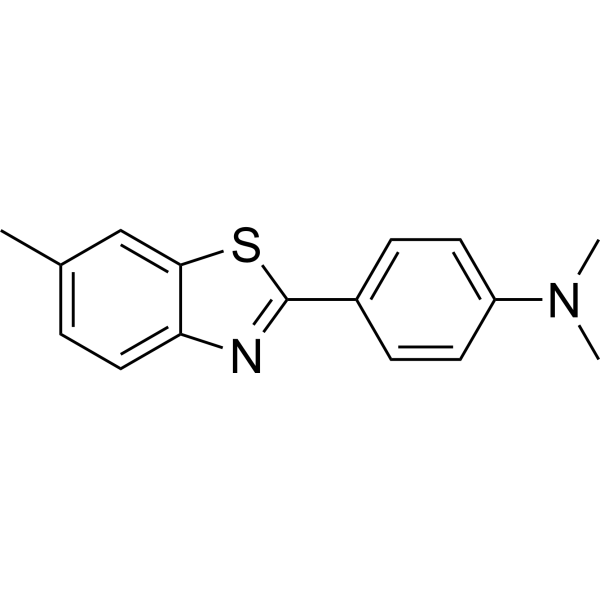
Physicochemical Properties
| Molecular Formula | C16H16N2S |
| Molecular Weight | 268.37664 |
| Exact Mass | 268.103 |
| CAS # | 10205-62-6 |
| PubChem CID | 82450 |
| Appearance | Typically exists as solid at room temperature |
| Density | 1.188g/cm3 |
| Boiling Point | 428.8ºC at 760mmHg |
| Melting Point | 204-206ºC(lit.) |
| Flash Point | 213.1ºC |
| Vapour Pressure | 1.48E-07mmHg at 25°C |
| Index of Refraction | 1.669 |
| LogP | 4.337 |
| Hydrogen Bond Donor Count | 0 |
| Hydrogen Bond Acceptor Count | 3 |
| Rotatable Bond Count | 2 |
| Heavy Atom Count | 19 |
| Complexity | 299 |
| Defined Atom Stereocenter Count | 0 |
| SMILES | CN(C)C1C=CC(C2=NC3C=CC(C)=CC=3S2)=CC=1 |
| InChi Key | OEOPVJYUCSQVMJ-UHFFFAOYSA-N |
| InChi Code | InChI=1S/C16H16N2S/c1-11-4-9-14-15(10-11)19-16(17-14)12-5-7-13(8-6-12)18(2)3/h4-10H,1-3H3 |
| Chemical Name | N,N-dimethyl-4-(6-methyl-1,3-benzothiazol-2-yl)aniline |
| HS Tariff Code | 2934.99.9001 |
| Storage |
Powder-20°C 3 years 4°C 2 years In solvent -80°C 6 months -20°C 1 month |
| Shipping Condition | Room temperature (This product is stable at ambient temperature for a few days during ordinary shipping and time spent in Customs) |
Biological Activity
| ln Vitro | Advice (This is our suggested protocol, which should be adjusted to suit your particular circumstances as it simply offers guidance). Analyze the effects of CH3CN on amyloid fibril binding (changing the concentration of CH3CN while maintaining the same concentrations of BTA-2, fibrils, and water) and the effects of BTA-2 concentration on binding (changing the concentration of BTA-2 while maintaining the same concentration) of a constant quantity of CH3CN, fibrils, and water [1]. BTA-2 in a solution with amyloid fibrils present: 1. The bovine pancreas was used to extract insulin, which was then kept at -20°C in a desiccator. 2. Combine BTA-2 and refine it even more. 3. To prepare the fibrils, dissolve the insulin in 5 mg/mL of pH 2 water, strain the mixture through a 0.2 μm filter, and then heat it for 24 hours at 60°C. For 2.5 minutes, centrifuge at 3000 rpm to get rid of any spherical artifacts. For subsequent use, save the supernatant that contains the fibrils. Until it was needed, the solution was kept in a refrigerator at 10°C. 4. BTA-2/fibril solution (made in two ways): (first approach) add 20 μL of 0.8 mg/mL (3.15 mM) BTA-2 in CH3CN after diluting (100 μL) fibril stock solution with 880 μL pH 2 water. (Second technique) Add 20 μL of 0.8 mg/mL (3.15 mM) BTA-2 after diluting the fibril stock solution by 100 μL with a 1:1 mixture of nanopure water: CH3CN. 5. Make two identical solutions with no fibrils and just BTA-2. 6. Thioflavin T (ThT), which is 20 μL of 0.8 mg/mL (2.51 mM) ThT in CH3CN and 100 μL of diluted fibril stock solution with 880 μL of pH 2 water, is the standard amyloid fluorescent marker. 7. BTA-2's excited emission spectra in pH 2 water at 430 and 360 nm. |
| References |
[1]. A spectroscopic study of 2-[4'-(dimethylamino)phenyl]-benzothiazole binding to insulin amyloid fibrils. J Fluoresc. 2010 Jul;20(4):881-9. |
Solubility Data
| Solubility (In Vitro) | May dissolve in DMSO (in most cases), if not, try other solvents such as H2O, Ethanol, or DMF with a minute amount of products to avoid loss of samples |
| Solubility (In Vivo) |
Note: Listed below are some common formulations that may be used to formulate products with low water solubility (e.g. < 1 mg/mL), you may test these formulations using a minute amount of products to avoid loss of samples. Injection Formulations (e.g. IP/IV/IM/SC) Injection Formulation 1: DMSO : Tween 80: Saline = 10 : 5 : 85 (i.e. 100 μL DMSO stock solution → 50 μL Tween 80 → 850 μL Saline) *Preparation of saline: Dissolve 0.9 g of sodium chloride in 100 mL ddH ₂ O to obtain a clear solution. Injection Formulation 2: DMSO : PEG300 :Tween 80 : Saline = 10 : 40 : 5 : 45 (i.e. 100 μL DMSO → 400 μLPEG300 → 50 μL Tween 80 → 450 μL Saline) Injection Formulation 3: DMSO : Corn oil = 10 : 90 (i.e. 100 μL DMSO → 900 μL Corn oil) Example: Take the Injection Formulation 3 (DMSO : Corn oil = 10 : 90) as an example, if 1 mL of 2.5 mg/mL working solution is to be prepared, you can take 100 μL 25 mg/mL DMSO stock solution and add to 900 μL corn oil, mix well to obtain a clear or suspension solution (2.5 mg/mL, ready for use in animals). Injection Formulation 4: DMSO : 20% SBE-β-CD in saline = 10 : 90 [i.e. 100 μL DMSO → 900 μL (20% SBE-β-CD in saline)] *Preparation of 20% SBE-β-CD in Saline (4°C,1 week): Dissolve 2 g SBE-β-CD in 10 mL saline to obtain a clear solution. Injection Formulation 5: 2-Hydroxypropyl-β-cyclodextrin : Saline = 50 : 50 (i.e. 500 μL 2-Hydroxypropyl-β-cyclodextrin → 500 μL Saline) Injection Formulation 6: DMSO : PEG300 : castor oil : Saline = 5 : 10 : 20 : 65 (i.e. 50 μL DMSO → 100 μLPEG300 → 200 μL castor oil → 650 μL Saline) Injection Formulation 7: Ethanol : Cremophor : Saline = 10: 10 : 80 (i.e. 100 μL Ethanol → 100 μL Cremophor → 800 μL Saline) Injection Formulation 8: Dissolve in Cremophor/Ethanol (50 : 50), then diluted by Saline Injection Formulation 9: EtOH : Corn oil = 10 : 90 (i.e. 100 μL EtOH → 900 μL Corn oil) Injection Formulation 10: EtOH : PEG300:Tween 80 : Saline = 10 : 40 : 5 : 45 (i.e. 100 μL EtOH → 400 μLPEG300 → 50 μL Tween 80 → 450 μL Saline) Oral Formulations Oral Formulation 1: Suspend in 0.5% CMC Na (carboxymethylcellulose sodium) Oral Formulation 2: Suspend in 0.5% Carboxymethyl cellulose Example: Take the Oral Formulation 1 (Suspend in 0.5% CMC Na) as an example, if 100 mL of 2.5 mg/mL working solution is to be prepared, you can first prepare 0.5% CMC Na solution by measuring 0.5 g CMC Na and dissolve it in 100 mL ddH2O to obtain a clear solution; then add 250 mg of the product to 100 mL 0.5% CMC Na solution, to make the suspension solution (2.5 mg/mL, ready for use in animals). Oral Formulation 3: Dissolved in PEG400 Oral Formulation 4: Suspend in 0.2% Carboxymethyl cellulose Oral Formulation 5: Dissolve in 0.25% Tween 80 and 0.5% Carboxymethyl cellulose Oral Formulation 6: Mixing with food powders Note: Please be aware that the above formulations are for reference only. InvivoChem strongly recommends customers to read literature methods/protocols carefully before determining which formulation you should use for in vivo studies, as different compounds have different solubility properties and have to be formulated differently. (Please use freshly prepared in vivo formulations for optimal results.) |
| Preparing Stock Solutions | 1 mg | 5 mg | 10 mg | |
| 1 mM | 3.7261 mL | 18.6303 mL | 37.2606 mL | |
| 5 mM | 0.7452 mL | 3.7261 mL | 7.4521 mL | |
| 10 mM | 0.3726 mL | 1.8630 mL | 3.7261 mL |