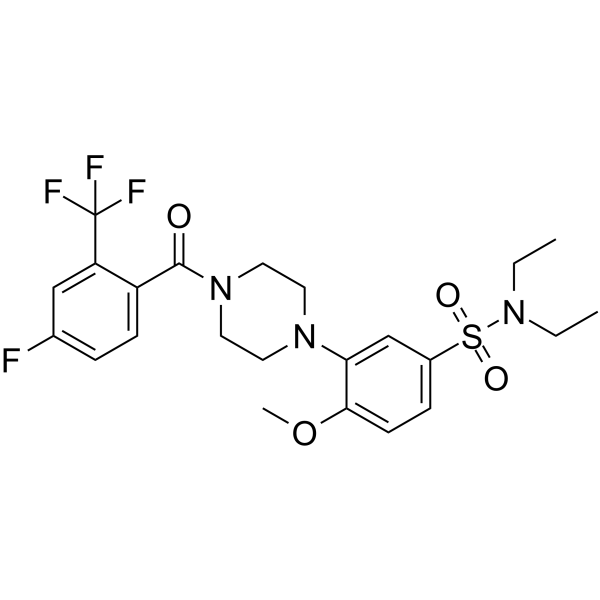
Physicochemical Properties
| Molecular Formula | C23H27F4N3O4S |
| Molecular Weight | 517.536798715591 |
| Exact Mass | 517.165 |
| CAS # | 924537-98-4 |
| PubChem CID | 46088379 |
| Appearance | White to off-white solid powder |
| LogP | 3.8 |
| Hydrogen Bond Donor Count | 0 |
| Hydrogen Bond Acceptor Count | 10 |
| Rotatable Bond Count | 7 |
| Heavy Atom Count | 35 |
| Complexity | 811 |
| Defined Atom Stereocenter Count | 0 |
| SMILES | O=C(N1CCN(C2C(OC)=CC=C(S(N(CC)CC)(=O)=O)C=2)CC1)C1C(C(F)(F)F)=CC(F)=CC=1 |
| InChi Key | GTDJOGZANHPKMR-UHFFFAOYSA-N |
| InChi Code | InChI=1S/C23H27F4N3O4S/c1-4-30(5-2)35(32,33)17-7-9-21(34-3)20(15-17)28-10-12-29(13-11-28)22(31)18-8-6-16(24)14-19(18)23(25,26)27/h6-9,14-15H,4-5,10-13H2,1-3H3 |
| Chemical Name | N,N-diethyl-3-[4-[4-fluoro-2-(trifluoromethyl)benzoyl]piperazin-1-yl]-4-methoxybenzenesulfonamide |
| HS Tariff Code | 2934.99.9001 |
| Storage |
Powder-20°C 3 years 4°C 2 years In solvent -80°C 6 months -20°C 1 month |
| Shipping Condition | Room temperature (This product is stable at ambient temperature for a few days during ordinary shipping and time spent in Customs) |
Biological Activity
| ln Vitro | While BT-13 promotes RET's phosphorylation and intracellular signal absorption, RET does not activate intracellular signals or cause NGF or BDNF to bind to TrkA or TrkB, respectively, when RET is not present [1]. |
| ln Vivo | In addition to having modest analgesic and antihyperalgesic effects, BT-13 (20 and 25 mg/kg bound to left L5 and L6 spinal nerve ligation induction) shields DRG neurons from neurological symptoms brought on by surgery [1]. |
| Animal Protocol |
Animal/Disease Models: Rats were induced by ligating the left L5 and L6 spinal nerves [1]. Doses: 5-25mg/kg, dissolved in sesame oil containing 5% DMSO. Route of Administration: subcutaneous injection on postoperative days 1, 3, 5, 8, 10, and 12. Experimental Results: 20 and 25 mg/kg diminished mechanical hypersensitivity and normalized the expression of sensory neuron markers in dorsal root ganglia. |
| References |
[1]. A Novel Small Molecule GDNF Receptor RET Agonist, BT13, Promotes Neurite Growth from Sensory Neurons in Vitro and Attenuates Experimental Neuropathy in the Rat. Front Pharmacol. 2017 Jun 21;8:365. |
Solubility Data
| Solubility (In Vitro) | DMSO : ~25 mg/mL (~48.31 mM) |
| Solubility (In Vivo) |
Solubility in Formulation 1: ≥ 2.5 mg/mL (4.83 mM) (saturation unknown) in 10% DMSO + 40% PEG300 + 5% Tween80 + 45% Saline (add these co-solvents sequentially from left to right, and one by one), clear solution. For example, if 1 mL of working solution is to be prepared, you can add 100 μL of 25.0 mg/mL clear DMSO stock solution to 400 μL PEG300 and mix evenly; then add 50 μL Tween-80 to the above solution and mix evenly; then add 450 μL normal saline to adjust the volume to 1 mL. Preparation of saline: Dissolve 0.9 g of sodium chloride in 100 mL ddH₂ O to obtain a clear solution. Solubility in Formulation 2: ≥ 2.5 mg/mL (4.83 mM) (saturation unknown) in 10% DMSO + 90% Corn Oil (add these co-solvents sequentially from left to right, and one by one), clear solution. For example, if 1 mL of working solution is to be prepared, you can add 100 μL of 25.0 mg/mL clear DMSO stock solution to 900 μL of corn oil and mix evenly. (Please use freshly prepared in vivo formulations for optimal results.) |
| Preparing Stock Solutions | 1 mg | 5 mg | 10 mg | |
| 1 mM | 1.9322 mL | 9.6611 mL | 19.3222 mL | |
| 5 mM | 0.3864 mL | 1.9322 mL | 3.8644 mL | |
| 10 mM | 0.1932 mL | 0.9661 mL | 1.9322 mL |