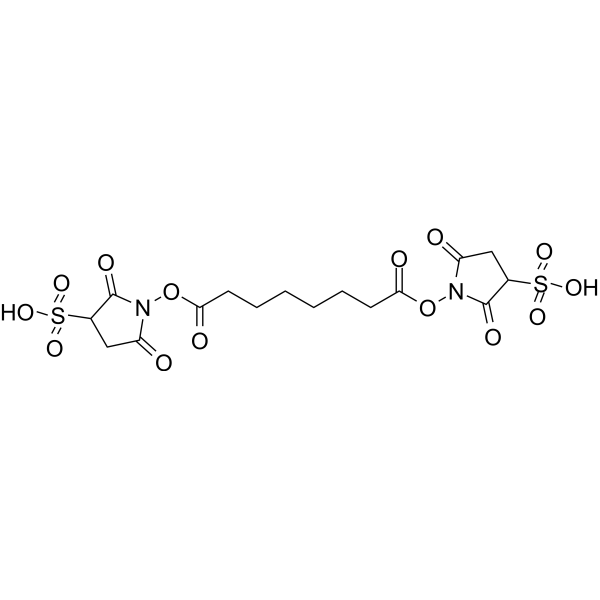
Physicochemical Properties
| Molecular Formula | C16H20N2O14S2 |
| Molecular Weight | 528.4650 |
| Exact Mass | 550.017 |
| Elemental Analysis | C, 36.37; H, 3.81; N, 5.30; O, 42.38; S, 12.13 |
| CAS # | 82436-77-9 |
| Related CAS # | BS3 Crosslinker disodium;127634-19-9 |
| PubChem CID | 123854 |
| Appearance | White to off-white solid powder |
| Melting Point | >300°C |
| LogP | -1 |
| Hydrogen Bond Donor Count | 2 |
| Hydrogen Bond Acceptor Count | 14 |
| Rotatable Bond Count | 13 |
| Heavy Atom Count | 34 |
| Complexity | 1010 |
| Defined Atom Stereocenter Count | 0 |
| InChi Key | VYLDEYYOISNGST-UHFFFAOYSA-N |
| InChi Code | InChI=1S/C16H20N2O14S2/c19-11-7-9(33(25,26)27)15(23)17(11)31-13(21)5-3-1-2-4-6-14(22)32-18-12(20)8-10(16(18)24)34(28,29)30/h9-10H,1-8H2,(H,25,26,27)(H,28,29,30) |
| Chemical Name | 1-[8-(2,5-dioxo-3-sulfopyrrolidin-1-yl)oxy-8-oxooctanoyl]oxy-2,5-dioxopyrrolidine-3-sulfonic acid |
| Synonyms | 82436-77-9; bis(sulfosuccinimidyl)suberate; BS3 Crosslinker; BSSIS; bis(sulphosuccinimidyl)suberate; bis(sulfosuccinimidyl) suberate; Disulfosuccinimidyl suberate; BS(3) Cpd; |
| HS Tariff Code | 2934.99.9001 |
| Storage |
Powder-20°C 3 years 4°C 2 years In solvent -80°C 6 months -20°C 1 month Note: Please store this product in a sealed and protected environment, avoid exposure to moisture. |
| Shipping Condition | Room temperature (This product is stable at ambient temperature for a few days during ordinary shipping and time spent in Customs) |
Biological Activity
| Targets | Non-cleavable Linker for ADC synthesis |
| ln Vitro | ADC cytotoxins are connected to antibodies through an ADC connector to form ADCs [1]. |
| References |
[1]. Strategies and challenges for the next generation of antibody-drug conjugates. Nat Rev Drug Discov. 2017 May;16(5):315-337. |
| Additional Infomation |
Cross-Linking Reagents Reagents with two reactive groups, usually at opposite ends of the molecule, that are capable of reacting with and thereby forming bridges between side chains of amino acids in proteins; the locations of naturally reactive areas within proteins can thereby be identified; may also be used for other macromolecules, like glycoproteins, nucleic acids, or other. Antibody-drug conjugates (ADCs) are one of the fastest growing classes of oncology therapeutics. After half a century of research, the approvals of brentuximab vedotin (in 2011) and trastuzumab emtansine (in 2013) have paved the way for ongoing clinical trials that are evaluating more than 60 further ADC candidates. The limited success of first-generation ADCs (developed in the early 2000s) informed strategies to bring second-generation ADCs to the market, which have higher levels of cytotoxic drug conjugation, lower levels of naked antibodies and more-stable linkers between the drug and the antibody. Furthermore, lessons learned during the past decade are now being used in the development of third-generation ADCs. In this Review, we discuss strategies to select the best target antigens as well as suitable cytotoxic drugs; the design of optimized linkers; the discovery of bioorthogonal conjugation chemistries; and toxicity issues. The selection and engineering of antibodies for site-specific drug conjugation, which will result in higher homogeneity and increased stability, as well as the quest for new conjugation chemistries and mechanisms of action, are priorities in ADC research.[1] |
Solubility Data
| Solubility (In Vitro) | May dissolve in DMSO (in most cases), if not, try other solvents such as H2O, Ethanol, or DMF with a minute amount of products to avoid loss of samples |
| Solubility (In Vivo) |
Note: Listed below are some common formulations that may be used to formulate products with low water solubility (e.g. < 1 mg/mL), you may test these formulations using a minute amount of products to avoid loss of samples. Injection Formulations (e.g. IP/IV/IM/SC) Injection Formulation 1: DMSO : Tween 80: Saline = 10 : 5 : 85 (i.e. 100 μL DMSO stock solution → 50 μL Tween 80 → 850 μL Saline) *Preparation of saline: Dissolve 0.9 g of sodium chloride in 100 mL ddH ₂ O to obtain a clear solution. Injection Formulation 2: DMSO : PEG300 :Tween 80 : Saline = 10 : 40 : 5 : 45 (i.e. 100 μL DMSO → 400 μLPEG300 → 50 μL Tween 80 → 450 μL Saline) Injection Formulation 3: DMSO : Corn oil = 10 : 90 (i.e. 100 μL DMSO → 900 μL Corn oil) Example: Take the Injection Formulation 3 (DMSO : Corn oil = 10 : 90) as an example, if 1 mL of 2.5 mg/mL working solution is to be prepared, you can take 100 μL 25 mg/mL DMSO stock solution and add to 900 μL corn oil, mix well to obtain a clear or suspension solution (2.5 mg/mL, ready for use in animals). Injection Formulation 4: DMSO : 20% SBE-β-CD in saline = 10 : 90 [i.e. 100 μL DMSO → 900 μL (20% SBE-β-CD in saline)] *Preparation of 20% SBE-β-CD in Saline (4°C,1 week): Dissolve 2 g SBE-β-CD in 10 mL saline to obtain a clear solution. Injection Formulation 5: 2-Hydroxypropyl-β-cyclodextrin : Saline = 50 : 50 (i.e. 500 μL 2-Hydroxypropyl-β-cyclodextrin → 500 μL Saline) Injection Formulation 6: DMSO : PEG300 : castor oil : Saline = 5 : 10 : 20 : 65 (i.e. 50 μL DMSO → 100 μLPEG300 → 200 μL castor oil → 650 μL Saline) Injection Formulation 7: Ethanol : Cremophor : Saline = 10: 10 : 80 (i.e. 100 μL Ethanol → 100 μL Cremophor → 800 μL Saline) Injection Formulation 8: Dissolve in Cremophor/Ethanol (50 : 50), then diluted by Saline Injection Formulation 9: EtOH : Corn oil = 10 : 90 (i.e. 100 μL EtOH → 900 μL Corn oil) Injection Formulation 10: EtOH : PEG300:Tween 80 : Saline = 10 : 40 : 5 : 45 (i.e. 100 μL EtOH → 400 μLPEG300 → 50 μL Tween 80 → 450 μL Saline) Oral Formulations Oral Formulation 1: Suspend in 0.5% CMC Na (carboxymethylcellulose sodium) Oral Formulation 2: Suspend in 0.5% Carboxymethyl cellulose Example: Take the Oral Formulation 1 (Suspend in 0.5% CMC Na) as an example, if 100 mL of 2.5 mg/mL working solution is to be prepared, you can first prepare 0.5% CMC Na solution by measuring 0.5 g CMC Na and dissolve it in 100 mL ddH2O to obtain a clear solution; then add 250 mg of the product to 100 mL 0.5% CMC Na solution, to make the suspension solution (2.5 mg/mL, ready for use in animals). Oral Formulation 3: Dissolved in PEG400 Oral Formulation 4: Suspend in 0.2% Carboxymethyl cellulose Oral Formulation 5: Dissolve in 0.25% Tween 80 and 0.5% Carboxymethyl cellulose Oral Formulation 6: Mixing with food powders Note: Please be aware that the above formulations are for reference only. InvivoChem strongly recommends customers to read literature methods/protocols carefully before determining which formulation you should use for in vivo studies, as different compounds have different solubility properties and have to be formulated differently. (Please use freshly prepared in vivo formulations for optimal results.) |
| Preparing Stock Solutions | 1 mg | 5 mg | 10 mg | |
| 1 mM | 1.8923 mL | 9.4613 mL | 18.9226 mL | |
| 5 mM | 0.3785 mL | 1.8923 mL | 3.7845 mL | |
| 10 mM | 0.1892 mL | 0.9461 mL | 1.8923 mL |