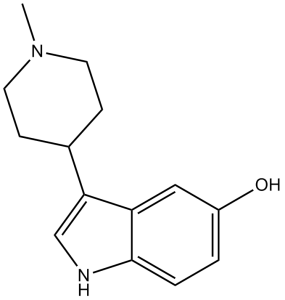
BRL 54443 (BRL54443; BRL-54443) is a potent agonist of 5-HT1E and 5-HT1F receptor with important biological activity. It suppresses 5-HT1E and 5-HT1F with pKi values of 8.7 and 9.25, respectively.
Physicochemical Properties
| Molecular Formula | C14H18N2O | |
| Molecular Weight | 230.31 | |
| Exact Mass | 230.141 | |
| Elemental Analysis | C, 73.01; H, 7.88; N, 12.16; O, 6.95 | |
| CAS # | 57477-39-1 | |
| Related CAS # |
|
|
| PubChem CID | 2438 | |
| Appearance | White to gray solid powder | |
| Density | 1.2±0.1 g/cm3 | |
| Boiling Point | 431.5±45.0 °C at 760 mmHg | |
| Flash Point | 214.8±28.7 °C | |
| Vapour Pressure | 0.0±1.1 mmHg at 25°C | |
| Index of Refraction | 1.646 | |
| LogP | 1.16 | |
| Hydrogen Bond Donor Count | 2 | |
| Hydrogen Bond Acceptor Count | 2 | |
| Rotatable Bond Count | 1 | |
| Heavy Atom Count | 17 | |
| Complexity | 263 | |
| Defined Atom Stereocenter Count | 0 | |
| SMILES | O([H])C1C([H])=C([H])C2=C(C=1[H])C(=C([H])N2[H])C1([H])C([H])([H])C([H])([H])N(C([H])([H])[H])C([H])([H])C1([H])[H] |
|
| InChi Key | WKNFADCGOAHBPG-UHFFFAOYSA-N | |
| InChi Code | InChI=1S/C14H18N2O/c1-16-6-4-10(5-7-16)13-9-15-14-3-2-11(17)8-12(13)14/h2-3,8-10,15,17H,4-7H2,1H3 | |
| Chemical Name | 3-(1-methylpiperidin-4-yl)-1H-indol-5-ol | |
| Synonyms |
|
|
| HS Tariff Code | 2934.99.9001 | |
| Storage |
Powder-20°C 3 years 4°C 2 years In solvent -80°C 6 months -20°C 1 month |
|
| Shipping Condition | Room temperature (This product is stable at ambient temperature for a few days during ordinary shipping and time spent in Customs) |
Biological Activity
| Targets |
5-HT1E Receptor ( Ki = 1.1 nM ); 5-HT1F Receptor ( Ki = 0.7 nM ); 5-HT1A Receptor ( Ki = 63 nM ); 5-HT1B Receptor( Ki = 126 nM ); 5-HT1D Receptor ( Ki = 63 nM ); 5-HT2A Receptor ( Ki = 1259 nM ); 5-HT2B Receptor( Ki = 100 nM ); 5-HT2C Receptor ( Ki = 316 nM ); 5-HT6 Receptor ( Ki > 10000 nM ); 5-HT7 Receptor ( Ki > 10000 nM ) |
||
| ln Vitro |
|
||
| ln Vivo |
|
||
| Animal Protocol |
|
||
| References |
[1]. Toward selective drug development for the human 5-hydroxytryptamine 1E receptor: a comparison of 5-hydroxytryptamine 1E and 1F receptor structure-affinity relationships. J Pharmacol Exp Ther. 2011 Jun;337(3):860-867. [2]. Characterization of the serotonin receptor mediating contraction in the mouse thoracic aorta and signal pathway coupling. J Pharmacol Exp Ther. 2001 Apr;297(1):88-95. [3]. Distribution of 5-ht(1E) receptors in the mammalian brain and cerebral vasculature: an immunohistochemical and pharmacological study. Br J Pharmacol. 2012 Jun;166(4):1290-302. [4]. The role of peripheral 5-HT1A, 5-HT1B, 5-HT1D, 5-HT1E and 5-HT1F serotonergic receptors in the reduction of nociception in rats. Neuroscience. 2010 Jan 20;165(2):561-8. |
||
| Additional Infomation | 3-(1-methyl-4-piperidinyl)-1H-indol-5-ol is a member of hydroxyindoles. |
Solubility Data
| Solubility (In Vitro) |
|
|||
| Solubility (In Vivo) |
Solubility in Formulation 1: ≥ 2.5 mg/mL (10.85 mM) (saturation unknown) in 10% DMSO + 40% PEG300 + 5% Tween80 + 45% Saline (add these co-solvents sequentially from left to right, and one by one), clear solution. For example, if 1 mL of working solution is to be prepared, you can add 100 μL of 25.0 mg/mL clear DMSO stock solution to 400 μL PEG300 and mix evenly; then add 50 μL Tween-80 to the above solution and mix evenly; then add 450 μL normal saline to adjust the volume to 1 mL. Preparation of saline: Dissolve 0.9 g of sodium chloride in 100 mL ddH₂ O to obtain a clear solution. Solubility in Formulation 2: ≥ 2.5 mg/mL (10.85 mM) (saturation unknown) in 10% DMSO + 90% (20% SBE-β-CD in Saline) (add these co-solvents sequentially from left to right, and one by one), clear solution. For example, if 1 mL of working solution is to be prepared, you can add 100 μL of 25.0 mg/mL clear DMSO stock solution to 900 μL of 20% SBE-β-CD physiological saline solution and mix evenly. Preparation of 20% SBE-β-CD in Saline (4°C,1 week): Dissolve 2 g SBE-β-CD in 10 mL saline to obtain a clear solution. Solubility in Formulation 3: 30% Propylene glycol , 5% Tween 80 , 65% D5W: 30 mg/mL (Please use freshly prepared in vivo formulations for optimal results.) |
| Preparing Stock Solutions | 1 mg | 5 mg | 10 mg | |
| 1 mM | 4.3420 mL | 21.7099 mL | 43.4197 mL | |
| 5 mM | 0.8684 mL | 4.3420 mL | 8.6839 mL | |
| 10 mM | 0.4342 mL | 2.1710 mL | 4.3420 mL |