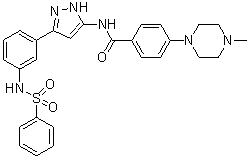
Physicochemical Properties
| Molecular Formula | C27H28N6O3S |
| Molecular Weight | 516.614624023438 |
| Exact Mass | 516.194 |
| Elemental Analysis | C, 62.77; H, 5.46; N, 16.27; O, 9.29; S, 6.21 |
| CAS # | 1327167-19-0 |
| Related CAS # | BPR1J-097 Hydrochloride |
| PubChem CID | 56673651 |
| Appearance | white solid powder |
| LogP | 5.111 |
| Hydrogen Bond Donor Count | 3 |
| Hydrogen Bond Acceptor Count | 7 |
| Rotatable Bond Count | 7 |
| Heavy Atom Count | 37 |
| Complexity | 845 |
| Defined Atom Stereocenter Count | 0 |
| SMILES | O=C(NC1=NNC(C2=CC=CC(NS(=O)(C3=CC=CC=C3)=O)=C2)=C1)C4=CC=C(N5CCN(C)CC5)C=C4 |
| InChi Key | RRKKHABFIOHAOI-UHFFFAOYSA-N |
| InChi Code | InChI=1S/C27H28N6O3S/c1-32-14-16-33(17-15-32)23-12-10-20(11-13-23)27(34)28-26-19-25(29-30-26)21-6-5-7-22(18-21)31-37(35,36)24-8-3-2-4-9-24/h2-13,18-19,31H,14-17H2,1H3,(H2,28,29,30,34) |
| Chemical Name | N-[5-[3-(benzenesulfonamido)phenyl]-1H-pyrazol-3-yl]-4-(4-methylpiperazin-1-yl)benzamide |
| Synonyms | BPR1J-097; BPR1J097; BPR1J 097; BPR1 J097; BPR1J097; BPR1-J097 |
| HS Tariff Code | 2934.99.9001 |
| Storage |
Powder-20°C 3 years 4°C 2 years In solvent -80°C 6 months -20°C 1 month |
| Shipping Condition | Room temperature (This product is stable at ambient temperature for a few days during ordinary shipping and time spent in Customs) |
Biological Activity
| Targets |
FLT3 (IC50 = 11 nM) FLT3 (Fms-like tyrosine kinase 3) wild-type with IC₅₀ = 11 ± 7 nM FLT3-D835Y mutant with IC₅₀ = 3 nM FLT1 (VEGFR1) with IC₅₀ = 211 nM KDR (VEGFR2) with IC₅₀ = 129 nM Aurora A with IC₅₀ = 340 nM Aurora B with IC₅₀ = 876 nM [1] |
| ln Vitro |
BPR1J-097 inhibits FLT3 kinase activity with IC₅₀ ranging from 1 to 10 nM in biochemical assays. In FLT3-driven AML cell lines MOLM-13 and MV4-11, it shows growth inhibitory GC₅₀ values of 21 ± 7 nM and 46 ± 14 nM, respectively. The compound suppresses phosphorylation of FLT3 and its downstream target STAT5 in a dose-dependent manner in transfected HEK293T cells and FLT3-ITD-homozygous MV4-11 cells. It also induces apoptosis in MOLM-13 and MV4-11 cells, evidenced by cleavage of caspase-3 and PARP. [1] |
| ln Vivo |
BPR1J-097 shows significant dose-dependent tumor growth inhibition and regression in subcutaneous xenograft models using MOLM-13 and MV4-11 cells in nude mice. Treatment with 25 mg/kg i.v. for 2 weeks caused tumor shrinkage even in large established tumors (>2000 mm³). In the MV4-11 model, tumors were completely eliminated after two cycles of treatment at 25 mg/kg. No significant body weight loss was observed. [1] |
| Enzyme Assay |
FLT3 kinase activity was assessed using a Kinase-Glo assay in 96-well plates. The reaction mixture contained Tris buffer, MgCl₂, MnCl₂, DTT, Triton X-100, BSA, ATP, a peptide substrate, and recombinant FLT3 protein. After incubation at 30°C for 4 hours, luminescence was measured to determine kinase activity inhibition. VEGFR1 and VEGFR2 kinase assays were performed similarly with specific peptide substrates and recombinant proteins. Aurora kinase A and B assays were carried out as previously described. IC₅₀ values were determined from three independent experiments. [1] |
| Cell Assay |
Cellular proliferation was assessed using the MTS method. Cells were seeded in 96-well plates, treated with BPR1J-097 for 72 hours, and absorbance was measured at 490 nm. GC₅₀ values were calculated using Prism software. For Western blot analysis, cells were lysed, proteins separated by SDS-PAGE, transferred to PVDF membranes, and probed with antibodies against phospho-FLT3, phospho-STAT5, cleaved PARP, caspase-3, and β-actin. Apoptosis was evaluated by detecting cleaved caspase-3 and PARP. [1] |
| Animal Protocol |
For pharmacokinetic studies, male Sprague–Dawley rats were administered a single i.v. bolus of BPR1J-097 (3.4 mg/kg) dissolved in PEG400/water (80/20, v/v). Blood samples were collected at specified time points up to 24 hours for LC-MS/MS analysis. For xenograft studies, nude mice were subcutaneously inoculated with MOLM-13 or MV4-11 cells. When tumors reached 100–200 mm³, mice were treated i.v. with BPR1J-097 (10 or 25 mg/kg) or vehicle once daily for 5 days per week for 2 weeks. Tumor volumes were measured twice weekly. [1] |
| ADME/Pharmacokinetics |
Following a single i.v. dose of 3.4 mg/kg in rats, BPR1J-097 achieved a maximum plasma concentration of 7.1 µM (3670 ng/mL) at 2 minutes. The plasma concentration remained at 1.9 nM at 24 hours post-dose. The apparent half-life (T₁/₂) was approximately 4.5 hours. Total body clearance (CL) was 102.4 ± 9.8 mL/min/kg. Volume of distribution at steady state (Vss) was 15.5 ± 4.8 L/kg. Area under the curve (AUC₀–₂₄) was 551 ± 51 ng·h/mL. [1] |
| References |
[1]. BPR1J-097, a novel FLT3 kinase inhibitor, exerts potent inhibitory activity against AML. Br J Cancer. 2012 Jan 31;106(3):475-81. |
| Additional Infomation |
BPR1J-097 is a novel sulfonamide-based FLT3 kinase inhibitor discovered through rational design. It exhibits high selectivity for FLT3 over related kinases. The compound inhibits FLT3 signaling pathways, including STAT5 phosphorylation, and induces apoptosis in FLT3-driven AML cells. It shows promising in vivo efficacy in xenograft models and favorable pharmacokinetic properties, supporting its further development as a potential therapeutic for AML. [1] |
Solubility Data
| Solubility (In Vitro) | May dissolve in DMSO (in most cases), if not, try other solvents such as H2O, Ethanol, or DMF with a minute amount of products to avoid loss of samples |
| Solubility (In Vivo) |
Note: Listed below are some common formulations that may be used to formulate products with low water solubility (e.g. < 1 mg/mL), you may test these formulations using a minute amount of products to avoid loss of samples. Injection Formulations (e.g. IP/IV/IM/SC) Injection Formulation 1: DMSO : Tween 80: Saline = 10 : 5 : 85 (i.e. 100 μL DMSO stock solution → 50 μL Tween 80 → 850 μL Saline) *Preparation of saline: Dissolve 0.9 g of sodium chloride in 100 mL ddH ₂ O to obtain a clear solution. Injection Formulation 2: DMSO : PEG300 :Tween 80 : Saline = 10 : 40 : 5 : 45 (i.e. 100 μL DMSO → 400 μLPEG300 → 50 μL Tween 80 → 450 μL Saline) Injection Formulation 3: DMSO : Corn oil = 10 : 90 (i.e. 100 μL DMSO → 900 μL Corn oil) Example: Take the Injection Formulation 3 (DMSO : Corn oil = 10 : 90) as an example, if 1 mL of 2.5 mg/mL working solution is to be prepared, you can take 100 μL 25 mg/mL DMSO stock solution and add to 900 μL corn oil, mix well to obtain a clear or suspension solution (2.5 mg/mL, ready for use in animals). Injection Formulation 4: DMSO : 20% SBE-β-CD in saline = 10 : 90 [i.e. 100 μL DMSO → 900 μL (20% SBE-β-CD in saline)] *Preparation of 20% SBE-β-CD in Saline (4°C,1 week): Dissolve 2 g SBE-β-CD in 10 mL saline to obtain a clear solution. Injection Formulation 5: 2-Hydroxypropyl-β-cyclodextrin : Saline = 50 : 50 (i.e. 500 μL 2-Hydroxypropyl-β-cyclodextrin → 500 μL Saline) Injection Formulation 6: DMSO : PEG300 : castor oil : Saline = 5 : 10 : 20 : 65 (i.e. 50 μL DMSO → 100 μLPEG300 → 200 μL castor oil → 650 μL Saline) Injection Formulation 7: Ethanol : Cremophor : Saline = 10: 10 : 80 (i.e. 100 μL Ethanol → 100 μL Cremophor → 800 μL Saline) Injection Formulation 8: Dissolve in Cremophor/Ethanol (50 : 50), then diluted by Saline Injection Formulation 9: EtOH : Corn oil = 10 : 90 (i.e. 100 μL EtOH → 900 μL Corn oil) Injection Formulation 10: EtOH : PEG300:Tween 80 : Saline = 10 : 40 : 5 : 45 (i.e. 100 μL EtOH → 400 μLPEG300 → 50 μL Tween 80 → 450 μL Saline) Oral Formulations Oral Formulation 1: Suspend in 0.5% CMC Na (carboxymethylcellulose sodium) Oral Formulation 2: Suspend in 0.5% Carboxymethyl cellulose Example: Take the Oral Formulation 1 (Suspend in 0.5% CMC Na) as an example, if 100 mL of 2.5 mg/mL working solution is to be prepared, you can first prepare 0.5% CMC Na solution by measuring 0.5 g CMC Na and dissolve it in 100 mL ddH2O to obtain a clear solution; then add 250 mg of the product to 100 mL 0.5% CMC Na solution, to make the suspension solution (2.5 mg/mL, ready for use in animals). Oral Formulation 3: Dissolved in PEG400 Oral Formulation 4: Suspend in 0.2% Carboxymethyl cellulose Oral Formulation 5: Dissolve in 0.25% Tween 80 and 0.5% Carboxymethyl cellulose Oral Formulation 6: Mixing with food powders Note: Please be aware that the above formulations are for reference only. InvivoChem strongly recommends customers to read literature methods/protocols carefully before determining which formulation you should use for in vivo studies, as different compounds have different solubility properties and have to be formulated differently. (Please use freshly prepared in vivo formulations for optimal results.) |
| Preparing Stock Solutions | 1 mg | 5 mg | 10 mg | |
| 1 mM | 1.9357 mL | 9.6785 mL | 19.3570 mL | |
| 5 mM | 0.3871 mL | 1.9357 mL | 3.8714 mL | |
| 10 mM | 0.1936 mL | 0.9678 mL | 1.9357 mL |