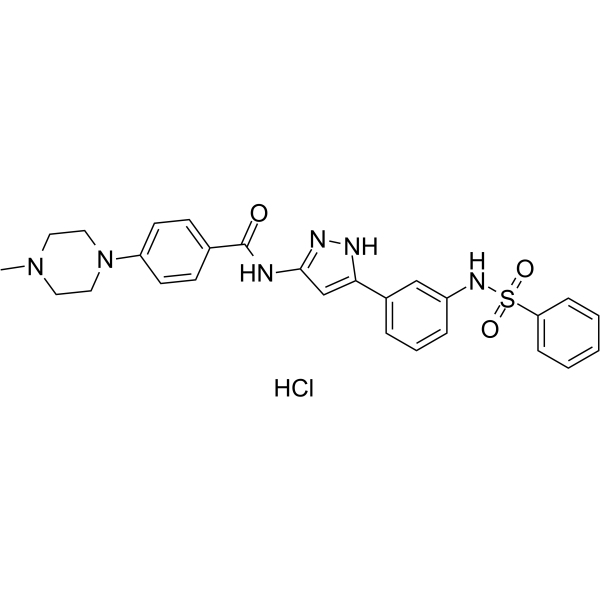
Physicochemical Properties
| Molecular Formula | C27H29CLN6O3S |
| Molecular Weight | 553.08 |
| Related CAS # | BPR1J-097;1327167-19-0 |
| Appearance | White to off-white solid powder |
| HS Tariff Code | 2934.99.9001 |
| Storage |
Powder-20°C 3 years 4°C 2 years In solvent -80°C 6 months -20°C 1 month Note: Please store this product in a sealed and protected environment, avoid exposure to moisture. |
| Shipping Condition | Room temperature (This product is stable at ambient temperature for a few days during ordinary shipping and time spent in Customs) |
Biological Activity
| Targets | IC50: 11 nM (FLT3)[1] |
| ln Vitro | BPR1J-097 Hydrochloride is a new, powerful FLT3 inhibitor with an 11nM IC50. BPR1J-097 Hydrochloride inhibits FLT3-phosphorylation-WT, FLT3-IDT, and FLT3-D835Y at concentrations as low as 10 nM. In a dose-dependent manner, BPR1J- 097 Hydrochloride inhibits the phosphorylation of FLT3 and STAT5. On MOLM-13 and MV4-11 cells, the IC50 values of BPR1J-097 Hydrochloride are 21±7 and 46±14 nM, respectively. Following treatment with BPR1J-097 Hydrochloride at a concentration of 10 nM, MOLM-13 cells exhibit the appearance of activated caspase-3. Since caspase-3 is not seen until 100 nM of BPR1J-097 Hydrochloride is administered to treat cells, the effect of the hydrochloride appears to be reduced in MV4-11 cells[1]. |
| ln Vivo | Mice given BPR1J-097 Hydrochloride intravenously (IV) for two cycles at 10 or 25 mg/kg, a definite dose-dependent antitumor effect is seen. When mice are given BPR1J-097 Hydrochloride (25 mg/kg daily), their tumors stop developing. When BPR1J-097 Hydrochloride (25 mg/kg) is applied topically to subcutaneously developing MOLM-13 tumors larger than 2000 mm3, there is a noticeable reduction in tumor size. Using MV4-11 cells, BPR1J-097 Hydrochloride (10 and 25 mg/kg) also causes a dose-dependent shrinkage and reduction in growth of another model. It is reported that mice given 25 mg/kg of BPR1J-097 Hydrochloride showed a prolonged elimination of MV4-11 tumors. In these in vivo experiments, BPR1J-097 Hydrochloride-treated nude mice lose little (3%), if any, of their body weight during the observation periods[1]. |
| References |
[1]. BPR1J-097, a novel FLT3 kinase inhibitor, exerts potent inhibitory activity against AML. Br J Cancer. 2012 Jan 31;106(3):475-81. |
Solubility Data
| Solubility (In Vitro) |
DMSO :~6 mg/mL (~10.85 mM) H2O :~2 mg/mL (~3.62 mM) |
| Solubility (In Vivo) |
Note: Listed below are some common formulations that may be used to formulate products with low water solubility (e.g. < 1 mg/mL), you may test these formulations using a minute amount of products to avoid loss of samples. Injection Formulations (e.g. IP/IV/IM/SC) Injection Formulation 1: DMSO : Tween 80: Saline = 10 : 5 : 85 (i.e. 100 μL DMSO stock solution → 50 μL Tween 80 → 850 μL Saline) *Preparation of saline: Dissolve 0.9 g of sodium chloride in 100 mL ddH ₂ O to obtain a clear solution. Injection Formulation 2: DMSO : PEG300 :Tween 80 : Saline = 10 : 40 : 5 : 45 (i.e. 100 μL DMSO → 400 μLPEG300 → 50 μL Tween 80 → 450 μL Saline) Injection Formulation 3: DMSO : Corn oil = 10 : 90 (i.e. 100 μL DMSO → 900 μL Corn oil) Example: Take the Injection Formulation 3 (DMSO : Corn oil = 10 : 90) as an example, if 1 mL of 2.5 mg/mL working solution is to be prepared, you can take 100 μL 25 mg/mL DMSO stock solution and add to 900 μL corn oil, mix well to obtain a clear or suspension solution (2.5 mg/mL, ready for use in animals). Injection Formulation 4: DMSO : 20% SBE-β-CD in saline = 10 : 90 [i.e. 100 μL DMSO → 900 μL (20% SBE-β-CD in saline)] *Preparation of 20% SBE-β-CD in Saline (4°C,1 week): Dissolve 2 g SBE-β-CD in 10 mL saline to obtain a clear solution. Injection Formulation 5: 2-Hydroxypropyl-β-cyclodextrin : Saline = 50 : 50 (i.e. 500 μL 2-Hydroxypropyl-β-cyclodextrin → 500 μL Saline) Injection Formulation 6: DMSO : PEG300 : castor oil : Saline = 5 : 10 : 20 : 65 (i.e. 50 μL DMSO → 100 μLPEG300 → 200 μL castor oil → 650 μL Saline) Injection Formulation 7: Ethanol : Cremophor : Saline = 10: 10 : 80 (i.e. 100 μL Ethanol → 100 μL Cremophor → 800 μL Saline) Injection Formulation 8: Dissolve in Cremophor/Ethanol (50 : 50), then diluted by Saline Injection Formulation 9: EtOH : Corn oil = 10 : 90 (i.e. 100 μL EtOH → 900 μL Corn oil) Injection Formulation 10: EtOH : PEG300:Tween 80 : Saline = 10 : 40 : 5 : 45 (i.e. 100 μL EtOH → 400 μLPEG300 → 50 μL Tween 80 → 450 μL Saline) Oral Formulations Oral Formulation 1: Suspend in 0.5% CMC Na (carboxymethylcellulose sodium) Oral Formulation 2: Suspend in 0.5% Carboxymethyl cellulose Example: Take the Oral Formulation 1 (Suspend in 0.5% CMC Na) as an example, if 100 mL of 2.5 mg/mL working solution is to be prepared, you can first prepare 0.5% CMC Na solution by measuring 0.5 g CMC Na and dissolve it in 100 mL ddH2O to obtain a clear solution; then add 250 mg of the product to 100 mL 0.5% CMC Na solution, to make the suspension solution (2.5 mg/mL, ready for use in animals). Oral Formulation 3: Dissolved in PEG400 Oral Formulation 4: Suspend in 0.2% Carboxymethyl cellulose Oral Formulation 5: Dissolve in 0.25% Tween 80 and 0.5% Carboxymethyl cellulose Oral Formulation 6: Mixing with food powders Note: Please be aware that the above formulations are for reference only. InvivoChem strongly recommends customers to read literature methods/protocols carefully before determining which formulation you should use for in vivo studies, as different compounds have different solubility properties and have to be formulated differently. (Please use freshly prepared in vivo formulations for optimal results.) |
| Preparing Stock Solutions | 1 mg | 5 mg | 10 mg | |
| 1 mM | 1.8081 mL | 9.0403 mL | 18.0806 mL | |
| 5 mM | 0.3616 mL | 1.8081 mL | 3.6161 mL | |
| 10 mM | 0.1808 mL | 0.9040 mL | 1.8081 mL |