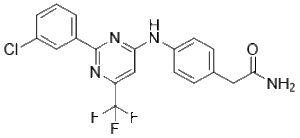
BPN14770 is a novel and potent allosteric modulator of phosphodiesterase-4 (PDE4) with IC50 values of 8 and 130 nM for human and mouse PDE4D, respectively. It may help reverse scopolamine-induced cognitive impairment. Inhibitors of phosphodiesterase-4 (PDE4) have beneficial effects on memory in preclinical and clinical studies. Development of these drugs has stalled due to dose-limiting side effects of nausea and emesis. While use of subtype-selective inhibitors (i.e., for PDE4A, B, or D) could overcome this issue, conservation of the catalytic region, to which classical inhibitors bind, limits this approach. The present study examined the effects of BPN14770, an allosteric inhibitor of PDE4D, which binds to a primate-specific, N-terminal region. In mice engineered to express PDE4D with this primate-specific sequence, BPN14770 was 100-fold more potent for improving memory than in wild-type mice; meanwhile, it exhibited low potency in a mouse surrogate model for emesis. BPN14770 also antagonized the amnesic effects of scopolamine, increased cAMP signaling in brain, and increased BDNF and markers of neuronal plasticity associated with memory. These data establish a relationship between PDE4D target engagement and effects on memory for BPN14770 and suggest clinical potential for PDE4D-selective inhibitors.
Physicochemical Properties
| Molecular Formula | C19H14CLF3N4O |
| Molecular Weight | 406.788873195648 |
| Exact Mass | 406.08 |
| CAS # | 1606975-12-5 |
| PubChem CID | 77461017 |
| Appearance | Typically exists as solid at room temperature |
| Density | 1.4±0.1 g/cm3 |
| Boiling Point | 511.4±50.0 °C at 760 mmHg |
| Flash Point | 263.1±30.1 °C |
| Vapour Pressure | 0.0±1.3 mmHg at 25°C |
| Index of Refraction | 1.611 |
| LogP | 3.3 |
| Hydrogen Bond Donor Count | 2 |
| Hydrogen Bond Acceptor Count | 7 |
| Rotatable Bond Count | 5 |
| Heavy Atom Count | 28 |
| Complexity | 528 |
| Defined Atom Stereocenter Count | 0 |
| SMILES | ClC1=CC=CC(=C1)C1=NC(C(F)(F)F)=CC(=N1)NC1C=CC(CC(N)=O)=CC=1 |
| InChi Key | KRRGWHSEDYQKDQ-UHFFFAOYSA-N |
| InChi Code | InChI=1S/C19H14ClF3N4O/c20-13-3-1-2-12(9-13)18-26-15(19(21,22)23)10-17(27-18)25-14-6-4-11(5-7-14)8-16(24)28/h1-7,9-10H,8H2,(H2,24,28)(H,25,26,27) |
| Chemical Name | 2-(4-((2-(3-chlorophenyl)-6-(trifluoromethyl)pyrimidin-4-yl)amino)phenyl)acetamide |
| Synonyms | BPN14770; BPN-14770; BPN 14770; D159797; D-159797; D 159797. |
| HS Tariff Code | 2934.99.9001 |
| Storage |
Powder-20°C 3 years 4°C 2 years In solvent -80°C 6 months -20°C 1 month |
| Shipping Condition | Room temperature (This product is stable at ambient temperature for a few days during ordinary shipping and time spent in Customs) |
Biological Activity
| ln Vivo |
Based on the unique binding pose of BPN14770 to primate PDE4D, we humanized the mouse PDE4D gene by knocking into C57bl/6 mouse embryonic stem cells a single-nucleotide substitution that replaces UCR2 tyrosine 271 by phenylalanine. By comparing their response to BPN14770 against wild-type, littermate controls, the humanized PDE4D mice therefore provide a unique and powerful genetic tool with which to asses PDE4D target engagement by BPN14770, and thereby, the ability of a PDE4D allosteric inhibitor to modulate neurochemical and cognitive biomarkers of PKA–CREB pathway outflow.[1] Mice were killed by decapitation, and the brains were immediately dissected on ice and homogenized in binding buffer using a Polytron homogenizer (Brinkman Instruments, Westbury, NY). The membrane fraction of the homogenate was obtained by centrifugation at 15,000 × g for 15 min, and resuspension of the pellet in the binding buffer. The method was modified by Zhao and coworkers [29, 30] based on Schneider’s earlier publication. Mouse brain membrane preparations containing 200 to 300 μg of protein were used for co-incubation with various concentrations of BPN14770 and/or [3H]-rolipram.[1] Mice were dosed with BPN14770 or vehicle (per os (PO)), or rolipram (1 mg/kg, intraperitoneal (IP)). After 30 min or 15 min (for PO and IP doses, respectively), mice were injected (IP) with a mixture of ketamine (80 mg/kg) and xylazine (10 mg/kg). The duration of anesthesia was determined as the time between the loss and return of the righting reflex, and was used as an endpoint to measure the duration of anesthesia.[1] Mice were treated with various doses of BPN14770 or vehicle and killed 1 h after dosing by rapid decapitation, and brains were immediately dissected on ice, flash frozen in liquid nitrogen, and stored at −80 °C. On the day of assay, frozen brain samples were analyzed using the cAMP complete ELISA kit (Enzo Life Sciences, Farmingdale, NY) according to the assay protocol.[1] |
| References | Neuropsychopharmacology.2018 Oct;43(11):2299-2309;Sci Rep.2017 Nov 7;7(1):14653. |
| Additional Infomation | See also: Zatolmilast (annotation moved to). |
Solubility Data
| Solubility (In Vitro) | May dissolve in DMSO (in most cases), if not, try other solvents such as H2O, Ethanol, or DMF with a minute amount of products to avoid loss of samples |
| Solubility (In Vivo) |
Note: Listed below are some common formulations that may be used to formulate products with low water solubility (e.g. < 1 mg/mL), you may test these formulations using a minute amount of products to avoid loss of samples. Injection Formulations (e.g. IP/IV/IM/SC) Injection Formulation 1: DMSO : Tween 80: Saline = 10 : 5 : 85 (i.e. 100 μL DMSO stock solution → 50 μL Tween 80 → 850 μL Saline) *Preparation of saline: Dissolve 0.9 g of sodium chloride in 100 mL ddH ₂ O to obtain a clear solution. Injection Formulation 2: DMSO : PEG300 :Tween 80 : Saline = 10 : 40 : 5 : 45 (i.e. 100 μL DMSO → 400 μLPEG300 → 50 μL Tween 80 → 450 μL Saline) Injection Formulation 3: DMSO : Corn oil = 10 : 90 (i.e. 100 μL DMSO → 900 μL Corn oil) Example: Take the Injection Formulation 3 (DMSO : Corn oil = 10 : 90) as an example, if 1 mL of 2.5 mg/mL working solution is to be prepared, you can take 100 μL 25 mg/mL DMSO stock solution and add to 900 μL corn oil, mix well to obtain a clear or suspension solution (2.5 mg/mL, ready for use in animals). Injection Formulation 4: DMSO : 20% SBE-β-CD in saline = 10 : 90 [i.e. 100 μL DMSO → 900 μL (20% SBE-β-CD in saline)] *Preparation of 20% SBE-β-CD in Saline (4°C,1 week): Dissolve 2 g SBE-β-CD in 10 mL saline to obtain a clear solution. Injection Formulation 5: 2-Hydroxypropyl-β-cyclodextrin : Saline = 50 : 50 (i.e. 500 μL 2-Hydroxypropyl-β-cyclodextrin → 500 μL Saline) Injection Formulation 6: DMSO : PEG300 : castor oil : Saline = 5 : 10 : 20 : 65 (i.e. 50 μL DMSO → 100 μLPEG300 → 200 μL castor oil → 650 μL Saline) Injection Formulation 7: Ethanol : Cremophor : Saline = 10: 10 : 80 (i.e. 100 μL Ethanol → 100 μL Cremophor → 800 μL Saline) Injection Formulation 8: Dissolve in Cremophor/Ethanol (50 : 50), then diluted by Saline Injection Formulation 9: EtOH : Corn oil = 10 : 90 (i.e. 100 μL EtOH → 900 μL Corn oil) Injection Formulation 10: EtOH : PEG300:Tween 80 : Saline = 10 : 40 : 5 : 45 (i.e. 100 μL EtOH → 400 μLPEG300 → 50 μL Tween 80 → 450 μL Saline) Oral Formulations Oral Formulation 1: Suspend in 0.5% CMC Na (carboxymethylcellulose sodium) Oral Formulation 2: Suspend in 0.5% Carboxymethyl cellulose Example: Take the Oral Formulation 1 (Suspend in 0.5% CMC Na) as an example, if 100 mL of 2.5 mg/mL working solution is to be prepared, you can first prepare 0.5% CMC Na solution by measuring 0.5 g CMC Na and dissolve it in 100 mL ddH2O to obtain a clear solution; then add 250 mg of the product to 100 mL 0.5% CMC Na solution, to make the suspension solution (2.5 mg/mL, ready for use in animals). Oral Formulation 3: Dissolved in PEG400 Oral Formulation 4: Suspend in 0.2% Carboxymethyl cellulose Oral Formulation 5: Dissolve in 0.25% Tween 80 and 0.5% Carboxymethyl cellulose Oral Formulation 6: Mixing with food powders Note: Please be aware that the above formulations are for reference only. InvivoChem strongly recommends customers to read literature methods/protocols carefully before determining which formulation you should use for in vivo studies, as different compounds have different solubility properties and have to be formulated differently. (Please use freshly prepared in vivo formulations for optimal results.) |
| Preparing Stock Solutions | 1 mg | 5 mg | 10 mg | |
| 1 mM | 2.4583 mL | 12.2914 mL | 24.5827 mL | |
| 5 mM | 0.4917 mL | 2.4583 mL | 4.9165 mL | |
| 10 mM | 0.2458 mL | 1.2291 mL | 2.4583 mL |