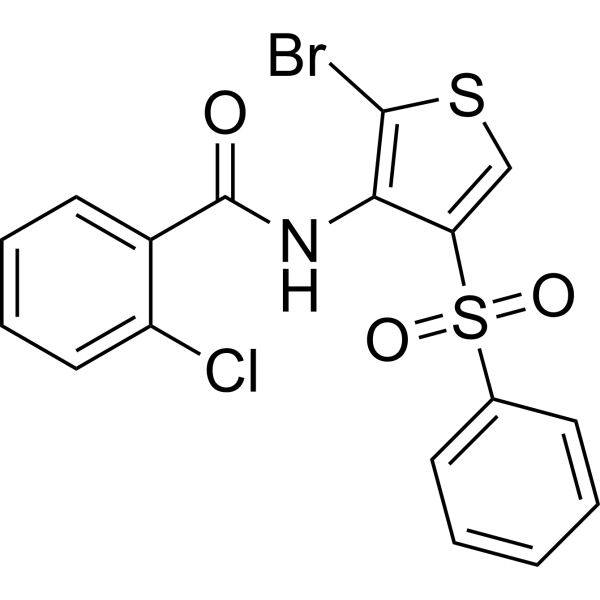
Physicochemical Properties
| Molecular Formula | C17H11BRCLNO3S2 |
| Molecular Weight | 456.7611 |
| Exact Mass | 454.905 |
| CAS # | 685119-25-9 |
| PubChem CID | 2819453 |
| Appearance | White to off-white solid powder |
| LogP | 5.4 |
| Hydrogen Bond Donor Count | 1 |
| Hydrogen Bond Acceptor Count | 4 |
| Rotatable Bond Count | 4 |
| Heavy Atom Count | 25 |
| Complexity | 577 |
| Defined Atom Stereocenter Count | 0 |
| SMILES | BrC1=C(C(=C([H])S1)S(C1C([H])=C([H])C([H])=C([H])C=1[H])(=O)=O)N([H])C(C1=C([H])C([H])=C([H])C([H])=C1Cl)=O |
| InChi Key | OCNJYMSNHNAZON-UHFFFAOYSA-N |
| InChi Code | InChI=1S/C17H11BrClNO3S2/c18-16-15(20-17(21)12-8-4-5-9-13(12)19)14(10-24-16)25(22,23)11-6-2-1-3-7-11/h1-10H,(H,20,21) |
| Chemical Name | N-[4-(benzenesulfonyl)-2-bromothiophen-3-yl]-2-chlorobenzamide |
| HS Tariff Code | 2934.99.9001 |
| Storage |
Powder-20°C 3 years 4°C 2 years In solvent -80°C 6 months -20°C 1 month |
| Shipping Condition | Room temperature (This product is stable at ambient temperature for a few days during ordinary shipping and time spent in Customs) |
Biological Activity
| ln Vitro | The cell viability of rat primary chondrocytes and human osteoarthritis chondrocytes is not affected by BNTA (0.01-10 μM; 1-7 d)[1]. SOX9 protein is significantly increased by BNTA (0.1 μM; 2 d)[1]. BNTA (0.1 μM; 2 d) significantly raises the levels of SOX9 and COL2A1 proteins in rat OA chondrocytes generated by IL1β[1]. In ATDC5 cells, BNTA (10 μM; 5 d) enhances proteoglycan staining[1]. In human OA chondrocytes, BNTA (0.01-10 μM; 6 h) increases the expression levels of ECM-related genes COL2A1, ACAN, proteoglycan 4 (PRG4), and SRY-box 9 (SOX9)[1]. In IL1β-induced rat OA chondrocytes, BNTA (0.01-10 μM; 6 h) raises Col2a1, Acan, Prg4, and Sox9 mRNA levels; the effects peak at 0.1 μM[1]. In arthritic cartilage explants, BNTA (0.01-1 μM; 2 or 3 w) increases anabolism and reduces inflammatory response[1]. |
| ln Vivo | In rats undergoing anterior cruciate ligament transection (ACLT), BNTA (0.015–1.5 mg/kg; intra-articular injection; twice weekly for 4 and 8 weeks) was able to slow the progression of osteoarthritis (OA)[1]. |
| Cell Assay |
Cell Viability Assay[1] Cell Types: Human OA chondrocytes Tested Concentrations: 0.01, 0.1, 1, 10 μM Incubation Duration: 1, 3, 5, 7 d Experimental Results: No toxicity was observed. Western Blot Analysis[1] Cell Types: Human OA chondrocytes Tested Concentrations: 0.1 μM Incubation Duration: 2 d Experimental Results: Elevated SOX9 protein compared with vehicle. |
| Animal Protocol |
Animal/Disease Models: Male SD rats weighing 80 g are induced by ACLT[1] Doses: 0.015, 0.15, 1.5 mg/kg Route of Administration: Intra-articular injection; twice a week for 4 and 8 weeks Experimental Results: Attenuated post-traumatic osteoarthritis development after intra-articular injection for 4 and 8 weeks and was well tolerated. |
| References |
[1]. A small molecule promotes cartilage extracellular matrix generation and inhibits osteoarthritis development. Nat Commun. 2019 Apr 23; 10(1): 1914. |
Solubility Data
| Solubility (In Vitro) | DMSO: 100 mg/mL (218.93 mM) |
| Solubility (In Vivo) |
Solubility in Formulation 1: ≥ 2.5 mg/mL (5.47 mM) (saturation unknown) in 10% DMSO + 40% PEG300 + 5% Tween80 + 45% Saline (add these co-solvents sequentially from left to right, and one by one), clear solution. For example, if 1 mL of working solution is to be prepared, you can add 100 μL of 25.0 mg/mL clear DMSO stock solution to 400 μL PEG300 and mix evenly; then add 50 μL Tween-80 to the above solution and mix evenly; then add 450 μL normal saline to adjust the volume to 1 mL. Preparation of saline: Dissolve 0.9 g of sodium chloride in 100 mL ddH₂ O to obtain a clear solution. Solubility in Formulation 2: ≥ 2.5 mg/mL (5.47 mM) (saturation unknown) in 10% DMSO + 90% Corn Oil (add these co-solvents sequentially from left to right, and one by one), clear solution. For example, if 1 mL of working solution is to be prepared, you can add 100 μL of 25.0 mg/mL clear DMSO stock solution to 900 μL of corn oil and mix evenly. (Please use freshly prepared in vivo formulations for optimal results.) |
| Preparing Stock Solutions | 1 mg | 5 mg | 10 mg | |
| 1 mM | 2.1893 mL | 10.9467 mL | 21.8933 mL | |
| 5 mM | 0.4379 mL | 2.1893 mL | 4.3787 mL | |
| 10 mM | 0.2189 mL | 1.0947 mL | 2.1893 mL |