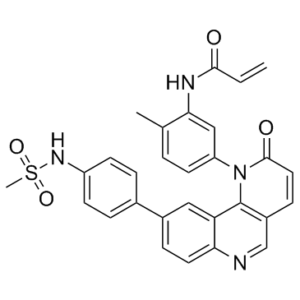
BMX-IN-1 is a novel, potent, selective and covalent / irreversible BMX (bone marrow tyrosine kinase on chromosome X) inhibitor with the potential for treating prostate cancer. BMX-IN-1 can covalently modifies Cys496. It is more than 47–656 times less potent against Blk, JAK3, EGFR, Itk, or Tec activity. It targets Cys496 in the BMX ATP binding domain with an IC50 of 8 nM.It also targets the related Bruton’s tyrosine kinase (BTK) with an IC50 value of 10.4 nM. At two-digit nanomolar concentrations, BMX-IN-1 suppresses the growth of Tel-BMX-transformed Ba/F3 cells, but only at single-digit micromolar concentrations can it suppress the growth of prostate cancer cell lines.
Physicochemical Properties
| Molecular Formula | C29H24N4O4S |
| Molecular Weight | 524.59 |
| Exact Mass | 524.151 |
| Elemental Analysis | C, 66.40; H, 4.61; N, 10.68; O, 12.20; S, 6.11 |
| CAS # | 1431525-23-3 |
| Related CAS # | 1431525-23-3 |
| PubChem CID | 71576693 |
| Appearance | White to yellow solid powder |
| Density | 1.4±0.1 g/cm3 |
| Index of Refraction | 1.708 |
| LogP | 3.52 |
| Hydrogen Bond Donor Count | 2 |
| Hydrogen Bond Acceptor Count | 6 |
| Rotatable Bond Count | 6 |
| Heavy Atom Count | 38 |
| Complexity | 1030 |
| Defined Atom Stereocenter Count | 0 |
| SMILES | O=C1N(C2=C(C=C1)C=NC3=CC=C(C4=CC=C(NS(=O)(C)=O)C=C4)C=C32)C5=CC=C(C)C(NC(C=C)=O)=C5 |
| InChi Key | SFMJNHNUOVADRW-UHFFFAOYSA-N |
| InChi Code | InChI=1S/C29H24N4O4S/c1-4-27(34)31-26-16-23(12-5-18(26)2)33-28(35)14-9-21-17-30-25-13-8-20(15-24(25)29(21)33)19-6-10-22(11-7-19)32-38(3,36)37/h4-17,32H,1H2,2-3H3,(H,31,34) |
| Chemical Name | N-[5-[9-[4-(methanesulfonamido)phenyl]-2-oxobenzo[h][1,6]naphthyridin-1-yl]-2-methylphenyl]prop-2-enamide |
| Synonyms | BMX-IN1; BMX-IN 1; BMX-IN-1 |
| HS Tariff Code | 2934.99.9001 |
| Storage |
Powder-20°C 3 years 4°C 2 years In solvent -80°C 6 months -20°C 1 month |
| Shipping Condition | Room temperature (This product is stable at ambient temperature for a few days during ordinary shipping and time spent in Customs) |
Biological Activity
| Targets |
BMX (IC50 = 8 nM); BTK (IC50 = 10.4 nM) BMX (IC₅₀ = 8.0 nM), BTK (IC₅₀ = 10.4 nM), BLK (IC₅₀ = 37.7 nM), JAK3 (IC₅₀ = 17.5 nM), EGFR(T790M) (IC₅₀ = 42.8 nM), ITK (IC₅₀ = 52 nM), TEC (IC₅₀ = 65.3 nM) |
| ln Vitro |
Tel-BMX-transformed Ba/F3 cells and RV-1 cells show IC50 values of 25 nM and 2.53 μM, respectively, when exposed to BMX-IN-1. BMX-IN-1, which has a S(10) value of 0.01 indicates considerable switching. With an IC50 of 138 nM, BMX-IN-1 single-inhibits wild-type BMX. For BMX-IN-1 to effectively inhibit BMX, Cys496 of BMX must be covalently regulated [1]. BMX-IN-1 inhibits proliferation of TEL-BMX-transformed Ba/F3 cells with an IC₅₀ of 25 nM, while showing no significant inhibition against TEL-JAK1, TEL-JAK2, TEL-JAK3, TEL-TYK2, or TEL-BLK transformed Ba/F3 cells (GI₅₀ > 4.9–93.6 μM). BMX-IN-1 inhibits proliferation of prostate cancer cell lines RV-1 (GI₅₀ = 2.54 μM), DU-145 (GI₅₀ = 4.38 μM), PC-3 (GI₅₀ = 5.37 μM), VCAP (GI₅₀ = 2.46 μM), and C4-2 (GI₅₀ > 10 μM). BMX-IN-1 induces apoptosis in RV-1 cells as assessed by Caspase 3 staining at 5 μM. BMX-IN-1 inhibits BMX autophosphorylation in RV-1 cells at 1 μM. BMX-IN-1 induces degradation of BMX protein in RV-1 cells stably expressing wild-type BMX but not C496S mutant BMX. The non-covalent analog BMX-IN-1R shows no antiproliferative activity against RV-1 cells or TEL-BMX Ba/F3 cells at concentrations below 10 μM. Combination of BMX-IN-1 with the allosteric Akt inhibitor MK2206 synergistically enhances antiproliferative and pro-apoptotic effects in RV-1 cells. |
| Enzyme Assay |
The kinase activity of recombinant BMX was measured using a Z′-Lyte assay. BMX-IN-1 was tested at various concentrations to determine IC₅₀ values. Selectivity profiling against 442 kinases was performed using the KinomeScan approach at 1 μM concentration, showing high selectivity (S(10) score = 0.01). SelectScreen technology was used to determine IC₅₀ values for kinases with a cysteine residue equivalent to Cys496 of BMX. |
| Cell Assay |
For five days, DMSO, BMX-IN-1 (2.5 μM), MK2206 (200 nM), or the combination of BMX-IN-1 and MK2206 are added to complete or serum-reduced DMEM-treated RV-1 cells. The cells are then harvested using trypsin and rinsed with cold PBS. Following an overnight prechilling at −20°C, the cells are fixed in 70% cold ethanol. Centrifugation is used to gather the cells on the day of flow cytometry. They are then washed with PBS, stained for 30 minutes at room temperature with 50 μg/mL propidium iodide + 0.5 mg/mL RNase in PBS + 0.5% Triton-X100, and stored at 4°C until the analysis is completed. At the Dana-Faber Cancer Institute's Flow Cytometry Core Facility, flow cytometry is carried out using a BD FACScan, and the results are analyzed using ModFit software. Proliferation assays were performed using murine Ba/F3 cells transformed with TEL fusions of various kinases. Cells were treated with BMX-IN-1 for 72 hours and viability was assessed. For prostate cancer cell lines, cells were treated with BMX-IN-1 for 72 hours under low serum conditions (1% FBS) and cell proliferation was measured. Apoptosis was assessed by Caspase 3 staining and flow cytometry using propidium iodide staining to analyze sub-G1 population. BMX autophosphorylation and protein levels were analyzed by immunoblotting after drug treatment. Protein degradation assay: RV-1 cells stably expressing wild-type or C496S BMX were treated with BMX-IN-1 or BMX-IN-1R for 4 hours, followed by cycloheximide chase for 16 or 24 hours. BMX protein levels were analyzed by immunoblotting. |
| References |
[1]. Discovery of a Selective Irreversible BMX Inhibitor for Prostate Cancer. ACS Chem. Biol., DOI: 10.1021/cb4000629. |
| Additional Infomation |
BMX-IN-1 is a covalent irreversible inhibitor targeting Cys496 of BMX. It also inhibits BTK, which is primarily expressed in B-cells, but this is not expected to interfere with its use as a BMX probe in epithelial cells. BMX-IN-1 induces degradation of BMX protein in addition to inhibiting its kinase activity. Combination with MK2206 enhances its antiproliferative effects in prostate cancer cells, suggesting potential for combination therapy. Ibrutinib also inhibits BMX but with broader kinase selectivity compared to BMX-IN-1. |
Solubility Data
| Solubility (In Vitro) |
DMF: ~10 mg/mL (~19.1 mM) DMSO: ~8.3 mg/mL (~15.9 mM) |
| Solubility (In Vivo) |
Note: Listed below are some common formulations that may be used to formulate products with low water solubility (e.g. < 1 mg/mL), you may test these formulations using a minute amount of products to avoid loss of samples. Injection Formulations (e.g. IP/IV/IM/SC) Injection Formulation 1: DMSO : Tween 80: Saline = 10 : 5 : 85 (i.e. 100 μL DMSO stock solution → 50 μL Tween 80 → 850 μL Saline) *Preparation of saline: Dissolve 0.9 g of sodium chloride in 100 mL ddH ₂ O to obtain a clear solution. Injection Formulation 2: DMSO : PEG300 :Tween 80 : Saline = 10 : 40 : 5 : 45 (i.e. 100 μL DMSO → 400 μLPEG300 → 50 μL Tween 80 → 450 μL Saline) Injection Formulation 3: DMSO : Corn oil = 10 : 90 (i.e. 100 μL DMSO → 900 μL Corn oil) Example: Take the Injection Formulation 3 (DMSO : Corn oil = 10 : 90) as an example, if 1 mL of 2.5 mg/mL working solution is to be prepared, you can take 100 μL 25 mg/mL DMSO stock solution and add to 900 μL corn oil, mix well to obtain a clear or suspension solution (2.5 mg/mL, ready for use in animals). Injection Formulation 4: DMSO : 20% SBE-β-CD in saline = 10 : 90 [i.e. 100 μL DMSO → 900 μL (20% SBE-β-CD in saline)] *Preparation of 20% SBE-β-CD in Saline (4°C,1 week): Dissolve 2 g SBE-β-CD in 10 mL saline to obtain a clear solution. Injection Formulation 5: 2-Hydroxypropyl-β-cyclodextrin : Saline = 50 : 50 (i.e. 500 μL 2-Hydroxypropyl-β-cyclodextrin → 500 μL Saline) Injection Formulation 6: DMSO : PEG300 : castor oil : Saline = 5 : 10 : 20 : 65 (i.e. 50 μL DMSO → 100 μLPEG300 → 200 μL castor oil → 650 μL Saline) Injection Formulation 7: Ethanol : Cremophor : Saline = 10: 10 : 80 (i.e. 100 μL Ethanol → 100 μL Cremophor → 800 μL Saline) Injection Formulation 8: Dissolve in Cremophor/Ethanol (50 : 50), then diluted by Saline Injection Formulation 9: EtOH : Corn oil = 10 : 90 (i.e. 100 μL EtOH → 900 μL Corn oil) Injection Formulation 10: EtOH : PEG300:Tween 80 : Saline = 10 : 40 : 5 : 45 (i.e. 100 μL EtOH → 400 μLPEG300 → 50 μL Tween 80 → 450 μL Saline) Oral Formulations Oral Formulation 1: Suspend in 0.5% CMC Na (carboxymethylcellulose sodium) Oral Formulation 2: Suspend in 0.5% Carboxymethyl cellulose Example: Take the Oral Formulation 1 (Suspend in 0.5% CMC Na) as an example, if 100 mL of 2.5 mg/mL working solution is to be prepared, you can first prepare 0.5% CMC Na solution by measuring 0.5 g CMC Na and dissolve it in 100 mL ddH2O to obtain a clear solution; then add 250 mg of the product to 100 mL 0.5% CMC Na solution, to make the suspension solution (2.5 mg/mL, ready for use in animals). Oral Formulation 3: Dissolved in PEG400 Oral Formulation 4: Suspend in 0.2% Carboxymethyl cellulose Oral Formulation 5: Dissolve in 0.25% Tween 80 and 0.5% Carboxymethyl cellulose Oral Formulation 6: Mixing with food powders Note: Please be aware that the above formulations are for reference only. InvivoChem strongly recommends customers to read literature methods/protocols carefully before determining which formulation you should use for in vivo studies, as different compounds have different solubility properties and have to be formulated differently. (Please use freshly prepared in vivo formulations for optimal results.) |
| Preparing Stock Solutions | 1 mg | 5 mg | 10 mg | |
| 1 mM | 1.9063 mL | 9.5313 mL | 19.0625 mL | |
| 5 mM | 0.3813 mL | 1.9063 mL | 3.8125 mL | |
| 10 mM | 0.1906 mL | 0.9531 mL | 1.9063 mL |