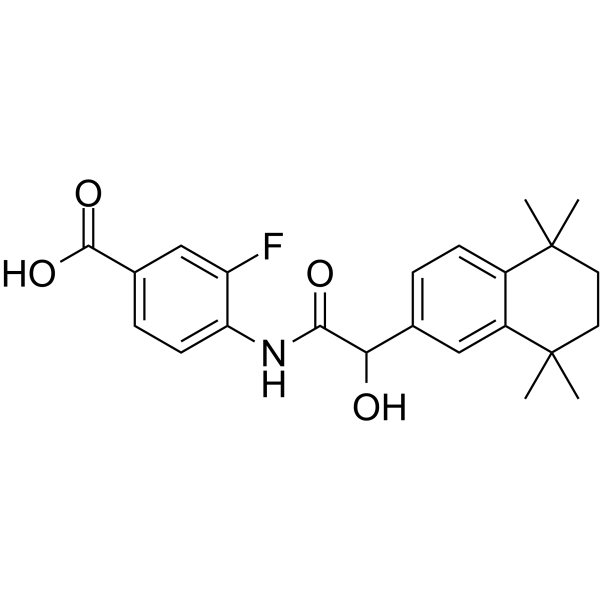
Physicochemical Properties
| Molecular Formula | C23H26FNO4 |
| Molecular Weight | 399.455250263214 |
| Exact Mass | 399.185 |
| Elemental Analysis | C, 69.16; H, 6.56; F, 4.76; N, 3.51; O, 16.02 |
| CAS # | 185629-22-5 |
| PubChem CID | 2418 |
| Appearance | White to off-white solid powder |
| LogP | 5.194 |
| Hydrogen Bond Donor Count | 3 |
| Hydrogen Bond Acceptor Count | 5 |
| Rotatable Bond Count | 4 |
| Heavy Atom Count | 29 |
| Complexity | 634 |
| Defined Atom Stereocenter Count | 0 |
| SMILES | FC1=C(NC(=O)C(O)C2C=CC3=C(C(C)(C)CCC3(C)C)C=2)C=CC(C(O)=O)=C1 |
| InChi Key | AANFHDFOMFRLLR-UHFFFAOYSA-N |
| InChi Code | InChI=1S/C23H26FNO4/c1-22(2)9-10-23(3,4)16-11-13(5-7-15(16)22)19(26)20(27)25-18-8-6-14(21(28)29)12-17(18)24/h5-8,11-12,19,26H,9-10H2,1-4H3,(H,25,27)(H,28,29) |
| Chemical Name | 3-fluoro-4-[[2-hydroxy-2-(5,5,8,8-tetramethyl-6,7-dihydronaphthalen-2-yl)acetyl]amino]benzoic acid |
| Synonyms | BMS 961; BMS-189961; 185629-22-5; BMS189961; BMS-961; 3-fluoro-4-[[2-hydroxy-2-(5,5,8,8-tetramethyl-6,7-dihydronaphthalen-2-yl)acetyl]amino]benzoic acid; BMS961; BMS 189961; 3-Fluoro-4-[[2-hydroxy-2-(5,5,8,8-tetramethyl-5,6,7,8,-tetrahydro-2-naphthalenyl)acetyl]amino]-benzoic acid; BENZOIC ACID, 3-FLUORO-4-[[(2R)-HYDROXY(5,6,7,8-TETRAHYDRO-5,5,8,8-TETRAMETHYL-2-NAPHTHALENYL)ACETYL]AMINO]-; |
| HS Tariff Code | 2934.99.9001 |
| Storage |
Powder-20°C 3 years 4°C 2 years In solvent -80°C 6 months -20°C 1 month |
| Shipping Condition | Room temperature (This product is stable at ambient temperature for a few days during ordinary shipping and time spent in Customs) |
Biological Activity
| Targets | RARγ/retinoic acid receptor-γ |
| ln Vitro |
Dectin-1 and pro-inflammatory cytokines are not expressed when BMS961 is present [1].The expression of RARγ was upregulated after stimulation with A. fumigatus. RARγ mRNA began to rise at 4h and peaked at 8h (P<0.001). The protein of RARγ reached to the peak at 16h (P<0.001). Pretreated with BMS961 before A. fumigatus hyphae stimulation, expression of Dectin-1, TNF-α and IL-6 decreased dramatically at mRNA and protein levels.
Conclusion: HCECs can express RARγ and A. fumigatus hyphae infection can increase RARγ expression. BMS961 can inhibit the expression of Dectin-1 and pro-inflammatory cytokines, and play an anti-inflammatory role in innate immune responses against A. fumigatus. BMS961 Modulates the Dectin-1 Expression Induced by Aspergillus fumigatus in Human Corneal Epithelial Cells [1] In order to know whether Dectin-1 expression are modulated in response to the activation of RARγ. HCECs were pretreated with or without BMS961 (1 µg/mL) for 30min, before incubated with hyphae for 8h. The mRNA and protein levels of Dectin-1 were measured by qRT-PCR and Western blot respectively. The mRNA expression of Dectin-1 were increased in HCECs after hyphae stimulation for 8h, but the levels were down-regulated by BMS961 pretreatment (P<0.001; Figure 2A). Similarly, compared with HCECs exposed to hyphae, the protein levels of Dectin-1 were also inhibited by BMS961 pretreatment (P<0.001; Figure 2B). BMS961 Pretreatment Inhibited Pro-inflammatory Cytokines Production Induced by Aspergillus fumigatus [1] To investigate whether RARγ can modulate the innate immune response to A. fumigatus in HCECs, HCECs were pretreated with BMS961 (1 µg/mL) for 30min, followed by hyphae for 8h or 16h. The mRNA and protein levels of TNF-α and IL-6 were measured by qRT-PCR and ELISA, respectively. Figure 3 showed that the expressions of TNF-α and IL-6 increased at 8h post-infection with A. fumigatus in HCECs compared with the control group. Agitated of RARγ by BMS961 suppressed the production of these cytokines compared with the infection group (P<0.01; Figure 3A). Meanwhile, the expressions of TNF-α and IL-6 in the supernatant were also down-regulated, which were consistent with the change of mRNA levels (P<0.01; Figure 3B). |
| Cell Assay |
Human Corneal Epithelial Cells Culture and Stimulation [1] HCECs were cultured and maintained in HCECs growth medium in a humidified 5% CO2 incubator at 37°C. HCECs growth medium contains 1:1 DMEM/HamF-12 supplemented with 5% fetal bovine serum (FBS), 10 ng/mL human epidermal growth factor (EGF), 5 mg/mL insulin, and 50 mg/mL penicillin and streptomycin. For stimulation, HCECs were treated with A. fumigatus hyphae (5×10⁷/mL) in different times. And HCECs pretreated with or without BMS961 (1 µg/mL) for 0.5h were stimulated by A. fumigatus hyphae. Total RNA, protein and supernatant were collected for qRT-PCR, Western blot and ELISA. BMS961 was dissolved in DMSO, preliminary experiments showed no obvious difference between the DMSO group and normal group. The HCECs were stimulated with A. fumigatus hyphae for 0, 2, 4, 8, 12 and 16h. RARγ mRNA and protein levels were tested by quantitative real-time polymerase chain reaction (qRT-PCR) and Western blot. Then HCECs were pretreated with or without BMS961 (RARγ agonist, 1 µg/mL). The mRNA and protein expression of Dectin-1 and the downstream cytokines (TNF-α and IL-6) were determined by qRT-PCR, Western blot and enzyme-linked immunosorbent assay (ELISA). |
| References |
[1]. Effects of retinoic acid receptor-γ on the Aspergillus fumigatus induced innate immunity response in human corneal epithelial cells. Int J Ophthalmol. 2016 Dec 18;9(12):1713-1718. |
| Additional Infomation |
BMS961 is a selective retinoic acid receptor gamma (RARgamma) agonist To further explore the influence of RARγ for immune response effect of A. fumigatus infection in corneal epithelial cells, we used the RARγ agonist BMS961 to observe the changes of Dectin-1 and pro-inflammatory cytokines. Interestingly, in our study, pretreatment with BMS961 led to an almost full abrogation of Dectin-1 mediated expression and secretion of TNF-α and IL-6 in HCECs. It would be interesting to investigate whether the higher impact of BMS961 observed in our study could be related to the nature of the immunological challenge. This is consistent with reports on other cell types that RARs signaling is critical for enhanced Raldh2 expression. Raldh2 suppresses pro-inflammatory cytokines in DCs via induction of Socs3, a well known regulatory of pro-inflammatory responses. In our previous study, Dectin-1 plays an important role in defending fungal infection. It can cause a series cellular responses, including respiratory burst, ligand endocytosis and phagocytosis, maturation of dendritic cells, generation of cytokine and chemokine (including TNF-α, IL-6, IL-10, IL-2, GM-CSF, G-CSF). Studies have shown that Dectin-1 was up-regulated in fungal infected corneas, and infected Dectin-1−/− corneas have diminished cellular infiltration and fungal clearance compared with control mice. Under these conditions, the modulatory effect of RARγ resembled the one observed in experiments performed with A. fumigatus. Our data provide evidence that RARγ had its ability to regulate Dectin-1 expression and activation and had the possible mechanism for the anti-inflammatory effect. Other mechanisms may contribute to the anti-inflammatory effect of RARγ, due to Manicassamy et al found that RA signaling attenuates activation of p38 MAPK. As we all know, corneal inflammatory reaction is like a double-edged sword. Appropriate inflammation will stimulate effective host defense responses and don't bring obvious tissue damage, while excessive inflammation will seriously destroy visual function. From the host's standpoint, a “balanced” response could ensure immune defense, without collateral damage caused by excessive inflammation. Therefore, proper inflammatory response is the key to removing fungi inflammation, once excessive, inflammation will seriously destroy visual function. In the early stage of the inflammatory response, it is necessary to increase the pro-inflammatory cytokines in order to initiate the inflammatory response. However, especially in the later stages of the inflammatory response, down-regulation of inflammation can reduce corneal tissue damage. When excessive inflammatory reaction occurs, timely appropriate use of immunosuppressive drugs can reduce the damage and the scar formation and can be beneficial to the future healed. In conclusion, RARγ played an indispensible role in FK to fight against corneal keratitis caused by A. fumigatus. This study opens up a new approach to explore the role of RARγ in fungal infections and shed light on further molecular mechanisms of its immunomodulatory function. This study also aroused awareness of the clinical importance of anti-fungal and admitted the need for a long-term study on the anti-fungal activity in cornea. Therefore, the ability of RARγ to inhibit Dectin-1 and pro-inflammatory cytokines expression and activation provides a novel therapeutic approach to managing cornea diseases in which Dectin-1-induced fungal inflammation contributes to tissue injury. The effects of RARγ can reduce the damage caused by pro-inflammatory cytokines and promote the ulcer healing.[1] |
Solubility Data
| Solubility (In Vitro) | May dissolve in DMSO (in most cases), if not, try other solvents such as H2O, Ethanol, or DMF with a minute amount of products to avoid loss of samples |
| Solubility (In Vivo) |
Note: Listed below are some common formulations that may be used to formulate products with low water solubility (e.g. < 1 mg/mL), you may test these formulations using a minute amount of products to avoid loss of samples. Injection Formulations (e.g. IP/IV/IM/SC) Injection Formulation 1: DMSO : Tween 80: Saline = 10 : 5 : 85 (i.e. 100 μL DMSO stock solution → 50 μL Tween 80 → 850 μL Saline) *Preparation of saline: Dissolve 0.9 g of sodium chloride in 100 mL ddH ₂ O to obtain a clear solution. Injection Formulation 2: DMSO : PEG300 :Tween 80 : Saline = 10 : 40 : 5 : 45 (i.e. 100 μL DMSO → 400 μLPEG300 → 50 μL Tween 80 → 450 μL Saline) Injection Formulation 3: DMSO : Corn oil = 10 : 90 (i.e. 100 μL DMSO → 900 μL Corn oil) Example: Take the Injection Formulation 3 (DMSO : Corn oil = 10 : 90) as an example, if 1 mL of 2.5 mg/mL working solution is to be prepared, you can take 100 μL 25 mg/mL DMSO stock solution and add to 900 μL corn oil, mix well to obtain a clear or suspension solution (2.5 mg/mL, ready for use in animals). Injection Formulation 4: DMSO : 20% SBE-β-CD in saline = 10 : 90 [i.e. 100 μL DMSO → 900 μL (20% SBE-β-CD in saline)] *Preparation of 20% SBE-β-CD in Saline (4°C,1 week): Dissolve 2 g SBE-β-CD in 10 mL saline to obtain a clear solution. Injection Formulation 5: 2-Hydroxypropyl-β-cyclodextrin : Saline = 50 : 50 (i.e. 500 μL 2-Hydroxypropyl-β-cyclodextrin → 500 μL Saline) Injection Formulation 6: DMSO : PEG300 : castor oil : Saline = 5 : 10 : 20 : 65 (i.e. 50 μL DMSO → 100 μLPEG300 → 200 μL castor oil → 650 μL Saline) Injection Formulation 7: Ethanol : Cremophor : Saline = 10: 10 : 80 (i.e. 100 μL Ethanol → 100 μL Cremophor → 800 μL Saline) Injection Formulation 8: Dissolve in Cremophor/Ethanol (50 : 50), then diluted by Saline Injection Formulation 9: EtOH : Corn oil = 10 : 90 (i.e. 100 μL EtOH → 900 μL Corn oil) Injection Formulation 10: EtOH : PEG300:Tween 80 : Saline = 10 : 40 : 5 : 45 (i.e. 100 μL EtOH → 400 μLPEG300 → 50 μL Tween 80 → 450 μL Saline) Oral Formulations Oral Formulation 1: Suspend in 0.5% CMC Na (carboxymethylcellulose sodium) Oral Formulation 2: Suspend in 0.5% Carboxymethyl cellulose Example: Take the Oral Formulation 1 (Suspend in 0.5% CMC Na) as an example, if 100 mL of 2.5 mg/mL working solution is to be prepared, you can first prepare 0.5% CMC Na solution by measuring 0.5 g CMC Na and dissolve it in 100 mL ddH2O to obtain a clear solution; then add 250 mg of the product to 100 mL 0.5% CMC Na solution, to make the suspension solution (2.5 mg/mL, ready for use in animals). Oral Formulation 3: Dissolved in PEG400 Oral Formulation 4: Suspend in 0.2% Carboxymethyl cellulose Oral Formulation 5: Dissolve in 0.25% Tween 80 and 0.5% Carboxymethyl cellulose Oral Formulation 6: Mixing with food powders Note: Please be aware that the above formulations are for reference only. InvivoChem strongly recommends customers to read literature methods/protocols carefully before determining which formulation you should use for in vivo studies, as different compounds have different solubility properties and have to be formulated differently. (Please use freshly prepared in vivo formulations for optimal results.) |
| Preparing Stock Solutions | 1 mg | 5 mg | 10 mg | |
| 1 mM | 2.5034 mL | 12.5169 mL | 25.0338 mL | |
| 5 mM | 0.5007 mL | 2.5034 mL | 5.0068 mL | |
| 10 mM | 0.2503 mL | 1.2517 mL | 2.5034 mL |