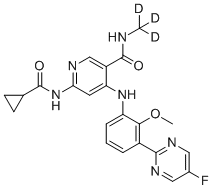
BMS-986202 (BMS986202), a tri-deuterated compound, is potent, selective Tyk2 inhibitor with the potential to be used for IL-23-driven acanthosis, anti-CD40-induced colitis, and spontaneous lupus. It acts by binding to Tyk2 JH2 domain with IC50 of 0.19 nM, Ki of 0.02 nM,and exhibits >10,000-fold over 273 kinases and pseudokinases.
Physicochemical Properties
| Molecular Formula | C22H21FN6O3 |
| Molecular Weight | 439.4574 |
| Exact Mass | 439.184 |
| CAS # | 1771691-34-9 |
| PubChem CID | 155981972 |
| Appearance | White to yellow solid powder |
| LogP | 2.2 |
| Hydrogen Bond Donor Count | 3 |
| Hydrogen Bond Acceptor Count | 8 |
| Rotatable Bond Count | 7 |
| Heavy Atom Count | 32 |
| Complexity | 658 |
| Defined Atom Stereocenter Count | 0 |
| SMILES | FC1C([H])=NC(C2C([H])=C([H])C([H])=C(C=2OC([H])([H])[H])N([H])C2C(C(N([H])C([2H])([2H])[2H])=O)=C([H])N=C(C=2[H])N([H])C(C2([H])C([H])([H])C2([H])[H])=O)=NC=1[H] |
| InChi Key | BBRMAVGRWHNAIG-FIBGUPNXSA-N |
| InChi Code | InChI=1S/C22H21FN6O3/c1-24-22(31)15-11-25-18(29-21(30)12-6-7-12)8-17(15)28-16-5-3-4-14(19(16)32-2)20-26-9-13(23)10-27-20/h3-5,8-12H,6-7H2,1-2H3,(H,24,31)(H2,25,28,29,30)/i1D3 |
| Chemical Name | 6-(cyclopropanecarboxamido)-4-((3-(5-fluoropyrimidin-2-yl)-2-methoxyphenyl)amino)-N-(methyl-d3)nicotinamide |
| Synonyms | BMS986202 BMS-986202 BMS 986202 |
| HS Tariff Code | 2934.99.9001 |
| Storage |
Powder-20°C 3 years 4°C 2 years In solvent -80°C 6 months -20°C 1 month |
| Shipping Condition | Room temperature (This product is stable at ambient temperature for a few days during ordinary shipping and time spent in Customs) |
Biological Activity
| ln Vitro | Drug compounds have included stable heavy isotopes of carbon, hydrogen, and other elements, mostly as tracers that influence measurement during the drug development process. It's possible that the pharmacokinetics and functional range of medications contribute to the concern over mutagenesis [1]. Potential benefits of compounds with delayed generation include: (1) compounds with delayed generation may be able to extend the compound's pharmacokinetic characteristics, which could extend the compound's safety, tolerability, and improved tolerance; and (2) compounds with delayed generation may expand intestinal bioavailability. Deuterated compounds may be able to lessen the amount of first-pass metabolism required in the colon and intestinal wall, which would enable a higher percentage of the medicine to reach high bioavailability levels, which dictate its efficacy at low doses and better tolerability. (3) Enhance the properties of metabolism. Drug safety, drug metabolism (4), and hazardous or reactive metabolite reduction are all potential benefits of metabolites. Deuterated chemicals are harmless and have the potential to lessen or completely eradicate the negative effects of medicinal drugs. (5) Preserve medicinal qualities. According to earlier research, deuterated chemicals should maintain comparable biological effects and efficacy to comparable hydrogen molecules. |
| ln Vivo | Treatment with BMS-986202 (Compound 7; 3-30 mg/kg; oral; daily; for 9 days) suppresses IL-23-driven acanthosis in mice [1]. Treatment with BMS-986202 (Compound 7; 0.4-10 mg/kg; oral) suppresses IL-12/IL-18-induced IFNγ production in mice. BMS-986202 dose-dependently suppresses IFNγ production by 46% and 80% at dosages of 2 mg/kg and 10 mg/kg, respectively [1]. BMS-986202 (Compound 7; 7-10 mg/kg; oral) is stable in liver microsomes with a half-life of longer than 120 minutes in mice, rats, monkeys, and humans, and a half-life of 89 minutes in dogs. Serum protein binding of BMS-986202 in these species ranges from 89.3% to 96.0%, leaving a good range of useable free fraction of the medication. The oral bioavailability of BMS-986202 is as high as 62-100%[1]. |
| Animal Protocol |
Animal/Disease Models: C57BL/6 female mice (9-11 weeks) were injected with IL-23[1]. Doses: 3 mg/kg, 10 mg/kg, 30 mg/kg. Route of Administration: oral administration; injection administration. Daily; lasted 9 days Experimental Results: Suppressed IL-23-induced ear swelling in mice with acanthosis in a dose-response manner. |
| References |
[1]. Discovery of BMS-986202: A Clinical Tyk2 Inhibitor that Binds to Tyk2 JH2. J Med Chem. 2021 Jan 14;64(1):677-694. |
Solubility Data
| Solubility (In Vitro) | DMSO : ~250 mg/mL (~568.88 mM) |
| Solubility (In Vivo) |
Solubility in Formulation 1: ≥ 2.08 mg/mL (4.73 mM) (saturation unknown) in 10% DMSO + 40% PEG300 + 5% Tween80 + 45% Saline (add these co-solvents sequentially from left to right, and one by one), clear solution. For example, if 1 mL of working solution is to be prepared, you can add 100 μL of 20.8 mg/mL clear DMSO stock solution to 400 μL PEG300 and mix evenly; then add 50 μL Tween-80 to the above solution and mix evenly; then add 450 μL normal saline to adjust the volume to 1 mL. Preparation of saline: Dissolve 0.9 g of sodium chloride in 100 mL ddH₂ O to obtain a clear solution. Solubility in Formulation 2: ≥ 2.08 mg/mL (4.73 mM) (saturation unknown) in 10% DMSO + 90% Corn Oil (add these co-solvents sequentially from left to right, and one by one), clear solution. For example, if 1 mL of working solution is to be prepared, you can add 100 μL of 20.8 mg/mL clear DMSO stock solution to 900 μL of corn oil and mix evenly. (Please use freshly prepared in vivo formulations for optimal results.) |
| Preparing Stock Solutions | 1 mg | 5 mg | 10 mg | |
| 1 mM | 2.2755 mL | 11.3776 mL | 22.7552 mL | |
| 5 mM | 0.4551 mL | 2.2755 mL | 4.5510 mL | |
| 10 mM | 0.2276 mL | 1.1378 mL | 2.2755 mL |