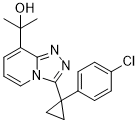
BMS-823778 is a novel, potent, orally bioavailable and selective inhibitor of 11-β-hydroxysteroid-dehydrogenase 1 (11βHSD-1). BMS-823778 is a potential therapeutic agent for type 2 diabetes mellitus (T2DM).
Physicochemical Properties
| Molecular Formula | C18H18CLN3O |
| Molecular Weight | 327.808022975922 |
| Exact Mass | 363.09 |
| CAS # | 1140898-87-8 |
| Related CAS # | 1140898-87-8 |
| PubChem CID | 54669979 |
| Appearance | Typically exists as solid at room temperature |
| Hydrogen Bond Donor Count | 2 |
| Hydrogen Bond Acceptor Count | 3 |
| Rotatable Bond Count | 3 |
| Heavy Atom Count | 24 |
| Complexity | 446 |
| Defined Atom Stereocenter Count | 0 |
| SMILES | ClC1C=CC(=CC=1)C1(C2=NN=C3C(=CC=CN23)C(C)(C)O)CC1 |
| InChi Key | PTIFVLOBVCIMKL-UHFFFAOYSA-N |
| InChi Code | InChI=1S/C18H18ClN3O/c1-17(2,23)14-4-3-11-22-15(14)20-21-16(22)18(9-10-18)12-5-7-13(19)8-6-12/h3-8,11,23H,9-10H2,1-2H3 SMILES |
| Chemical Name | 3-[1-(4-Chlorophenyl)cyclopropyl]-α,α-dimethyl-1,2,4-triazolo[4,3-a]pyridine-8-methanol |
| Synonyms | BMS-823778 BMS 823778 BMS823778 |
| HS Tariff Code | 2934.99.9001 |
| Storage |
Powder-20°C 3 years 4°C 2 years In solvent -80°C 6 months -20°C 1 month |
| Shipping Condition | Room temperature (This product is stable at ambient temperature for a few days during ordinary shipping and time spent in Customs) |
Biological Activity
| Targets |
Human 11β-hydroxysteroid dehydrogenase type 1 (11β-HSD-1) (IC₅₀ = 2.3 nM; Ki = 0.9 nM)[1] Mouse 11β-HSD-1 (IC₅₀ = 600 nM; Ki = 380 nM)[1] Cynomolgus monkey 11β-HSD-1 (Ki = 7 nM)[1] No inhibition of 11β-HSD-2 up to 30 µM (human) and 20 µM (mouse, rat, monkey)[1] |
| ln Vitro |
BMS-823778 inhibits human 11β-HSD-1 enzyme with an IC₅₀ of 2.3 nM and a Ki of 0.9 nM. It shows >10,000-fold selectivity over 11β-HSD-2. Mouse enzyme activity is weaker (IC₅₀ = 600 nM). Pregnane X receptor (PXR) transactivation is negligible (EC₅₀ > 50 µM). It exhibits excellent aqueous solubility.[1] Cytochrome P450 inhibition for CYP2C19 is present (IC₅₀ = 1.9 µM for compound 1, a predecessor.[1] |
| ln Vivo |
During diet-induced exercise (DIO), BMS-823778 (10-100 mg/kg; oral; once) hydrochloride shows strong acute pharmacodynamic effects (ED50=34 mg/kg) [1]. In cynomolgus monkeys, BMS-823778 shows robust acute pharmacodynamic effects with an ED₅₀ of 0.6 mg/kg in a dehydrocorticosterone (DHC) challenge assay.[1] In diet-induced obese (DIO) mice, the ED₅₀ is 34 mg/kg in the same DHC challenge assay.[1] In an ex vivo adipose DIO mouse model, the ED₅₀ for inhibition of 11β-HSD-1 in adipose tissue is 5.2 mg/kg.[1] |
| Enzyme Assay |
Human 11β-HSD-1 enzyme inhibition was assessed using a microsomal form of the enzyme at 37°C. The assay measures conversion of cortisone to cortisol (or DHC to corticosterone in rodents). Inhibition is quantified by IC₅₀ and Ki values using standard enzymatic kinetic analysis. Compound activity was tested in duplicate.[1] PXR transactivation assay was performed to assess off-target liability, with EC₅₀ values reported for activation.[1] |
| Animal Protocol |
Animal/Disease Models: Diet-induced obesity (DIO) mice [1] Doses: 10-100 mg/kg Route of Administration: po (po (oral gavage)) once Experimental Results: Inhibition of 11β-HSD-1 was observed as an indicator of diminished plasma corticosterone concentrations. ED50 is 34 mg/kg. Animal/Disease Models: Male Balb/C mouse[1] Doses: 5 or 10 mg/kg Route of Administration: IV or PO (pharmacokinetic/PK/PK analysis) Experimental Results: Single-dose pharmacokinetic/PK/PK parameters of BMS-823778[1] Species route dose (mg/kg) Cmax (μM) Tmax (h) AUC (0-24 h) (μM·h) T1/2 (h) CLTp (mL/min/kg) Vss (L/kg) F ( %) Mouse IV 5 - - 106 5.2 2.3 1.2 - PO 10 10.6 ± 1.3 3 95 - - - 44 PO Vehicle: 0.5% Methocel/0.1% Tween 80 IV Vehicle: 10% Ethanol/30% Propylene glycol/60% saline For pharmacodynamic assessment in mice and cynomolgus monkeys, BMS-823778 was administered orally prior to a challenge with dehydrocorticosterone (DHC). Plasma samples were collected at various time points, and corticosterone levels were measured by immunoassay to determine inhibition of 11β-HSD-1.[1] In the ex vivo adipose model, male DIO mice were treated orally with BMS-823778. Three hours later, adipose tissue was harvested and incubated with exogenous DHC to measure conversion to corticosterone.[1] |
| ADME/Pharmacokinetics |
Oral bioavailability ranges from 44% to 100% across preclinical species.[1] BMS-823778 exhibits a high adipose-to-plasma concentration ratio.[1] Systemic clearance is correlated with CYP2C19 genetic polymorphism in humans.[1] |
| References |
[1]. Discovery of Clinical Candidate BMS-823778 as an Inhibitor of Human 11β-Hydroxysteroid Dehydrogenase Type 1 (11β-HSD-1). ACS Med Chem Lett. 2018 Nov 13;9(12):1170-1174. |
| Additional Infomation |
BMS-823778 is a 1,2,4-triazolopyridinyl-methanol derived analog developed as an 11β-HSD-1 inhibitor for the treatment of type 2 diabetes and metabolic syndrome.[1] It entered Phase 2 clinical trials based on its favorable preclinical profile.[1] Preliminary clinical trials indicated that BMS-823778 is safe and well-tolerated in healthy subjects after single and multiple oral doses.[1] |
Solubility Data
| Solubility (In Vitro) | May dissolve in DMSO (in most cases), if not, try other solvents such as H2O, Ethanol, or DMF with a minute amount of products to avoid loss of samples |
| Solubility (In Vivo) |
Note: Listed below are some common formulations that may be used to formulate products with low water solubility (e.g. < 1 mg/mL), you may test these formulations using a minute amount of products to avoid loss of samples. Injection Formulations (e.g. IP/IV/IM/SC) Injection Formulation 1: DMSO : Tween 80: Saline = 10 : 5 : 85 (i.e. 100 μL DMSO stock solution → 50 μL Tween 80 → 850 μL Saline) *Preparation of saline: Dissolve 0.9 g of sodium chloride in 100 mL ddH ₂ O to obtain a clear solution. Injection Formulation 2: DMSO : PEG300 :Tween 80 : Saline = 10 : 40 : 5 : 45 (i.e. 100 μL DMSO → 400 μLPEG300 → 50 μL Tween 80 → 450 μL Saline) Injection Formulation 3: DMSO : Corn oil = 10 : 90 (i.e. 100 μL DMSO → 900 μL Corn oil) Example: Take the Injection Formulation 3 (DMSO : Corn oil = 10 : 90) as an example, if 1 mL of 2.5 mg/mL working solution is to be prepared, you can take 100 μL 25 mg/mL DMSO stock solution and add to 900 μL corn oil, mix well to obtain a clear or suspension solution (2.5 mg/mL, ready for use in animals). Injection Formulation 4: DMSO : 20% SBE-β-CD in saline = 10 : 90 [i.e. 100 μL DMSO → 900 μL (20% SBE-β-CD in saline)] *Preparation of 20% SBE-β-CD in Saline (4°C,1 week): Dissolve 2 g SBE-β-CD in 10 mL saline to obtain a clear solution. Injection Formulation 5: 2-Hydroxypropyl-β-cyclodextrin : Saline = 50 : 50 (i.e. 500 μL 2-Hydroxypropyl-β-cyclodextrin → 500 μL Saline) Injection Formulation 6: DMSO : PEG300 : castor oil : Saline = 5 : 10 : 20 : 65 (i.e. 50 μL DMSO → 100 μLPEG300 → 200 μL castor oil → 650 μL Saline) Injection Formulation 7: Ethanol : Cremophor : Saline = 10: 10 : 80 (i.e. 100 μL Ethanol → 100 μL Cremophor → 800 μL Saline) Injection Formulation 8: Dissolve in Cremophor/Ethanol (50 : 50), then diluted by Saline Injection Formulation 9: EtOH : Corn oil = 10 : 90 (i.e. 100 μL EtOH → 900 μL Corn oil) Injection Formulation 10: EtOH : PEG300:Tween 80 : Saline = 10 : 40 : 5 : 45 (i.e. 100 μL EtOH → 400 μLPEG300 → 50 μL Tween 80 → 450 μL Saline) Oral Formulations Oral Formulation 1: Suspend in 0.5% CMC Na (carboxymethylcellulose sodium) Oral Formulation 2: Suspend in 0.5% Carboxymethyl cellulose Example: Take the Oral Formulation 1 (Suspend in 0.5% CMC Na) as an example, if 100 mL of 2.5 mg/mL working solution is to be prepared, you can first prepare 0.5% CMC Na solution by measuring 0.5 g CMC Na and dissolve it in 100 mL ddH2O to obtain a clear solution; then add 250 mg of the product to 100 mL 0.5% CMC Na solution, to make the suspension solution (2.5 mg/mL, ready for use in animals). Oral Formulation 3: Dissolved in PEG400 Oral Formulation 4: Suspend in 0.2% Carboxymethyl cellulose Oral Formulation 5: Dissolve in 0.25% Tween 80 and 0.5% Carboxymethyl cellulose Oral Formulation 6: Mixing with food powders Note: Please be aware that the above formulations are for reference only. InvivoChem strongly recommends customers to read literature methods/protocols carefully before determining which formulation you should use for in vivo studies, as different compounds have different solubility properties and have to be formulated differently. (Please use freshly prepared in vivo formulations for optimal results.) |
| Preparing Stock Solutions | 1 mg | 5 mg | 10 mg | |
| 1 mM | 3.0505 mL | 15.2527 mL | 30.5055 mL | |
| 5 mM | 0.6101 mL | 3.0505 mL | 6.1011 mL | |
| 10 mM | 0.3051 mL | 1.5253 mL | 3.0505 mL |