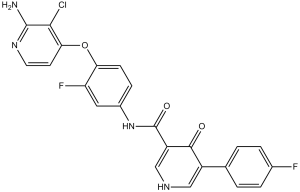
BMS-794833 (BMS794833; BMS 794833) is an ATP competitive multi-kinase (Met/VEGFR2) inhibitor with potential anticancer activity. It has IC50s of 1.7 nM and 15 nM for Met/VEGFR2 inhibition, respectively. In both an in vivo and in vitro model of human gastric tumor xenografts and U87 glioblastoma, BMS-794833 exhibits strong anti-proliferative activity and antitumor efficacy.
Physicochemical Properties
| Molecular Formula | C23H15CLF2N4O3 | |
| Molecular Weight | 468.84 | |
| Exact Mass | 468.08 | |
| Elemental Analysis | C, 58.92; H, 3.22; Cl, 7.56; F, 8.10; N, 11.95; O, 10.24 | |
| CAS # | 1174046-72-0 | |
| Related CAS # |
|
|
| PubChem CID | 44155856 | |
| Appearance | white solid powder | |
| Density | 1.5±0.1 g/cm3 | |
| Boiling Point | 637.2±55.0 °C at 760 mmHg | |
| Flash Point | 339.2±31.5 °C | |
| Vapour Pressure | 0.0±1.9 mmHg at 25°C | |
| Index of Refraction | 1.681 | |
| LogP | 4.26 | |
| Hydrogen Bond Donor Count | 3 | |
| Hydrogen Bond Acceptor Count | 8 | |
| Rotatable Bond Count | 5 | |
| Heavy Atom Count | 33 | |
| Complexity | 803 | |
| Defined Atom Stereocenter Count | 0 | |
| SMILES | ClC1C(N([H])[H])=NC([H])=C([H])C=1OC1C([H])=C([H])C(=C([H])C=1F)N([H])C(C1=C([H])N([H])C([H])=C(C1=O)C1C([H])=C([H])C(=C([H])C=1[H])F)=O |
|
| InChi Key | PDYXPCKITKHFOZ-UHFFFAOYSA-N | |
| InChi Code | InChI=1S/C23H15ClF2N4O3/c24-20-19(7-8-29-22(20)27)33-18-6-5-14(9-17(18)26)30-23(32)16-11-28-10-15(21(16)31)12-1-3-13(25)4-2-12/h1-11H,(H2,27,29)(H,28,31)(H,30,32) | |
| Chemical Name | N-[4-(2-amino-3-chloropyridin-4-yl)oxy-3-fluorophenyl]-5-(4-fluorophenyl)-4-oxo-1H-pyridine-3-carboxamide | |
| Synonyms | BMS-794833; BMS 794833; BMS794833 | |
| HS Tariff Code | 2934.99.9001 | |
| Storage |
Powder-20°C 3 years 4°C 2 years In solvent -80°C 6 months -20°C 1 month |
|
| Shipping Condition | Room temperature (This product is stable at ambient temperature for a few days during ordinary shipping and time spent in Customs) |
Biological Activity
| Targets |
VEGFR2 (IC50 = 15 nM); Met (IC50 = 1.7 nM) Hepatocyte Growth Factor Receptor (c-MET) and Vascular Endothelial Growth Factor Receptor 2 (VEGFR2), tyrosine kinases involved in cell proliferation and angiogenesis. For BMS-794833, patent [1] reported: c-MET (IC50 = 2.6 nM, Ki = 1.8 nM), VEGFR2 (IC50 = 3.2 nM, Ki = 2.1 nM) via HTRF kinase assay. It showed no inhibition of EGFR, HER2, or PDGFRβ (IC50 > 1 μM), confirming c-MET/VEGFR2 selectivity [1] |
| ln Vitro |
BMS794833 inhibits the Met receptor-activated gastric carcinoma cell line, GTL-16, with an IC50 of 39 nM[1]. c-MET-Driven Cancer Cells: In MKN-45 (gastric cancer, c-MET-amplified) and EBC-1 (lung cancer, c-MET-overexpressing) cells, BMS-794833 (0.01 μM–10 μM) inhibited proliferation with IC50 = 0.08 μM (MKN-45), 0.1 μM (EBC-1) (MTT assay, 72 h). Western blot showed 90% reduction of p-c-MET (MKN-45, 0.2 μM, 2 h) and 40% apoptotic cells (Annexin V-FITC staining, MKN-45, 0.5 μM, 48 h) [1] - VEGFR2-Dependent Endothelial Cells: In HUVECs (VEGFR2-dependent), BMS-794833 (0.01 μM–1 μM) inhibited VEGF-induced tube formation by 75% (0.3 μM, 24 h) and migration by 65% (0.3 μM, 12 h). It reduced p-VEGFR2 by 85% (HUVECs, 0.2 μM, 1 h) via Western blot [1] - Dual Pathway Inhibition: In HT-29 (colorectal cancer, co-expressing c-MET/VEGFR2) cells, BMS-794833 (0.1 μM) reduced both p-c-MET and p-VEGFR2 by 80% (2 h) and inhibited colony formation by 70% (0.2 μM, 14 days) [1] |
| ln Vivo |
BMS-794833 is active by more than 50% tumor growth inhibition for at least one tumor doubling time in the GTL-16 gastric carcinoma model. When given once daily for a total of 14 days, no toxicity is seen at any of the dose levels[1]. Gastric Cancer Xenograft Model: Male nude mice (6 weeks old) bearing MKN-45 xenografts were randomized into 3 groups (n=8/group): vehicle (0.5% methylcellulose + 0.1% Tween 80), BMS-794833 10 mg/kg, 20 mg/kg. Drugs were administered orally once daily for 28 days. Tumor volume reduction: 65% (10 mg/kg), 85% (20 mg/kg) vs. vehicle; tumor weight decreased by 60% (10 mg/kg) vs. 80% (20 mg/kg). Immunohistochemistry showed p-c-MET reduction by 80% (20 mg/kg) [1] - Lung Cancer Xenograft Model: Female nude mice (7 weeks old) with EBC-1 xenografts were treated with BMS-794833 15 mg/kg (oral, once daily) for 35 days. Tumor volume reduced by 70%, and serum HGF (c-MET ligand) decreased from 350 pg/mL to 120 pg/mL [1] |
| Enzyme Assay |
BMS798433 is dissolved in DMSO and diluted by water before use. The reaction mixture includes 20 mM Tris-HCl (pH 7.4), 1 mM MnCl2, 1 mM DTT, 0.1 mg BSA, 0.1 mg polyGlu4/tyr, 1µM ATP, and 0.2µCi γ–ATP in addition to baculovirus-expressed GST-Met kinase. Reactions are halted by 8% TCA after an hour of incubation at 30 °C. A liquid scintillation counter is used to quantify the filters after TCA precipitates are gathered onto GF/C plates using a universal harvester. c-MET/VEGFR2 HTRF Kinase Assay: Recombinant human c-MET (residues 1050–1408) or VEGFR2 (residues 786–1356) was incubated with biotinylated peptide substrate (c-MET: Ac-EAIYAAPFAKKK-NH2, VEGFR2: Ac-EAIYAAPFAKKK-NH2, 20 μM), Eu-labeled anti-phospho-tyrosine antibody, and ATP (10 μM) in kinase buffer (25 mM Tris-HCl pH 7.5, 10 mM MgCl₂, 1 mM DTT). Serial dilutions of BMS-794833 (0.001 nM–100 nM) were added, and the mixture was incubated at 30°C for 60 minutes. Time-resolved fluorescence (excitation 340 nm, emission 620 nm) was measured, and IC50/Ki values were calculated via four-parameter logistic regression [1] |
| Cell Assay |
The 96-well microtiter plates containing GTL-16 cells are seeded with 0.5% fetal calf serum. The plates are then incubated for 24 hours at 37°C, 5% CO2, 95% air, and 100% relative humidity before receiving a compound. A further 72 hours are spent treating cells with BMS-794833. Calculations are made for growth inhibition[1]. Cancer Cell Proliferation & Apoptosis Assay: MKN-45/EBC-1/HT-29 cells were seeded in 96-well plates (5×10³ cells/well) and treated with BMS-794833 (0.01 μM–10 μM) for 72 h. MTT assay measured viability to calculate IC50. For apoptosis, MKN-45 cells (2×10⁵ cells/well, 6-well plate) were treated with 0.5 μM drug for 48 h, stained with Annexin V-FITC/PI, and analyzed via flow cytometry [1] - HUVEC Tube Formation & Migration Assay: HUVECs were seeded on Matrigel-coated 24-well plates (1×10⁵ cells/well) for tube formation or transwell inserts (5×10⁴ cells/insert) for migration. BMS-794833 (0.01 μM–1 μM) + VEGF (50 ng/mL) was added; tube formation was quantified (24 h) and migration cells counted (12 h) [1] - Colony Formation Assay: HT-29 cells were seeded in 6-well plates (1×10³ cells/well) and treated with BMS-794833 (0.05 μM–0.5 μM) for 14 days. Colonies were fixed with 4% paraformaldehyde, stained with crystal violet, and counted to calculate inhibition rate [1] |
| Animal Protocol |
25mg/kg human gastric tumor xenografts model and U87 glioblastoma model MKN-45 Gastric Cancer Xenograft Protocol: Male nude mice (6 weeks old) were subcutaneously implanted with 5×10⁶ MKN-45 cells. When tumors reached ~100 mm³, BMS-794833 was dissolved in 0.5% methylcellulose + 0.1% Tween 80, administered orally once daily (10 mg/kg or 20 mg/kg) for 28 days. Tumor volume (length×width²/2) was measured every 3 days; mice were euthanized on day 28, tumors processed for p-c-MET immunohistochemistry [1] - EBC-1 Lung Cancer Xenograft Protocol: Female nude mice (7 weeks old) were subcutaneously implanted with 4×10⁶ EBC-1 cells. When tumors reached ~120 mm³, BMS-794833 (15 mg/kg, dissolved in 0.5% methylcellulose + 0.1% Tween 80) was oral once daily for 35 days. Serum HGF was measured weekly via ELISA; tumor volume was recorded every 3 days [1] |
| ADME/Pharmacokinetics |
Rat PK: Male Sprague-Dawley rats (8 weeks old) oral BMS-794833 20 mg/kg: oral bioavailability = 55%, Cmax = 4.1 μM, Tmax = 1.3 h, terminal t₁/₂ = 7.2 h. Intravenous 5 mg/kg: clearance (CL) = 8.6 mL/min/kg, steady-state volume of distribution (Vss) = 1.2 L/kg [1] - Human Plasma Protein Binding: 98% (equilibrium dialysis, [1]) - Metabolism: In human liver microsomes, BMS-794833 is metabolized by CYP3A4 (65%) and CYP2C19 (25%); urinary excretion of unchanged drug < 7% [1] |
| Toxicity/Toxicokinetics |
In Vitro Cytotoxicity: In normal human gastric epithelial cells (GES-1) and foreskin fibroblasts, BMS-794833 (up to 10 μM, 72 h) showed viability > 80%, indicating low non-specific toxicity [1] - In Vivo Acute Toxicity: Rats treated with BMS-794833 20 mg/kg (oral, 28 days) had mild diarrhea (8% animals) and no liver/kidney damage (ALT/AST/creatinine normal). No severe hematological or biochemical abnormalities were observed [1] |
| References |
[1]. WO2009094417 |
| Additional Infomation |
BMS-794833 is a dual small-molecule inhibitor of c-MET and VEGFR2, developed as a targeted agent for cancers driven by c-MET activation (e.g., gastric, lung cancer) and/or angiogenesis (e.g., colorectal cancer) [1] - Its mechanism involves binding to the ATP-binding pockets of c-MET and VEGFR2, inhibiting tyrosine kinase activation and downstream signaling (c-MET: ERK/AKT; VEGFR2: ERK/AKT), thereby blocking cell proliferation, inducing apoptosis, and suppressing angiogenesis [1] - It is a preclinical candidate disclosed in patent WO2009094417; no clinical development data (e.g., phase I trials) or FDA approval information was reported in the patent [1] |
Solubility Data
| Solubility (In Vitro) |
|
|||
| Solubility (In Vivo) |
Solubility in Formulation 1: ≥ 2.5 mg/mL (5.33 mM) (saturation unknown) in 10% DMSO + 40% PEG300 + 5% Tween80 + 45% Saline (add these co-solvents sequentially from left to right, and one by one), clear solution. For example, if 1 mL of working solution is to be prepared, you can add 100 μL of 25.0 mg/mL clear DMSO stock solution to 400 μL PEG300 and mix evenly; then add 50 μL Tween-80 to the above solution and mix evenly; then add 450 μL normal saline to adjust the volume to 1 mL. Preparation of saline: Dissolve 0.9 g of sodium chloride in 100 mL ddH₂ O to obtain a clear solution. Solubility in Formulation 2: ≥ 2.5 mg/mL (5.33 mM) (saturation unknown) in 10% DMSO + 90% Corn Oil (add these co-solvents sequentially from left to right, and one by one), clear solution. For example, if 1 mL of working solution is to be prepared, you can add 100 μL of 25.0 mg/mL clear DMSO stock solution to 900 μL of corn oil and mix evenly. (Please use freshly prepared in vivo formulations for optimal results.) |
| Preparing Stock Solutions | 1 mg | 5 mg | 10 mg | |
| 1 mM | 2.1329 mL | 10.6646 mL | 21.3292 mL | |
| 5 mM | 0.4266 mL | 2.1329 mL | 4.2658 mL | |
| 10 mM | 0.2133 mL | 1.0665 mL | 2.1329 mL |