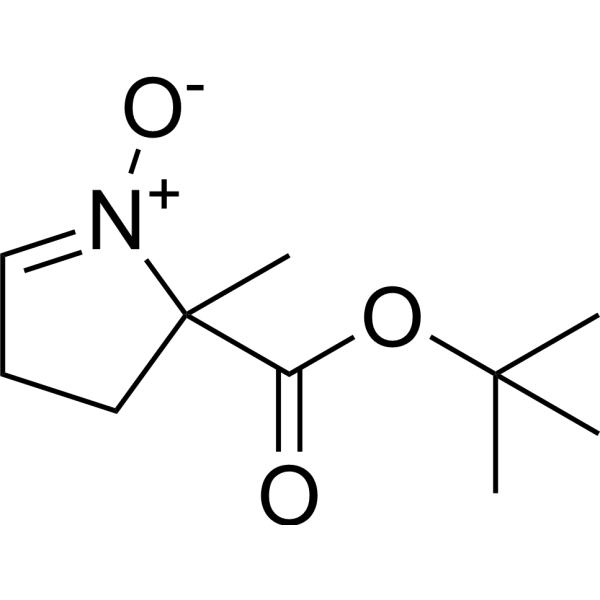
Physicochemical Properties
| Molecular Formula | C10H17NO3 |
| Molecular Weight | 199.246883153915 |
| Exact Mass | 199.12 |
| CAS # | 387334-31-8 |
| PubChem CID | 11241066 |
| Appearance | Off-white to light yellow solid powder |
| Density | 1.1±0.1 g/cm3 |
| Boiling Point | 339.8±35.0 °C at 760 mmHg |
| Melting Point | 90-91 °C |
| Flash Point | 151.5±27.9 °C |
| Vapour Pressure | 0.0±0.7 mmHg at 25°C |
| Index of Refraction | 1.484 |
| LogP | 0.4 |
| Hydrogen Bond Donor Count | 0 |
| Hydrogen Bond Acceptor Count | 3 |
| Rotatable Bond Count | 3 |
| Heavy Atom Count | 14 |
| Complexity | 278 |
| Defined Atom Stereocenter Count | 0 |
| SMILES | O(C(C)(C)C)C(C1(C)CCC=[N+]1[O-])=O |
| InChi Key | MDMUYJRRYYXDLZ-UHFFFAOYSA-N |
| InChi Code | InChI=1S/C10H17NO3/c1-9(2,3)14-8(12)10(4)6-5-7-11(10)13/h7H,5-6H2,1-4H3 |
| Chemical Name | tert-butyl 2-methyl-1-oxido-3,4-dihydropyrrol-1-ium-2-carboxylate |
| HS Tariff Code | 2934.99.9001 |
| Storage |
Powder-20°C 3 years 4°C 2 years In solvent -80°C 6 months -20°C 1 month Note: Please store this product in a sealed and protected environment (e.g. under nitrogen), avoid exposure to moisture and light. |
| Shipping Condition | Room temperature (This product is stable at ambient temperature for a few days during ordinary shipping and time spent in Customs) |
Biological Activity
| ln Vitro | By capturing •OH and GS•, BMPO can create more long-lasting BMPO/•OH and BMPO/•SG adducts. Additionally, in biological systems, the electron spin resonance (ESR) spectra of adducts produced from BMPO show a good signal-to-noise ratio. For instance, the hydroxyl adduct of BMPO glutathione adduct (BMPO/·SG) and its ESR spectrum do not entirely coincide. BMPO is perfect for the detection of superoxide anions, hydroxyl, and sulfide radicals due to its good chemical and spectroscopic qualities. [1] Two cell viability estimations were used to quantify the possible harmful effects of spin trap BMPO (trypan blue exclusion and colony formation). [3] In CHO cells, BMPO at 2.5 or 25 mM had no discernible impact on cell viability. Nonetheless, it led to a notable rise in the quantity of cells that were incapable of excluding 50 mM BMPO trypan blue. At a 25 mM dose, BMPO dramatically decreased colony formation in CHO cells by 30%. Additionally, at 50 mM, BMPO entirely blocked the formation of colonies in 9L tumor cells. [3] also evaluated the rate at which CHO cells consumed oxygen, and BMPO (25 mM) considerably decreased this rate. [3] |
| References |
[1]. Synthesis and biochemical applications of a solid cyclic nitrone spin trap: a relatively superior trap for detecting superoxide anions and glutathiyl radicals. Free Radic Biol Med. [2]. Detection and characterization of the product of hydroethidine and intracellular superoxide by HPLC and limitations of fluorescence. Proc Natl Acad Sci U S A. [3]. Spin traps: in vitro toxicity and stability of radical adducts. Free Radic Biol Med. 2003 Jun 1;34(11):1473-81. |
Solubility Data
| Solubility (In Vitro) | DMSO : ~100 mg/mL (~501.88 mM) |
| Solubility (In Vivo) |
Solubility in Formulation 1: ≥ 2.5 mg/mL (12.55 mM) (saturation unknown) in 10% DMSO + 40% PEG300 + 5% Tween80 + 45% Saline (add these co-solvents sequentially from left to right, and one by one), clear solution. For example, if 1 mL of working solution is to be prepared, you can add 100 μL of 25.0 mg/mL clear DMSO stock solution to 400 μL PEG300 and mix evenly; then add 50 μL Tween-80 to the above solution and mix evenly; then add 450 μL normal saline to adjust the volume to 1 mL. Preparation of saline: Dissolve 0.9 g of sodium chloride in 100 mL ddH₂ O to obtain a clear solution. Solubility in Formulation 2: 2.5 mg/mL (12.55 mM) in 10% DMSO + 90% (20% SBE-β-CD in Saline) (add these co-solvents sequentially from left to right, and one by one), clear solution; with ultrasonication. For example, if 1 mL of working solution is to be prepared, you can add 100 μL of 25.0 mg/mL clear DMSO stock solution to 900 μL of 20% SBE-β-CD physiological saline solution and mix evenly. Preparation of 20% SBE-β-CD in Saline (4°C,1 week): Dissolve 2 g SBE-β-CD in 10 mL saline to obtain a clear solution. Solubility in Formulation 3: ≥ 2.5 mg/mL (12.55 mM) (saturation unknown) in 10% DMSO + 90% Corn Oil (add these co-solvents sequentially from left to right, and one by one), clear solution. For example, if 1 mL of working solution is to be prepared, you can add 100 μL of 25.0 mg/mL clear DMSO stock solution to 900 μL of corn oil and mix evenly. (Please use freshly prepared in vivo formulations for optimal results.) |
| Preparing Stock Solutions | 1 mg | 5 mg | 10 mg | |
| 1 mM | 5.0188 mL | 25.0941 mL | 50.1882 mL | |
| 5 mM | 1.0038 mL | 5.0188 mL | 10.0376 mL | |
| 10 mM | 0.5019 mL | 2.5094 mL | 5.0188 mL |