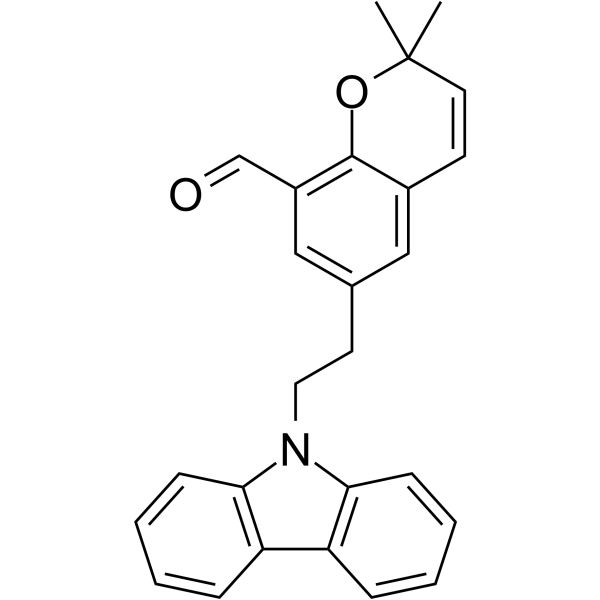
Physicochemical Properties
| Molecular Formula | C26H23NO2 |
| Molecular Weight | 381.4663 |
| Exact Mass | 381.172 |
| CAS # | 1564249-38-2 |
| PubChem CID | 85471521 |
| Appearance | White to off-white solid powder |
| LogP | 5.6 |
| Hydrogen Bond Donor Count | 0 |
| Hydrogen Bond Acceptor Count | 2 |
| Rotatable Bond Count | 4 |
| Heavy Atom Count | 29 |
| Complexity | 606 |
| Defined Atom Stereocenter Count | 0 |
| SMILES | O1C2C(C([H])=O)=C([H])C(=C([H])C=2C([H])=C([H])C1(C([H])([H])[H])C([H])([H])[H])C([H])([H])C([H])([H])N1C2=C([H])C([H])=C([H])C([H])=C2C2=C([H])C([H])=C([H])C([H])=C12 |
| InChi Key | QLDDENZBVHBRKN-UHFFFAOYSA-N |
| InChi Code | InChI=1S/C26H23NO2/c1-26(2)13-11-19-15-18(16-20(17-28)25(19)29-26)12-14-27-23-9-5-3-7-21(23)22-8-4-6-10-24(22)27/h3-11,13,15-17H,12,14H2,1-2H3 |
| Chemical Name | 6-(2-carbazol-9-ylethyl)-2,2-dimethylchromene-8-carbaldehyde |
| HS Tariff Code | 2934.99.9001 |
| Storage |
Powder-20°C 3 years 4°C 2 years In solvent -80°C 6 months -20°C 1 month |
| Shipping Condition | Room temperature (This product is stable at ambient temperature for a few days during ordinary shipping and time spent in Customs) |
Biological Activity
| ln Vitro | BJE6-106 (B106) (0.2 μM, 0.5 μM; 24-72 hours) reduces cell survival in melanoma cell lines carrying NRAS mutations [1]. BJE6-106 (B106) (0.2 μM, 0.5 μM; 6-24 hours) causes caspase-dependent apoptosis and enhances caspase 3/7 activity. The effect of B106 is stronger than that of Rottlerin (10-fold) in SBcl2 cells [1]. BJE6-106 (B106) (0.5 μM; 2-10 hours) triggers the MKK4-JNK-H2AX pathway by triggering MKK4, JNK and H2AX activation at separate periods in SBcl2 cells [1]. |
| Cell Assay |
Cell Viability Assay[1] Cell Types: Melanoma cell lines with NRAS mutations: SBcl2, FM6, SKMEL2, WM1366, WM1361A, and WM852 Cell Tested Concentrations: 0.2 μM, 0.5 μM Incubation Duration: 24 hrs (hours), 48 hrs (hours), or 72 hrs (hours) Experimental Results: Inhibition of cell survival in melanoma cell lines. Apoptosis analysis[1] Cell Types: SBcl2 Cell Tested Concentrations: 0.2 μM, 0.5 μM Incubation Duration: 6 hrs (hours), 12 hrs (hours) or 24 hrs (hours) Experimental Results: Induction of caspase 3/7 activation. Western Blot Analysis[1] Cell Types: SBcl2 Cell Tested Concentrations: 0.2 μM, 0.5 μM Incubation Duration: 2 hrs (hours), 5 hrs (hours), 10 hrs (hours) Experimental Results: Increased phosphorylation of MKK4, JNK and H2AX. |
| References |
[1]. Protein kinase Cδ is a therapeutic target in malignant melanoma with NRAS mutation. ACS Chem Biol. 2014 Apr 18;9(4):1003-14. |
Solubility Data
| Solubility (In Vitro) | DMSO : ~50 mg/mL (~131.07 mM) |
| Solubility (In Vivo) |
Solubility in Formulation 1: 2.5 mg/mL (6.55 mM) in 10% DMSO + 90% (20% SBE-β-CD in Saline) (add these co-solvents sequentially from left to right, and one by one), suspension solution; with sonication. For example, if 1 mL of working solution is to be prepared, you can add 100 μL of 25.0 mg/mL clear DMSO stock solution to 900 μL of 20% SBE-β-CD physiological saline solution and mix evenly. Preparation of 20% SBE-β-CD in Saline (4°C,1 week): Dissolve 2 g SBE-β-CD in 10 mL saline to obtain a clear solution. Solubility in Formulation 2: ≥ 2.5 mg/mL (6.55 mM) (saturation unknown) in 10% DMSO + 90% Corn Oil (add these co-solvents sequentially from left to right, and one by one), clear solution. For example, if 1 mL of working solution is to be prepared, you can add 100 μL of 25.0 mg/mL clear DMSO stock solution to 900 μL of corn oil and mix evenly. (Please use freshly prepared in vivo formulations for optimal results.) |
| Preparing Stock Solutions | 1 mg | 5 mg | 10 mg | |
| 1 mM | 2.6214 mL | 13.1072 mL | 26.2144 mL | |
| 5 mM | 0.5243 mL | 2.6214 mL | 5.2429 mL | |
| 10 mM | 0.2621 mL | 1.3107 mL | 2.6214 mL |