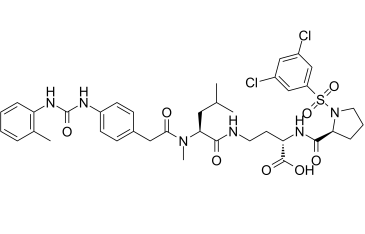
BIO-5192 is a novel, potent α4β1 VLA-4 inhibitor with Kd<10 pM. It selectively binds to α4β1 (IC50=1.8 nM) over a range of other integrins. BIO5192 hydrate results in a 30-fold increase in mobilization of murine hematopoietic stem and progenitors (HSPCs) over basal levels. BIO-5192 has been shown to increase mobilization of murine hematopoietic stem and progenitors (HSPCs) over basal levels. An additive affect on HSPC mobilization (3-fold) was observed when plerixafor (AMD3100), a small molecule inhibitor of the CXCR-4/SDF-1 axis, was combined with BIO5192. HSPCs mobilized by BIO5192 or the combination of BIO5192 and plerixafor has been shown to mobilize long-term repopulating cells, which successfully engraft and expand in a multilineage fashion in secondary transplantation recipients.
Physicochemical Properties
| Exact Mass | 816.247 |
| CAS # | 327613-57-0 |
| Related CAS # | BIO5192 hydrate |
| PubChem CID | 10350459 |
| Appearance | White to off-white solid powder |
| Density | 1.4±0.1 g/cm3 |
| Index of Refraction | 1.625 |
| LogP | 5.1 |
| Hydrogen Bond Donor Count | 5 |
| Hydrogen Bond Acceptor Count | 9 |
| Rotatable Bond Count | 16 |
| Heavy Atom Count | 55 |
| Complexity | 1430 |
| Defined Atom Stereocenter Count | 3 |
| SMILES | CC1=CC=CC=C1NC(=O)NC2=CC=C(C=C2)CC(=O)N(C)C(CC(C)C)C(=O)NCCC(C(=O)O)NC(=O)C3CCCN3S(=O)(=O)C4=CC(=CC(=C4)Cl)Cl |
| InChi Key | MNQBPRHHZPXCKZ-ZDCRTTOTSA-N |
| InChi Code | 1S/C38H46Cl2N6O8S/c1-23(2)18-33(45(4)34(47)19-25-11-13-28(14-12-25)42-38(52)44-30-9-6-5-8-24(30)3)35(48)41-16-15-31(37(50)51)43-36(49)32-10-7-17-46(32)55(53,54)29-21-26(39)20-27(40)22-29/h5-6,8-9,11-14,20-23,31-33H,7,10,15-19H2,1-4H3,(H,41,48)(H,43,49)(H,50,51)(H2,42,44,52)/t31-,32-,33-/m0/s1 |
| Chemical Name | Butanoic acid, 1-((3,5-dichlorophenyl)sulfonyl)-L-prolyl-N4-(N-methyl-N-((4-((((2-methylphenyl)amino)carbonyl)amino)phenyl)acetyl)-L-leucyl)-2,4-diamino-, (2S)- |
| Synonyms | BIO-5192 AMD-15057BIO5192 AMD15057BIO 5192 AMD 15057 |
| HS Tariff Code | 2934.99.9001 |
| Storage |
Powder-20°C 3 years 4°C 2 years In solvent -80°C 6 months -20°C 1 month |
| Shipping Condition | Room temperature (This product is stable at ambient temperature for a few days during ordinary shipping and time spent in Customs) |
Biological Activity
| ln Vivo | The combination of BIO5192 (1 mg/kg; intravenously) and Plerixafor (5 mg/kg; subcutaneously) produces additive effects on progenitor cell mobilization [1]. BIO5192 (30 mg/kg; subcutaneous; bid; days 5 to 14) delays paralysis associated with EAE (experimental autoimmune encephalomyelitis) [2]. BIO5192 (1 mg/kg, intravenously) showed a terminal half-life of 1.1 hours. The half-lives of BIO5192 (3, 10 and 30 mg/kg; subcutaneous) are 1.7, 2.7 and 4.7 hours, respectively. Plasma curves showed an approximately 2.5-fold increase in AUC for the subcutaneous route, from 5,460 h*ng/ml at the 3 mg/kg dose to 14,175 h*ng/ml at the 30 mg/kg dose [1]. |
| Animal Protocol |
Animal/Disease Models: C57BL/6J x 129Sv/J F1 mice [1] Doses: 1 mg/kg (with plerixafor: 5 mg/kg) Route of Administration: intravenous (iv) (iv)injection Experimental Results: Additive effect on progenitor cell mobilization. Animal/Disease Models: Healthy female Lewis rats, body weight 150g [2] Doses: 30 mg/kg Route of Administration: Sc; Bid; Days 5 to 14 Experimental Results: demonstrated a 3-day delay in disease onset. |
| References |
[1]. BIO5192, a small molecule inhibitor of VLA-4, mobilizes hematopoietic stem and progenitor cells. Blood. 2009;114(7):1340‐1343. [2]. An assessment of the mechanistic differences between two integrin alpha 4 beta 1 inhibitors, the monoclonal antibody TA-2 and the small molecule BIO5192, in rat experimental autoimmune encephalomyelitis. J Pharmacol Exp Ther. 2003;305(3):. |
Solubility Data
| Solubility (In Vitro) | DMSO : ~12.5 mg/mL (~15.29 mM) |
| Solubility (In Vivo) |
Solubility in Formulation 1: ≥ 1.25 mg/mL (1.53 mM) (saturation unknown) in 10% DMSO + 40% PEG300 + 5% Tween80 + 45% Saline (add these co-solvents sequentially from left to right, and one by one), clear solution. For example, if 1 mL of working solution is to be prepared, you can add 100 μL of 12.5 mg/mL clear DMSO stock solution to 400 μL PEG300 and mix evenly; then add 50 μL Tween-80 to the above solution and mix evenly; then add 450 μL normal saline to adjust the volume to 1 mL. Preparation of saline: Dissolve 0.9 g of sodium chloride in 100 mL ddH₂ O to obtain a clear solution. Solubility in Formulation 2: ≥ 1.25 mg/mL (1.53 mM) (saturation unknown) in 10% DMSO + 90% Corn Oil (add these co-solvents sequentially from left to right, and one by one), clear solution. For example, if 1 mL of working solution is to be prepared, you can add 100 μL of 12.5 mg/mL clear DMSO stock solution to 900 μL of corn oil and mix evenly. (Please use freshly prepared in vivo formulations for optimal results.) |