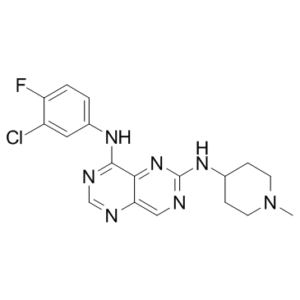
Falnidamol (formerly known as BIBX 1382) is a potent and selective inhibitor EGFR inhibitor with IC50 of 3 nM and potential anticancer activities; it displays > 1000-fold lower potency against ErbB2 (IC50 = 3.4 μM) and a range of other related tyrosine kinases (IC50 > 10 μM). BIBX1382 and BIBU1361 are both potent and selective submicromolar inhibitors of the EGFR kinase activity. An IC50 value of 3 nM was determined for both compounds. The potency of these two compounds compares with the one obtained with Iressa, which is a leading EGFR inhibitor in the field. Inhibition of the closest family member, HER2, was 100- to 1000-fold less potent. Furthermore, BIBX1382 and BIBU1361 did not inhibit a number of other related tyrosine kinases.
Physicochemical Properties
| Molecular Formula | C18H19CLFN7 | |
| Molecular Weight | 387.84 | |
| Exact Mass | 387.137 | |
| CAS # | 196612-93-8 | |
| Related CAS # |
|
|
| PubChem CID | 6918508 | |
| Appearance | Light yellow to khaki solid powder | |
| Boiling Point | 594ºC at 760mmHg | |
| Flash Point | 313.1ºC | |
| Vapour Pressure | 3.15E-12mmHg at 25°C | |
| Index of Refraction | 1.7 | |
| LogP | 5.149 | |
| Hydrogen Bond Donor Count | 2 | |
| Hydrogen Bond Acceptor Count | 8 | |
| Rotatable Bond Count | 4 | |
| Heavy Atom Count | 27 | |
| Complexity | 479 | |
| Defined Atom Stereocenter Count | 0 | |
| InChi Key | FTFRZXFNZVCRSK-UHFFFAOYSA-N | |
| InChi Code | InChI=1S/C18H19ClFN7/c1-27-6-4-11(5-7-27)25-18-21-9-15-16(26-18)17(23-10-22-15)24-12-2-3-14(20)13(19)8-12/h2-3,8-11H,4-7H2,1H3,(H,21,25,26)(H,22,23,24) | |
| Chemical Name | 4-N-(3-chloro-4-fluorophenyl)-6-N-(1-methylpiperidin-4-yl)pyrimido[5,4-d]pyrimidine-4,6-diamine | |
| Synonyms |
|
|
| HS Tariff Code | 2934.99.9001 | |
| Storage |
Powder-20°C 3 years 4°C 2 years In solvent -80°C 6 months -20°C 1 month |
|
| Shipping Condition | Room temperature (This product is stable at ambient temperature for a few days during ordinary shipping and time spent in Customs) |
Biological Activity
| ln Vitro | Falnidamol (BIBX 1382) exhibits antiproliferative activity in KB cell mitogenic assays[2]. |
| ln Vivo | After two weeks of treatment, falnidamol (BIBX 1382; po; 10 mg/kg/day; 16 days) totally inhibited the growth of tumors in human A431 xenografts, with a corresponding T/C value of 15%[2]. In mice bearing A431 xenografts, falnidamol (50 mg/kg/day) causes the EGF receptor to become dephosphorylated[2]. The C4h and C24h of falnidamol (po; 10 mg/kg/day; 16 days) are 2222 and 244 nM, respectively [2]. |
| Animal Protocol |
Animal/Disease Models: Five- to sixweeks old athymic NMRI-nu/nu female mice (21-31 g) with A431, FaDu, or HN5 cells[2] Doses: 10 mg/kg Route of Administration: po; daily; 16 days Experimental Results: Completely suppressed tumor growth of human A431 xenografts with respective T/C values of 15 and 6% after 2 weeks of treatment. Animal/Disease Models: Five- to sixweeks old athymic NMRI-nu/nu female mice (21–31 g) with A431 cells[2] Doses: 10 mg/kg (pharmacokinetic/PK Analysis) Route of Administration: po; daily; 16 days Experimental Results: The C4h is 2222 nM and the C24h is 244 nM. |
| References |
[1]. Phase I and pharmacokinetic study of BIBX 1382 BS, an epidermal growth factor receptor (EGFR) inhibitor, given in a continuous daily oral administration. Eur J Cancer. 2002 May;38(8):1072-80. [2]. Inhibition of epidermal growth factor receptor activity by two pyrimidopyrimidine derivatives. J Pharmacol Exp Ther. 2004 Nov;311(2):502-9. |
| Additional Infomation |
N4-(3-chloro-4-fluorophenyl)-N6-(1-methyl-4-piperidinyl)pyrimido[5,4-d]pyrimidine-4,6-diamine is a substituted aniline. Falnidamol has been used in trials studying the treatment of Unspecified Adult Solid Tumor, Protocol Specific. Falnidamol is a pyrimido-pyrimidine with antitumor activity. BIBX 1382 inhibits the intracellular tyrosine kinase domain of the Epidermal Growth Factor Receptor (EGFR) thus specifically reversing the aberrant enzymatic activity from overexpressed and constitutively activated EGFR, and subsequently inhibiting cell proliferation and inducing cell differentiation. |
Solubility Data
| Solubility (In Vitro) |
|
|||
| Solubility (In Vivo) |
Solubility in Formulation 1: ≥ 1.67 mg/mL (4.31 mM) (saturation unknown) in 10% DMSO + 40% PEG300 +5% Tween-80 + 45% Saline (add these co-solvents sequentially from left to right, and one by one), clear solution. For example, if 1 mL of working solution is to be prepared, you can add 100 μL of 16.7 mg/mL clear DMSO stock solution to 400 μL PEG300 and mix evenly; then add 50 μL Tween-80 + to the above solution and mix evenly; then add 450 μL normal saline to adjust the volume to 1 mL. Preparation of saline: Dissolve 0.9 g of sodium chloride in 100 mL ddH₂ O to obtain a clear solution. (Please use freshly prepared in vivo formulations for optimal results.) |
| Preparing Stock Solutions | 1 mg | 5 mg | 10 mg | |
| 1 mM | 2.5784 mL | 12.8919 mL | 25.7838 mL | |
| 5 mM | 0.5157 mL | 2.5784 mL | 5.1568 mL | |
| 10 mM | 0.2578 mL | 1.2892 mL | 2.5784 mL |