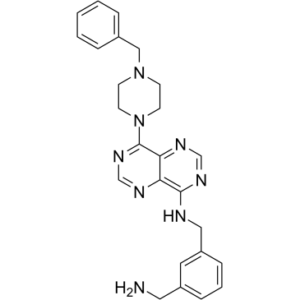
BI8626 is a novel, potent and specific inhibitor of the ubiquitin ligase HUWE1 with an IC50 of 0.9 μM. Deregulated expression of MYC is a driver of colorectal carcinogenesis, necessitating novel strategies to inhibit MYC function. The ubiquitin ligase HUWE1 (HECTH9, ARF-BP1, MULE) associates with both MYC and the MYC-associated protein MIZ1.
Physicochemical Properties
| Molecular Formula | C25H28N8 |
| Molecular Weight | 440.543423652649 |
| Exact Mass | 440.243 |
| CAS # | 1875036-75-1 |
| PubChem CID | 138377589 |
| Appearance | Light yellow to yellow solid powder |
| LogP | 2.3 |
| Hydrogen Bond Donor Count | 2 |
| Hydrogen Bond Acceptor Count | 8 |
| Rotatable Bond Count | 7 |
| Heavy Atom Count | 33 |
| Complexity | 577 |
| Defined Atom Stereocenter Count | 0 |
| SMILES | N1(CC2C=CC=CC=2)CCN(C2C3C(=C(N=CN=3)NCC3C=CC=C(CN)C=3)N=CN=2)CC1 |
| InChi Key | DZDNGSNKWIORRZ-UHFFFAOYSA-N |
| InChi Code | InChI=1S/C25H28N8/c26-14-20-7-4-8-21(13-20)15-27-24-22-23(29-17-30-24)25(31-18-28-22)33-11-9-32(10-12-33)16-19-5-2-1-3-6-19/h1-8,13,17-18H,9-12,14-16,26H2,(H,27,29,30) |
| Chemical Name | N-(3-(Aminomethyl)benzyl)-8-(4-benzylpiperazin-1-yl)pyrimido[5,4-d]pyrimidin-4-amine |
| Synonyms | BI8626; BI 8626; BI-8626 |
| HS Tariff Code | 2934.99.9001 |
| Storage |
Powder-20°C 3 years 4°C 2 years In solvent -80°C 6 months -20°C 1 month |
| Shipping Condition | Room temperature (This product is stable at ambient temperature for a few days during ordinary shipping and time spent in Customs) |
Biological Activity
| ln Vitro | In HeLa cells, BI8626 stimulates HUWE1 ectopic expression to remove MCL1 ubiquitination [1]. BI8626 has an IC50 value of 0.7 μM, which inhibits the development of Ls174T cell colonies. All phases of the cell cycle are delayed in LS174T cells by BI8622 (1-4 days) treatment, with the G1 phase being most affected [1]. In U2OS cells, BI8626 (0-50 μM; 0–6 hours) postpones MCL1 degradation in response to fast depletion to a degree similar to HUWE1 depletion. |
| Cell Assay |
Cell Cycle Analysis [1] Cell Types: Ls174T Cell Tested Concentrations: 0 μM, 5 μM, 10 μM, 15 μM, 20 μM Incubation Duration: 0-4 days Experimental Results: Ls174T cells passed all stages with delayed passage. cell cycle, among which G1 has the strongest influence. Western Blot Analysis[1] Cell Types: U2OS Cell Tested Concentrations: 0 μM, 20 μM, 50 μM Incubation Duration: 0 hrs (hours), 1 hour, 2 hrs (hours), 4 hrs (hours), 6 hrs (hours) Experimental Results: Delayed degradation of MCL1 due to UV irradiation Acts in HeLa cells by inhibiting HUWE1 in U2OS cells. |
| References |
[1]. Tumor cell-specific inhibition of MYC function using small molecule inhibitors of the HUWE1 ubiquitin ligase.EMBO Mol Med. 2014 Dec;6(12):1525-41. |
Solubility Data
| Solubility (In Vitro) | DMSO : ~83.33 mg/mL (~189.15 mM) |
| Solubility (In Vivo) |
Solubility in Formulation 1: ≥ 2.08 mg/mL (4.72 mM) (saturation unknown) in 10% DMSO + 40% PEG300 + 5% Tween80 + 45% Saline (add these co-solvents sequentially from left to right, and one by one), clear solution. For example, if 1 mL of working solution is to be prepared, you can add 100 μL of 20.8 mg/mL clear DMSO stock solution to 400 μL PEG300 and mix evenly; then add 50 μL Tween-80 to the above solution and mix evenly; then add 450 μL normal saline to adjust the volume to 1 mL. Preparation of saline: Dissolve 0.9 g of sodium chloride in 100 mL ddH₂ O to obtain a clear solution. Solubility in Formulation 2: ≥ 2.08 mg/mL (4.72 mM) (saturation unknown) in 10% DMSO + 90% Corn Oil (add these co-solvents sequentially from left to right, and one by one), clear solution. For example, if 1 mL of working solution is to be prepared, you can add 100 μL of 20.8 mg/mL clear DMSO stock solution to 900 μL of corn oil and mix evenly. (Please use freshly prepared in vivo formulations for optimal results.) |
| Preparing Stock Solutions | 1 mg | 5 mg | 10 mg | |
| 1 mM | 2.2699 mL | 11.3497 mL | 22.6994 mL | |
| 5 mM | 0.4540 mL | 2.2699 mL | 4.5399 mL | |
| 10 mM | 0.2270 mL | 1.1350 mL | 2.2699 mL |