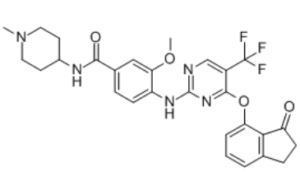
BI-4464 is a novel, potent and highly selective ATP competitive inhibitor of PTK2/FAK with an IC50 of 17 nM. It is a PTK2 ligand that PROTAC uses. Human hepatocellular carcinoma (HCC) frequently has elevated levels of focal adhesion tyrosine kinase (PTK2), and a number of studies have found a correlation between decreased tumorigenicity and PTK2 depletion or pharmacological inhibition. It is still unclear, though, whether targeting PTK2 has any clinical value. This chimera targets PTK2 proteolysis with great selectivity and functionality. It does this by using von Hippel-Lindau and cereblon ligands to hijack E3 ligases and cause PTK2 degradation. Across a panel of 11 HCC cell lines, BI-3663 (cereblon-based) degrades PTK2 with a median DC50 of 30 nM to >80%. These compounds did not phenocopy the reported antiproliferative effects of PTK2 depletion in any of the tested cell lines, despite effective PTK2 degradation.
Physicochemical Properties
| Molecular Formula | C28H28F3N5O4 |
| Molecular Weight | 555.548236846924 |
| Exact Mass | 555.21 |
| Elemental Analysis | C, 60.54; H, 5.08; F, 10.26; N, 12.61; O, 11.52 |
| CAS # | 1227948-02-8 |
| Related CAS # | 1227948-02-8;BI4464 HCl; |
| PubChem CID | 58522530 |
| Appearance | Light yellow to yellow solid powder |
| LogP | 4.4 |
| Hydrogen Bond Donor Count | 2 |
| Hydrogen Bond Acceptor Count | 11 |
| Rotatable Bond Count | 7 |
| Heavy Atom Count | 40 |
| Complexity | 887 |
| Defined Atom Stereocenter Count | 0 |
| InChi Key | QUSSZSMDFABHLI-UHFFFAOYSA-N |
| InChi Code | InChI=1S/C28H28F3N5O4/c1-36-12-10-18(11-13-36)33-25(38)17-6-8-20(23(14-17)39-2)34-27-32-15-19(28(29,30)31)26(35-27)40-22-5-3-4-16-7-9-21(37)24(16)22/h3-6,8,14-15,18H,7,9-13H2,1-2H3,(H,33,38)(H,32,34,35) |
| Chemical Name | 3-methoxy-N-(1-methylpiperidin-4-yl)-4-[[4-[(3-oxo-1,2-dihydroinden-4-yl)oxy]-5-(trifluoromethyl)pyrimidin-2-yl]amino]benzamide |
| Synonyms | BI-4464; ;BI 4464; BI4464 |
| HS Tariff Code | 2934.99.9001 |
| Storage |
Powder-20°C 3 years 4°C 2 years In solvent -80°C 6 months -20°C 1 month Note: Please store this product in a sealed and protected environment, avoid exposure to moisture. |
| Shipping Condition | Room temperature (This product is stable at ambient temperature for a few days during ordinary shipping and time spent in Customs) |
Biological Activity
| Targets |
PTK2/FAK (IC50 = 17 nM) PTK2 (Focal Adhesion Kinase, FAK) (IC₅₀ = 17 nM) [1] |
| ln Vitro |
BI-4464 is a close analogue of the clinical candidate BI-853520 and serves as the PTK2-targeting ligand for PROTAC molecules in this study. It was reported to be a highly selective ATP-competitive inhibitor of PTK2. [1] - In a panel of 397 kinases, BI-4464 showed exquisite selectivity, inhibiting only 2 kinases by more than 90% at 1 µM concentration. [1] - The compound inhibited PTK2 autophosphorylation in cancer cell lines and blocked anchorage-independent proliferation with single-digit nanomolar potency. In contrast, cells grown in conventional 2D culture were about 1,000-fold less sensitive. [1] - In proliferation assays across a panel of eleven hepatocellular carcinoma (HCC) cell lines, BI-4464 showed pIC₅₀ values ranging from approximately 5.1 to 5.5 (IC₅₀ ~ 8-32 µM) under standard 2D culture conditions. The antiproliferative effect was comparable to that achieved by the PROTACs BI-3663 and BI-0319, which degrade PTK2. [1] |
| Enzyme Assay |
A kinase inhibition assay (SelectScreen Kinase Profiling Service, Z’-Lyte) was used to determine the biochemical potency of BI-4464 against PTK2, yielding a pIC₅₀ of 7.8 ± 0.1 (IC₅₀ = 17 nM). The assay measures inhibition of kinase activity at ATP concentrations equal to the Km. [1] |
| Cell Assay |
PTK2 Degradation Assay: Although BI-4464 itself is not a degrader, its effect on PTK2 protein levels was tested as a control. A549 cells were treated with BI-4464 for 18 hours at concentrations up to 10,000 nM. PTK2 levels were determined by protein capillary electrophoresis (Wes system) and normalized to GAPDH. BI-4464 did not affect PTK2 protein levels, confirming that degradation required the PROTAC format. [1] - Proliferation Assay: Cells (e.g., HCC lines) were seeded in 96-well plates (1000 cells/well for adherent lines, 2500 cells/well for suspension lines) in growth medium and allowed to attach overnight. A baseline luminescence reading was taken using CellTiter-Glo reagent. BI-4464 was added in a logarithmic dose series via a digital dispenser, with DMSO concentration normalized. Cells were incubated for six days, after which viability was measured again using CellTiter-Glo. Antiproliferative activity (pIC₅₀) was calculated from the dose-response curves. [1] - Anchorage-Independent Growth Assay: Cells were seeded in a top layer of 0.3% agarose in culture medium over a bottom layer of 1.2% agarose in 96-well plates. After solidification, medium was overlaid, and BI-4464 was added. Cultures grew for 7-14 days, were stained with alamar blue, and fluorescence was measured (544 nm ex / 590 nm em). [1] |
| References |
[1]. Highly Selective PTK2 Proteolysis Targeting Chimeras to Probe Focal Adhesion Kinase Scaffolding Functions. J Med Chem. 2019 Mar 14;62(5):2508-2520. |
| Additional Infomation |
BI-4464 is a 2-aminophenyl-4-phenoxypyrimidine derivative and a close analogue of BI-853520, a PTK2 inhibitor that has entered clinical trials. [1] - It was selected as the PTK2-targeting ligand for PROTAC development due to its high binding affinity and exceptional kinase selectivity profile. [1] - The crystal structure of BI-4464 bound to the PTK2 kinase domain (PDB: 618Z) was solved, revealing key hydrogen bonds to Cys502 in the hinge region and Asp564. The N-methylpiperidine group was solvent-exposed and used as the linker attachment point for PROTAC design. [1] - The study concluded that despite potent PTK2 inhibition by BI-4464 (and degradation by the derived PROTACs), no significant anti-proliferative advantage over kinase inhibition was observed in the tested HCC cell lines under standard 2D or anchorage-independent conditions, questioning the essential role of PTK2's scaffolding function for in vitro proliferation in these models. [1] |
Solubility Data
| Solubility (In Vitro) |
DMSO: ~25 mg/mL (~45.0 mM) Ethanol: ~13 mg/mL (~23.4 mM) |
| Solubility (In Vivo) |
Note: Listed below are some common formulations that may be used to formulate products with low water solubility (e.g. < 1 mg/mL), you may test these formulations using a minute amount of products to avoid loss of samples. Injection Formulations (e.g. IP/IV/IM/SC) Injection Formulation 1: DMSO : Tween 80: Saline = 10 : 5 : 85 (i.e. 100 μL DMSO stock solution → 50 μL Tween 80 → 850 μL Saline) *Preparation of saline: Dissolve 0.9 g of sodium chloride in 100 mL ddH ₂ O to obtain a clear solution. Injection Formulation 2: DMSO : PEG300 :Tween 80 : Saline = 10 : 40 : 5 : 45 (i.e. 100 μL DMSO → 400 μLPEG300 → 50 μL Tween 80 → 450 μL Saline) Injection Formulation 3: DMSO : Corn oil = 10 : 90 (i.e. 100 μL DMSO → 900 μL Corn oil) Example: Take the Injection Formulation 3 (DMSO : Corn oil = 10 : 90) as an example, if 1 mL of 2.5 mg/mL working solution is to be prepared, you can take 100 μL 25 mg/mL DMSO stock solution and add to 900 μL corn oil, mix well to obtain a clear or suspension solution (2.5 mg/mL, ready for use in animals). Injection Formulation 4: DMSO : 20% SBE-β-CD in saline = 10 : 90 [i.e. 100 μL DMSO → 900 μL (20% SBE-β-CD in saline)] *Preparation of 20% SBE-β-CD in Saline (4°C,1 week): Dissolve 2 g SBE-β-CD in 10 mL saline to obtain a clear solution. Injection Formulation 5: 2-Hydroxypropyl-β-cyclodextrin : Saline = 50 : 50 (i.e. 500 μL 2-Hydroxypropyl-β-cyclodextrin → 500 μL Saline) Injection Formulation 6: DMSO : PEG300 : castor oil : Saline = 5 : 10 : 20 : 65 (i.e. 50 μL DMSO → 100 μLPEG300 → 200 μL castor oil → 650 μL Saline) Injection Formulation 7: Ethanol : Cremophor : Saline = 10: 10 : 80 (i.e. 100 μL Ethanol → 100 μL Cremophor → 800 μL Saline) Injection Formulation 8: Dissolve in Cremophor/Ethanol (50 : 50), then diluted by Saline Injection Formulation 9: EtOH : Corn oil = 10 : 90 (i.e. 100 μL EtOH → 900 μL Corn oil) Injection Formulation 10: EtOH : PEG300:Tween 80 : Saline = 10 : 40 : 5 : 45 (i.e. 100 μL EtOH → 400 μLPEG300 → 50 μL Tween 80 → 450 μL Saline) Oral Formulations Oral Formulation 1: Suspend in 0.5% CMC Na (carboxymethylcellulose sodium) Oral Formulation 2: Suspend in 0.5% Carboxymethyl cellulose Example: Take the Oral Formulation 1 (Suspend in 0.5% CMC Na) as an example, if 100 mL of 2.5 mg/mL working solution is to be prepared, you can first prepare 0.5% CMC Na solution by measuring 0.5 g CMC Na and dissolve it in 100 mL ddH2O to obtain a clear solution; then add 250 mg of the product to 100 mL 0.5% CMC Na solution, to make the suspension solution (2.5 mg/mL, ready for use in animals). Oral Formulation 3: Dissolved in PEG400 Oral Formulation 4: Suspend in 0.2% Carboxymethyl cellulose Oral Formulation 5: Dissolve in 0.25% Tween 80 and 0.5% Carboxymethyl cellulose Oral Formulation 6: Mixing with food powders Note: Please be aware that the above formulations are for reference only. InvivoChem strongly recommends customers to read literature methods/protocols carefully before determining which formulation you should use for in vivo studies, as different compounds have different solubility properties and have to be formulated differently. (Please use freshly prepared in vivo formulations for optimal results.) |
| Preparing Stock Solutions | 1 mg | 5 mg | 10 mg | |
| 1 mM | 1.8000 mL | 9.0001 mL | 18.0002 mL | |
| 5 mM | 0.3600 mL | 1.8000 mL | 3.6000 mL | |
| 10 mM | 0.1800 mL | 0.9000 mL | 1.8000 mL |