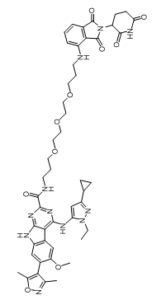
BETd-246 is a novel, potent and second-generation BET bromodomain (BRD) degrader which exhibits superior selectivity, potency and antitumor activity. Triple-negative breast cancers (TNBC) remain clinically challenging with a lack of options for targeted therapy. In human TNBC cells, BETd-246 induced degradation of BET proteins at low nanomolar concentrations within 1 hour of exposure, resulting in robust growth inhibition and apoptosis. BETd-246 was more potent and effective in TNBC cells than its parental BET inhibitor compound BETi-211. RNA-seq analysis revealed predominant downregulation of a large number of genes involved in proliferation and apoptosis in cells treated with BETd-246, as compared with BETi-211 treatment that upregulated and downregulated a similar number of genes. Functional investigations identified the MCL1 gene as a critical downstream effector for BET degraders, which synergized with small-molecule inhibitors of BCL-xL in triggering apoptosis. In multiple murine xenograft models of human breast cancer, BETd-246 and a further optimized analogue BETd-260 effectively depleted BET proteins in tumors and exhibited strong antitumor activities at well-tolerated dosing schedules. Overall, these findings show that targeting BET proteins for degradation represents an effective therapeutic strategy for TNBC treatment.
Physicochemical Properties
| Molecular Formula | C48H55N11O10 |
| Molecular Weight | 946.018010377884 |
| Exact Mass | 945.413 |
| CAS # | 2140289-17-2 |
| PubChem CID | 131698640 |
| Appearance | Light yellow to yellow solid powder |
| LogP | 4.6 |
| Hydrogen Bond Donor Count | 5 |
| Hydrogen Bond Acceptor Count | 16 |
| Rotatable Bond Count | 23 |
| Heavy Atom Count | 69 |
| Complexity | 1800 |
| Defined Atom Stereocenter Count | 0 |
| SMILES | O(C)C1C(C2C(C)=NOC=2C)=CC2=C(C=1)C1=C(N=C(C(NCCCOCCOCCOCCCNC3=CC=CC4C(N(C(C=43)=O)C3C(NC(CC3)=O)=O)=O)=O)N=C1NC1=CC(C3CC3)=NN1CC)N2 |
| InChi Key | XEJMFVWHCPNMRS-UHFFFAOYSA-N |
| InChi Code | InChI=1S/C48H55N11O10/c1-5-58-37(25-33(56-58)28-11-12-28)52-43-41-30-24-36(65-4)31(39-26(2)57-69-27(39)3)23-34(30)51-42(41)54-44(55-43)46(62)50-16-8-18-67-20-22-68-21-19-66-17-7-15-49-32-10-6-9-29-40(32)48(64)59(47(29)63)35-13-14-38(60)53-45(35)61/h6,9-10,23-25,28,35,49H,5,7-8,11-22H2,1-4H3,(H,50,62)(H,53,60,61)(H2,51,52,54,55) |
| Chemical Name | 4-[(5-cyclopropyl-2-ethylpyrazol-3-yl)amino]-7-(3,5-dimethyl-1,2-oxazol-4-yl)-N-[3-[2-[2-[3-[[2-(2,6-dioxopiperidin-3-yl)-1,3-dioxoisoindol-4-yl]amino]propoxy]ethoxy]ethoxy]propyl]-6-methoxy-9H-pyrimido[4,5-b]indole-2-carboxamide |
| Synonyms | BETd-246; BETd246; BETd 246 |
| HS Tariff Code | 2934.99.9001 |
| Storage |
Powder-20°C 3 years 4°C 2 years In solvent -80°C 6 months -20°C 1 month Note: Please store this product in a sealed and protected environment (e.g. under nitrogen), avoid exposure to moisture. |
| Shipping Condition | Room temperature (This product is stable at ambient temperature for a few days during ordinary shipping and time spent in Customs) |
Biological Activity
| ln Vitro | In test TNBC cell lines, BETd-246 treatment (0-100 nM, 1-3 hours) causes dose-dependent BRD2, BRD3, and BRD4 depletion (30-100 nM for 1 hour or 10-30 nM for 3 hours of incubation). In the MDA-MB-468 cell line, BETd-246 (100 nM, 24/48 hours) has potent growth inhibitory and apoptosis-inducing properties. In every TNBC cell line tested, BETd-246 causes the MCL1 protein to be rapidly and time-dependently downregulated. More apoptosis was triggered by BETd-246 than by BETi-211. In TNBC cell lines, BETd-246 (100 nM, 24 h) significantly promotes cell cycle arrest and apoptosis [1]. |
| ln Vivo | The administration of BETd-246 (5 mg/kg, intravenous injection, three times per week for three weeks) substantially reduced the growth of WHIM24 tumors, exhibiting anti-tumor efficacy comparable to that of BETi-211 at higher doses and more frequent administration. Partial tumor regression was induced after therapy at a dose of 10 mg/kg without any apparent side effects. BETd-246 drug exposure in xenograft tumor tissue was very low in the MDA-M-231 and MDA-MB-468 models [1]. |
| Cell Assay |
Cell proliferation analysis [1] Cell Types: MDA-MB-468 Cell Tested Concentrations: 100 nM Incubation Duration: 24 or 48 hrs (hours) Experimental Results: demonstrated strong growth inhibition and apoptosis-inducing activity in TNBC cell lines. Cell cycle analysis[1] Cell Types: Human TNBC Cell Tested Concentrations: 100 nM Incubation Duration: 24 hrs (hours) Experimental Results: Induced significant cell cycle arrest and apoptosis in TNBC cell line. Western Blot Analysis[1] Cell Types: Human TNBC Cell Tested Concentrations: 0-100 nM Incubation Duration: 1-3 hrs (hours) Experimental Results: Caused dose-dependent depletion of BRD2, BRD3 and BRD4. |
| Animal Protocol |
Animal/Disease Models: The “Washington Human Mouse (WHIM)” (PDX) model was developed from patients with refractory breast cancer (ESRE380Q, PR- and HER2-) [1]. Doses: 5, 10 mg/kg Route of Administration: intravenously (iv) (iv)(iv), 3 times a week for 3 weeks. Experimental Results: Effectively inhibited WHIM24 tumor growth. |
| References |
[1]. Targeted Degradation of BET Proteins in Triple-Negative Breast Cancer. Cancer Res. 2017 May 1;77(9):2476-2487. |
Solubility Data
| Solubility (In Vitro) | DMSO : ~200 mg/mL (~211.41 mM) |
| Solubility (In Vivo) |
Solubility in Formulation 1: ≥ 5 mg/mL (5.29 mM) (saturation unknown) in 10% DMSO + 90% Corn Oil (add these co-solvents sequentially from left to right, and one by one), clear solution. For example, if 1 mL of working solution is to be prepared, you can add 100 μL of 50.0 mg/mL clear DMSO stock solution to 900 μL of corn oil and mix evenly. (Please use freshly prepared in vivo formulations for optimal results.) |
| Preparing Stock Solutions | 1 mg | 5 mg | 10 mg | |
| 1 mM | 1.0571 mL | 5.2853 mL | 10.5706 mL | |
| 5 mM | 0.2114 mL | 1.0571 mL | 2.1141 mL | |
| 10 mM | 0.1057 mL | 0.5285 mL | 1.0571 mL |