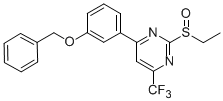
BETP is a novel and potent PAM (positive allosteric modulator) and partial agonist of glucagon-like peptide-1 (GLP-1) receptor (EC50= 0.66 μM) with antidiabetic effects. It shows excellent selectivity against glucagon, PTH, GIP, and GLP-2 receptors. In CHO cells expressing GLP-1R, BETP enhanced calcium influx and stimulated glucose-dependent insulin secretion both in vitro and in vivo.
Physicochemical Properties
| Molecular Formula | C20H17N2O2F3S |
| Molecular Weight | 406.42138 |
| Exact Mass | 406.096 |
| CAS # | 1371569-69-5 |
| PubChem CID | 49868481 |
| Appearance | Light yellow to yellow solid powder |
| LogP | 5.734 |
| Hydrogen Bond Donor Count | 0 |
| Hydrogen Bond Acceptor Count | 8 |
| Rotatable Bond Count | 6 |
| Heavy Atom Count | 28 |
| Complexity | 514 |
| Defined Atom Stereocenter Count | 0 |
| SMILES | FC(C1=CC(C2=CC=CC(OCC3=CC=CC=C3)=C2)=NC(S(CC)=O)=N1)(F)F |
| InChi Key | NTDFYGSSDDMNHI-UHFFFAOYSA-N |
| InChi Code | InChI=1S/C20H17F3N2O2S/c1-2-28(26)19-24-17(12-18(25-19)20(21,22)23)15-9-6-10-16(11-15)27-13-14-7-4-3-5-8-14/h3-12H,2,13H2,1H3 |
| Chemical Name | 2-ethylsulfinyl-4-(3-phenylmethoxyphenyl)-6-(trifluoromethyl)pyrimidine |
| Synonyms | BETP |
| HS Tariff Code | 2934.99.9001 |
| Storage |
Powder-20°C 3 years 4°C 2 years In solvent -80°C 6 months -20°C 1 month |
| Shipping Condition | Room temperature (This product is stable at ambient temperature for a few days during ordinary shipping and time spent in Customs) |
Biological Activity
| Targets | Human GLP-1 receptor ( EC50 = 0.66 μM ); Rat GLP-1 receptor ( EC50 = 0.755 μM ) |
| ln Vitro | BETP is an agonist of the GLP-1 receptor; its EC50s for the rat and human GLP-1 receptors are 0.755 and 0.66 μM, respectively. In cells expressing GLP-2, GIP, PTH, or glucagon receptors, BETP (Compound B) is inactive. In both normal and diabetic human islets, BETP (1-10 μM) increases insulin secretion. Furthermore, there are additive effects of BETP and GLP-1 on enhancing GLP-1 receptor signaling[1]. Oxyntomodulin's potency is ten times higher with BETP (EC50 of 80 pM). At the glucagon receptor, GLP-1 has no effect on the potencies and efficacies of either oxyntomodulin or glucagon. BETP (0-30 μM) raises oxyntomodulin's affinity for binding to the GLP-1 receptor[2]. |
| ln Vivo | BETP BETP has an insulinotropic effect in SD rats. In the intravenous glucose tolerance test (IVGTT) model, BETP (10 mg/kg, jugular vein cannula) demonstrates insulin secretagogue activity. Rats treated with BETP (10 mg/kg, i.v.) require 20% higher glucose infusion rates and exhibit higher plasma insulin levels in the hyperglycemic clamp model of SD rats[1]. BETP (5 mg/kg) increases insulin release that is triggered by oxyntomodulin[2]. |
| Animal Protocol | Rats: The IVGTT research is carried out. Three male SD rats per cage are kept in groups in polycarbonate cages with filter tops. Rats are kept at 21°C on a 12:12 h light-dark cycle (lights come on at 6:00 a.m.), where they are given an unlimited supply of food and deionized water. Rats are fasted for the entire experiment and given 60 mg/kg of pentobarbital to put them to sleep. The jugular vein is punctured with a 0.84 mm catheter to administer glucose and compounds (BETP, etc.). A larger, 1.02 mm-diameter catheter is placed into the carotid artery to collect blood quickly. At times 0, 2, 4, 6, 10, and 20 minutes following intravenous administration of the BETP, blood is drawn for the measurement of glucose and insulin levels. An intravenous glucose bolus of 0.5 g/kg is then administered right away. Insulin and glucose plasma levels are measured[1]. |
| References |
[1]. Novel small molecule glucagon-like peptide-1 receptor agonist stimulates insulin secretion in rodents and from human islets. Diabetes. 2010 Dec;59(12):3099-107. [2]. Small molecule allosteric modulation of the glucagon-like Peptide-1 receptor enhances the insulinotropic effect of oxyntomodulin. Mol Pharmacol. 2012 Dec;82(6):1066-73. |
Solubility Data
| Solubility (In Vitro) | DMSO: ~25 mg/mL (~61.5 mM) |
| Solubility (In Vivo) |
Solubility in Formulation 1: ≥ 2.5 mg/mL (6.15 mM) (saturation unknown) in 10% DMSO + 40% PEG300 + 5% Tween80 + 45% Saline (add these co-solvents sequentially from left to right, and one by one), clear solution. For example, if 1 mL of working solution is to be prepared, you can add 100 μL of 25.0 mg/mL clear DMSO stock solution to 400 μL PEG300 and mix evenly; then add 50 μL Tween-80 to the above solution and mix evenly; then add 450 μL normal saline to adjust the volume to 1 mL. Preparation of saline: Dissolve 0.9 g of sodium chloride in 100 mL ddH₂ O to obtain a clear solution. Solubility in Formulation 2: ≥ 2.5 mg/mL (6.15 mM) (saturation unknown) in 10% DMSO + 90% Corn Oil (add these co-solvents sequentially from left to right, and one by one), clear solution. For example, if 1 mL of working solution is to be prepared, you can add 100 μL of 25.0 mg/mL clear DMSO stock solution to 900 μL of corn oil and mix evenly. (Please use freshly prepared in vivo formulations for optimal results.) |
| Preparing Stock Solutions | 1 mg | 5 mg | 10 mg | |
| 1 mM | 2.4605 mL | 12.3025 mL | 24.6051 mL | |
| 5 mM | 0.4921 mL | 2.4605 mL | 4.9210 mL | |
| 10 mM | 0.2461 mL | 1.2303 mL | 2.4605 mL |