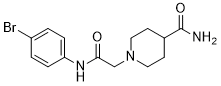
Physicochemical Properties
| Exact Mass | 339.058 |
| CAS # | 432529-82-3 |
| Related CAS # | 432529-82-3 |
| PubChem CID | 795875 |
| Appearance | Light yellow to yellow solid powder |
| Density | 1.5±0.1 g/cm3 |
| Boiling Point | 576.1±50.0 °C at 760 mmHg |
| Flash Point | 302.2±30.1 °C |
| Vapour Pressure | 0.0±1.6 mmHg at 25°C |
| Index of Refraction | 1.619 |
| LogP | 1.8 |
| Hydrogen Bond Donor Count | 2 |
| Hydrogen Bond Acceptor Count | 3 |
| Rotatable Bond Count | 4 |
| Heavy Atom Count | 20 |
| Complexity | 348 |
| Defined Atom Stereocenter Count | 0 |
| SMILES | NC(C1CCN(CC(NC2=CC=C(Br)C=C2)=O)CC1)=O |
| InChi Key | KSUYPIXCRPCPGF-UHFFFAOYSA-N |
| InChi Code | InChI=1S/C14H18BrN3O2/c15-11-1-3-12(4-2-11)17-13(19)9-18-7-5-10(6-8-18)14(16)20/h1-4,10H,5-9H2,(H2,16,20)(H,17,19) |
| Chemical Name | 4-(Aminocarbonyl)-N-(4-bromophenyl)-1-piperidineacetamide |
| Synonyms | BCI-121 BCI 121 BCI121 |
| HS Tariff Code | 2934.99.9001 |
| Storage |
Powder-20°C 3 years 4°C 2 years In solvent -80°C 6 months -20°C 1 month |
| Shipping Condition | Room temperature (This product is stable at ambient temperature for a few days during ordinary shipping and time spent in Customs) |
Biological Activity
| ln Vitro | BCI-121 efficiently lowers the proliferation of different cancer cell types by substantially inhibiting chromatin recruitment and SMYD3-substrate interaction. After 72 hours, BCI-121 dramatically decreased the HT29 (46% reduction) and HCT116 (54% reduction) cells' ability to proliferate, as well as the expression levels of the SMYD3 target genes. Histone H4 is preferentially methylated by SMYD3, and in vitro SMYD3-mediated H4 methylation is inhibited by BCI-121. Cancer cells treated with BCI-121 had much less growth potential, which accumulated in the S phase of the cell cycle. Targeted methyl marks (H4K5me and H3K4me2) were reduced and cell proliferation was inhibited in a dose-dependent manner in response to BCI-121 treatment. In cancer cell lines overexpressing SMYD3, BCI-121 has antiproliferative characteristics and typically resembles the effects of RNAi targeting SMYD3. BCI-121 inhibits SMYD3 from recruiting to the promoters of its target genes, an event linked to decreased gene expression, according to experiments conducted in cancer cells [1]. |
| References |
[1]. A SMYD3 Small-Molecule Inhibitor Impairing Cancer Cell Growth. J Cell Physiol. 2015 Oct;230(10):2447-2460. |
Solubility Data
| Solubility (In Vitro) | DMSO : ≥ 100 mg/mL (~293.93 mM) |
| Solubility (In Vivo) |
Solubility in Formulation 1: ≥ 2.75 mg/mL (8.08 mM) (saturation unknown) in 10% DMSO + 40% PEG300 + 5% Tween80 + 45% Saline (add these co-solvents sequentially from left to right, and one by one), clear solution. For example, if 1 mL of working solution is to be prepared, you can add 100 μL of 27.5 mg/mL clear DMSO stock solution to 400 μL PEG300 and mix evenly; then add 50 μL Tween-80 to the above solution and mix evenly; then add 450 μL normal saline to adjust the volume to 1 mL. Preparation of saline: Dissolve 0.9 g of sodium chloride in 100 mL ddH₂ O to obtain a clear solution. Solubility in Formulation 2: ≥ 2.75 mg/mL (8.08 mM) (saturation unknown) in 10% DMSO + 90% (20% SBE-β-CD in Saline) (add these co-solvents sequentially from left to right, and one by one), clear solution. For example, if 1 mL of working solution is to be prepared, you can add 100 μL of 27.5 mg/mL clear DMSO stock solution to 900 μL of 20% SBE-β-CD physiological saline solution and mix evenly. Preparation of 20% SBE-β-CD in Saline (4°C,1 week): Dissolve 2 g SBE-β-CD in 10 mL saline to obtain a clear solution. Solubility in Formulation 3: ≥ 2.75 mg/mL (8.08 mM) (saturation unknown) in 10% DMSO + 90% Corn Oil (add these co-solvents sequentially from left to right, and one by one), clear solution. For example, if 1 mL of working solution is to be prepared, you can add 100 μL of 27.5 mg/mL clear DMSO stock solution to 900 μL of corn oil and mix evenly. (Please use freshly prepared in vivo formulations for optimal results.) |