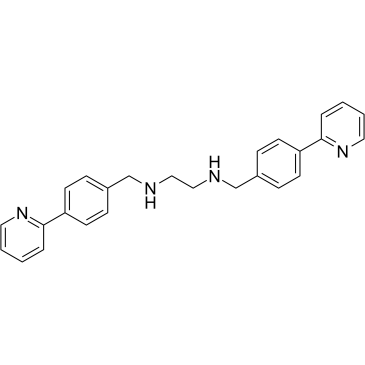
BC-1215 is an inhibitor of F-box protein 3 (FBXO3, a ubiquitin E3 ligase component, IC50=0.9 μg/mL for IL-1β release). BC-1215 decreases Fbxo3-Fbxl2 interaction and prevents SCFFbxo3 catalyzed Fbxl2 ubiquitination. BC-1215 inhibits the Fbxo3-TRAF activation pathway by destabilizing TRAF1–TRAF6. BC-1215, interacts with ApaG to profoundly inhibit secretion of a broad spectrum of TH1 panel cytokines from human PBMC.
Physicochemical Properties
| Molecular Formula | C26H26N4 |
| Molecular Weight | 394.51 |
| Exact Mass | 394.215 |
| CAS # | 1507370-20-8 |
| PubChem CID | 72201045 |
| Appearance | White to off-white solid powder |
| Density | 1.1±0.1 g/cm3 |
| Boiling Point | 589.9±50.0 °C at 760 mmHg |
| Flash Point | 310.6±30.1 °C |
| Vapour Pressure | 0.0±1.7 mmHg at 25°C |
| Index of Refraction | 1.613 |
| LogP | 3.68 |
| Hydrogen Bond Donor Count | 2 |
| Hydrogen Bond Acceptor Count | 4 |
| Rotatable Bond Count | 9 |
| Heavy Atom Count | 30 |
| Complexity | 412 |
| Defined Atom Stereocenter Count | 0 |
| InChi Key | IXEPQJQQSLMESJ-UHFFFAOYSA-N |
| InChi Code | InChI=1S/C26H26N4/c1-3-15-29-25(5-1)23-11-7-21(8-12-23)19-27-17-18-28-20-22-9-13-24(14-10-22)26-6-2-4-16-30-26/h1-16,27-28H,17-20H2 |
| Chemical Name | N,N'-bis[(4-pyridin-2-ylphenyl)methyl]ethane-1,2-diamine |
| HS Tariff Code | 2934.99.9001 |
| Storage |
Powder-20°C 3 years 4°C 2 years In solvent -80°C 6 months -20°C 1 month |
| Shipping Condition | Room temperature (This product is stable at ambient temperature for a few days during ordinary shipping and time spent in Customs) |
Biological Activity
| Targets | By destabilizing TRAF1-6, BC-1215 (0, 0.4, 2, 10, 50 μg/mL; 16 h, 18 h, and 24 h) inhibits the Fbxo3-TRAF activation pathway[1]. |
| ln Vitro |
By destabilizing TRAF1-6, BC-1215 (0, 0.4, 2, 10, 50 μg/mL; 16 h, 18 h, and 24 h) inhibits the Fbxo3-TRAF activation pathway[1]. BC-1215 exhibited an IC50 of 0.9 μg/ml for inhibiting IL-1β release from LPS-stimulated human peripheral blood mononuclear cells (PBMC). The lethal concentration, 50% (LC50) was 87 μg/ml in U937 cells. [1] BC-1215 decreased the interaction between Fbxo3 and Fbxl2 in a dose-dependent manner and prevented SCFFbxo3-catalyzed ubiquitination of Fbxl2. [1] BC-1215 effectively reduced TRAF1-6 protein levels in U937 cells and primary human PBMCs under both resting conditions and after LPS stimulation. This reduction occurred without altering steady-state TRAF mRNA levels. [1] BC-1215 blunted the induction of TRAF1-6 proteins after ectopic expression of Fbxo3 plasmid in U937 cells. [1] BC-1215 inhibited LPS-induced secretion of a broad spectrum of cytokines (Th1 panel) in human PBMC. [1] |
| ln Vivo |
Induced inflammation caused by bacteria is lessened by BC-1215 (i.p.; 100 μg)[1]. In a murine cecal ligation and puncture (CLP)-induced sepsis model, administration of BC-1215 (100 μg, i.p.) significantly attenuated CLP-induced secretion of circulating IL-6, TNF, and IL-1β. [1] BC-1215 treatment decreased bacterial counts in the peritoneal fluid in the CLP model. [1] In a murine Pseudomonas aeruginosa (strain PA103) pneumonia model, administration of BC-1215 (100 μg, i.p.) significantly ameliorated adverse effects on lung mechanics, decreased bronchoalveolar lavage (BAL) protein concentration and cell counts, reduced lung cell infiltrates, and decreased BAL pro-inflammatory cytokine levels. [1] Similar beneficial effects of BC-1215 were observed in a murine H1N1 pneumonia model. [1] |
| Enzyme Assay | Molecular docking studies were performed using Discovery Studio 3.1 software to screen a library of 6507 approved or experimental drugs for potential ligands of Fbxo3. Based on docking and best-fit analysis, benzathine was selected as a backbone to develop a series of new small molecules, including BC-1215. BC-1215 scored high on docking studies with the Fbxo3-ApaG domain. [1] |
| Cell Assay |
For cytokine release assays, human PBMC (0.6 ml at 1.5 × 10⁶/ml) were treated with LPS (2 μg/ml) for 16 hours in the presence of varying concentrations of BC-1215. Cell-free medium was collected and assayed for cytokine (e.g., IL-1β) levels by ELISA to determine IC50 values. [1] For cytotoxicity assessment, U937 cells (0.6 ml at 1.5 × 10⁶/ml) were treated with BC-1215 for 16 hours. Cells were then stained with trypan blue to identify dead cells and calculate the LC50. [1] For protein analysis, U937 cells or PBMC were transfected or treated as indicated (e.g., with BC-1215 or LPS). Cells were harvested, lysed, and proteins were analyzed by immunoblotting for targets such as TRAFs, Fbxl2, and Fbxo3. [1] |
| Animal Protocol |
Animal Model: Sepsis model caused by cecal ligation and puncture (CLP)[1]
Dosage: 100 μg
Administration: i.p.
Result:reduced the number of bacteria in the CLP model and significantly attenuated the release of all three of the circulating pro-inflammatory cytokines when exposed to CLP. For the CLP-induced sepsis model, mice were anesthetized and a midline laparotomy was performed. The cecum was exteriorized, ligated, and punctured with an 18-gauge needle. The abdomen was closed. Sham-operated animals received laparotomy only. BC-1215 (100 μg) or vehicle was administered via intraperitoneal (i.p.) injection immediately prior to the procedure. Mice were euthanized 6 hours later, and blood was collected for plasma cytokine analysis. Peritoneal fluid was obtained for bacterial counts. [1] For the P. aeruginosa pneumonia model, C57BL/6 mice were anesthetized, and the larynx was visualized for endotracheal intubation. P. aeruginosa (strain PA103, 104 CFU/mouse) was instilled intratracheally (i.t.). BC-1215 (100 μg) or vehicle was administered via i.p. injection immediately prior to bacterial challenge. Mice were euthanized 18 hours later. Lung mechanics were measured using a flexiVent system. Bronchoalveolar lavage (BAL) was performed with sterile PBS to collect fluid for protein, cell count, and cytokine analysis. Lung tissue was collected for histological examination (H&E staining). [1] For survival studies in the pneumonia model, mice were administered a higher dose of PA103 (105 CFU/mouse, i.t.) with or without BC-1215 treatment and monitored over time. [1] |
| Toxicity/Toxicokinetics |
The in vitro lethal concentration, 50% (LC50) of BC-1215 in U937 cells was 87 μg/ml, as determined by trypan blue exclusion assay after 16 hours of treatment. [1] |
| References |
[1]. A combinatorial F box protein directed pathway controls TRAF adaptor stability to regulateinflammation. Nat Immunol. 2013 May;14(5):470-9. |
| Additional Infomation |
BC-1215 is a small-molecule inhibitor designed to target the Fbxo3 protein, a component of the SCF E3 ubiquitin ligase complex. It was developed based on the benzathine backbone with added modifications (e.g., a pyridine group) to optimize interaction with the Fbxo3 ApaG domain. [1] The compound exerts its anti-inflammatory effect by antagonizing Fbxo3, which normally targets the inhibitory F-box protein Fbxl2 for degradation. By inhibiting Fbxo3, BC-1215 stabilizes Fbxl2, leading to increased ubiquitination and degradation of TRAF family proteins (TRAF1-6). Reduced TRAF protein levels subsequently dampen downstream NF-κB signaling and pro-inflammatory cytokine production (e.g., TNF, IL-1β, IL-6). [1] The study suggests that the Fbxo3-TRAF pathway is relevant in human sepsis, and inhibitors like BC-1215 may have therapeutic potential for cytokine-driven inflammatory illnesses. [1] |
Solubility Data
| Solubility (In Vitro) |
DMSO : 12.5~79 mg/mL ( 31.68~200.24 ) Ethanol : ~79 mg/mL |
| Solubility (In Vivo) |
Solubility in Formulation 1: ≥ 1.25 mg/mL (3.17 mM) (saturation unknown) in 10% DMSO + 40% PEG300 + 5% Tween80 + 45% Saline (add these co-solvents sequentially from left to right, and one by one), clear solution. For example, if 1 mL of working solution is to be prepared, you can add 100 μL of 12.5 mg/mL clear DMSO stock solution to 400 μL PEG300 and mix evenly; then add 50 μL Tween-80 to the above solution and mix evenly; then add 450 μL normal saline to adjust the volume to 1 mL. Preparation of saline: Dissolve 0.9 g of sodium chloride in 100 mL ddH₂ O to obtain a clear solution. Solubility in Formulation 2: ≥ 1.25 mg/mL (3.17 mM) (saturation unknown) in 10% DMSO + 90% (20% SBE-β-CD in Saline) (add these co-solvents sequentially from left to right, and one by one), clear solution. For example, if 1 mL of working solution is to be prepared, you can add 100 μL of 12.5 mg/mL clear DMSO stock solution to 900 μL of 20% SBE-β-CD physiological saline solution and mix evenly. Preparation of 20% SBE-β-CD in Saline (4°C,1 week): Dissolve 2 g SBE-β-CD in 10 mL saline to obtain a clear solution. Solubility in Formulation 3: ≥ 1.25 mg/mL (3.17 mM) (saturation unknown) in 10% DMSO + 90% Corn Oil (add these co-solvents sequentially from left to right, and one by one), clear solution. For example, if 1 mL of working solution is to be prepared, you can add 100 μL of 12.5 mg/mL clear DMSO stock solution to 900 μL of corn oil and mix evenly. (Please use freshly prepared in vivo formulations for optimal results.) |
| Preparing Stock Solutions | 1 mg | 5 mg | 10 mg | |
| 1 mM | 2.5348 mL | 12.6739 mL | 25.3479 mL | |
| 5 mM | 0.5070 mL | 2.5348 mL | 5.0696 mL | |
| 10 mM | 0.2535 mL | 1.2674 mL | 2.5348 mL |