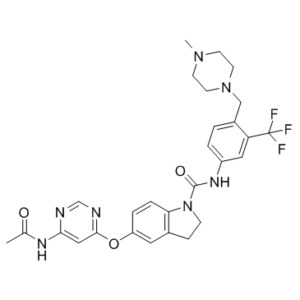
BBT-594 (also known as NVP-BBT594) is a novel, potent and selective receptor tyrosine kinase RET inhibitor used for cancer treatment. BBT594 inhibits MCF7-LTED cell growth that is dependent on GDNF and GDNF-RET signaling. By focusing on GDNF-RET signaling, it makes MCF7-2A cells more susceptible to letrozole treatment. As a logical therapeutic target, GDNF-RET signaling may help prevent or postpone the emergence of AI resistance in breast cancer.
Physicochemical Properties
| Molecular Formula | C28H30F3N7O3 |
| Molecular Weight | 569.5781 |
| Exact Mass | 569.236 |
| Elemental Analysis | C, 59.04; H, 5.31; F, 10.01; N, 17.21; O, 8.43 |
| CAS # | 882405-89-2 |
| Related CAS # | 882405-89-2 |
| PubChem CID | 59596344 |
| Appearance | White to khaki solid powder |
| Density | 1.4±0.1 g/cm3 |
| Boiling Point | 723.9±70.0 °C at 760 mmHg |
| Flash Point | 391.6±35.7 °C |
| Vapour Pressure | 0.0±2.5 mmHg at 25°C |
| Index of Refraction | 1.640 |
| LogP | 3.28 |
| Hydrogen Bond Donor Count | 2 |
| Hydrogen Bond Acceptor Count | 10 |
| Rotatable Bond Count | 6 |
| Heavy Atom Count | 41 |
| Complexity | 904 |
| Defined Atom Stereocenter Count | 0 |
| SMILES | O=C(N1CCC2C1=CC=C(C=2)OC1C=C(NC(C)=O)N=CN=1)NC1C=C(C(F)(F)F)C(CN2CCN(C)CC2)=CC=1 |
| InChi Key | VQLNKQZLPGLOSI-UHFFFAOYSA-N |
| InChi Code | InChI=1S/C28H30F3N7O3/c1-18(39)34-25-15-26(33-17-32-25)41-22-5-6-24-19(13-22)7-8-38(24)27(40)35-21-4-3-20(23(14-21)28(29,30)31)16-37-11-9-36(2)10-12-37/h3-6,13-15,17H,7-12,16H2,1-2H3,(H,35,40)(H,32,33,34,39) |
| Chemical Name | 5-(6-acetamidopyrimidin-4-yl)oxy-N-[4-[(4-methylpiperazin-1-yl)methyl]-3-(trifluoromethyl)phenyl]-2,3-dihydroindole-1-carboxamide |
| Synonyms | BBT-594; BBT-594; BBT-594; NVP BBT594; NVP-BBT594; NVP BBT-594 |
| HS Tariff Code | 2934.99.9001 |
| Storage |
Powder-20°C 3 years 4°C 2 years In solvent -80°C 6 months -20°C 1 month |
| Shipping Condition | Room temperature (This product is stable at ambient temperature for a few days during ordinary shipping and time spent in Customs) |
Biological Activity
| Targets |
Inhibitor of the receptor tyrosine kinase RET (REarranged during Transfection). [1] |
| ln Vitro |
NVP-BBT594 inhibits the growth of MCF7-LTED cell viability in 2D culture and 3D colony formation, which is mediated by GDNF. Both MCF7 and MCF7-LTED cells form more 3D colonies when 10 pM E2, which is added to replicate the E2 level in post-menopausal patients who have relapsed on AI therapy and stopped AI therapy, is added. NVP-BBT594 effectively reverses this effect. NVP-BBT594 significantly reverses the increased formation of 3D colonies in parental T47D cells cultured in the presence of low level E2, GFRα1/GDNF stimulation. MCF7-2A cells become more susceptible to letrozole treatment when NVP-BBT594 targets GDNF-RET signaling. Letrozole's antiproliferative effects are markedly enhanced by NVP-BBT594, which also inhibits GDNF-mediated RET downstream signaling[1]. According to phosphorylation of RET, ERK1/2, AKT, and ER, NVP-BBT594 exhibits the strongest suppression of GDNF-induced RET signaling. Comparable RET inhibitory activity has been observed for NVP-AST487 and NVP-BBT594 in wild-type MCF7 cells [2]. In MCF7 and MCF7-LTED breast cancer cells, pretreatment with 100 nM NVP-BBT594 for 90 minutes blocked GDNF-induced RET autophosphorylation (at Tyr905) and downstream signaling events, demonstrating its role as a RET kinase inhibitor [1]. In 3D colony formation assays using MCF7 and MCF7-LTED cells cultured on Matrigel, addition of 100 nM NVP-BBT594 significantly reverted the GDNF-mediated enhancement of colony formation. It also reverted the increase in colony formation induced by a low dose of estradiol (E2, 10 pM) in these cells [1]. In T47D breast cancer cells cultured on Matrigel in the presence of low-level E2, 100 nM NVP-BBT594 significantly inhibited the increase in 3D colony formation induced by GFRα1/GDNF stimulation [1]. In MCF7-2A cells (which express aromatase), NVP-BBT594 (100 nM) impaired GDNF-mediated downstream signaling, including the phosphorylation of RET, ERK1/2, AKT, and estrogen receptor (ER). This effect was specific to RET inhibition, as the compound did not significantly affect colony formation in T47D-LTED and ZR75-1-LTED cells, which have undetectable levels of RET [1]. In 2D culture viability assays with MCF7-2A cells, co-treatment with 100 nM NVP-BBT594 and the aromatase inhibitor letrozole significantly enhanced the antiproliferative effect of letrozole alone, lowering the survival fraction 50% (SF50) value [1]. In 3D colony formation assays with MCF7-2A cells, 100 nM NVP-BBT594 completely abrogated the GDNF-induced promotion of colony formation, both in the absence and presence of letrozole (10 nM) [1]. |
| Cell Assay |
For signaling inhibition studies, MCF7, MCF7-LTED, or MCF7-2A breast cancer cells were first estrogen-deprived for 3 days by culturing in phenol red-free medium supplemented with charcoal-stripped serum. Cells were then serum-starved overnight. To assess the effect of NVP-BBT594 on GDNF-induced signaling, cells were pretreated with the compound (100 nM) for 90 minutes, followed by stimulation with GDNF (20 ng/mL) for 30 minutes. Cells were then lysed, and total protein extracts were analyzed by western blotting to detect phosphorylation levels of RET and downstream targets like ERK1/2, AKT, and ER [1]. For 3D colony formation assays, breast cancer cells (MCF7, MCF7-LTED, T47D, ZR75-1, or MCF7-2A) were plated on a basement membrane matrix (Matrigel). The culture medium was supplemented with various agents as per experimental design: GDNF (20 ng/mL), GFRα1 (100 ng/mL), estradiol (E2, 10 pM), androstenedione (10 nM for MCF7-2A), letrozole (10 nM), and/or NVP-BBT594 (100 nM) or its vehicle (DMSO). The medium was refreshed every 3-4 days. After 7 days of culture, colonies with a diameter greater than 200 μm were counted under a microscope. The data were presented as the mean fold increase in colony number compared to control (untreated) cells [1]. For 2D cell viability/proliferation assays (used with MCF7-2A cells), cells were estrogen-deprived for 3 days and then cultured in the presence of 10 nM androstenedione along with a range of concentrations of letrozole. The assay was performed in the presence of vehicle, GDNF (20 ng/mL), or GDNF plus NVP-BBT594 (100 nM). Cell survival was measured after 6 days, and survival fraction curves were plotted to determine the SF50 (concentration of letrozole reducing survival by 50%) [1]. |
| References |
[1]. GDNF-RET signaling in ER-positive breast cancers is a key determinant of response and resistance to aromatase inhibitors. Cancer Res. 2013 Jun 15;73(12):3783-95. [2]. Targeting the receptor tyrosine kinase RET in combination with aromatase inhibitors in ER positive breast cancer xenografts. Oncotarget. 2016 Sep 2. doi: 10.18632/oncotarget.11826. |
| Additional Infomation |
NVP-BBT594 is a RET kinase inhibitor compound supplied by Novartis and used in this study as a pharmacological tool to inhibit GDNF-RET signaling [1]. The study demonstrates that NVP-BBT594 can selectively inhibit RET signaling in breast cancer cells, as it had no significant impact on the 3D colony formation of T47D-LTED and ZR75-1-LTED cells, which lack RET expression, indicating the absence of off-target toxicity at the concentration used (100 nM) [1]. The core finding is that NVP-BBT594 can reverse GDNF-mediated resistance to aromatase inhibitors (like letrozole) in estrogen receptor-positive (ER+) breast cancer cell models. It enhances the sensitivity of AI-sensitive cells and re-sensitizes AI-resistant cells to AI treatment, highlighting the potential of RET inhibition as a combination therapy strategy to combat AI resistance [1]. |
Solubility Data
| Solubility (In Vitro) | DMSO: ≥ 33 mg/mL (~57.9 mM) |
| Solubility (In Vivo) |
Solubility in Formulation 1: ≥ 2.5 mg/mL (4.39 mM) (saturation unknown) in 10% DMSO + 40% PEG300 + 5% Tween80 + 45% Saline (add these co-solvents sequentially from left to right, and one by one), clear solution. For example, if 1 mL of working solution is to be prepared, you can add 100 μL of 25.0 mg/mL clear DMSO stock solution to 400 μL PEG300 and mix evenly; then add 50 μL Tween-80 to the above solution and mix evenly; then add 450 μL normal saline to adjust the volume to 1 mL. Preparation of saline: Dissolve 0.9 g of sodium chloride in 100 mL ddH₂ O to obtain a clear solution. Solubility in Formulation 2: ≥ 2.5 mg/mL (4.39 mM) (saturation unknown) in 10% DMSO + 90% (20% SBE-β-CD in Saline) (add these co-solvents sequentially from left to right, and one by one), clear solution. For example, if 1 mL of working solution is to be prepared, you can add 100 μL of 25.0 mg/mL clear DMSO stock solution to 900 μL of 20% SBE-β-CD physiological saline solution and mix evenly. Preparation of 20% SBE-β-CD in Saline (4°C,1 week): Dissolve 2 g SBE-β-CD in 10 mL saline to obtain a clear solution. Solubility in Formulation 3: ≥ 2.5 mg/mL (4.39 mM) (saturation unknown) in 10% DMSO + 90% Corn Oil (add these co-solvents sequentially from left to right, and one by one), clear solution. For example, if 1 mL of working solution is to be prepared, you can add 100 μL of 25.0 mg/mL clear DMSO stock solution to 900 μL of corn oil and mix evenly. (Please use freshly prepared in vivo formulations for optimal results.) |
| Preparing Stock Solutions | 1 mg | 5 mg | 10 mg | |
| 1 mM | 1.7557 mL | 8.7784 mL | 17.5568 mL | |
| 5 mM | 0.3511 mL | 1.7557 mL | 3.5114 mL | |
| 10 mM | 0.1756 mL | 0.8778 mL | 1.7557 mL |