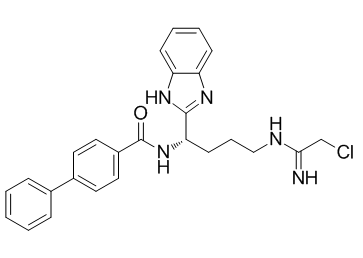
BB-Cl-Amidine is a peptidylarginine deminase (PAD) inhibitor with potential for Canine and Feline Mammary Cancer via Activation of the Endoplasmic Reticulum Stress Pathway. BB-Cl-Amidine is a modified version of Cl-amidine that retains the functional components but possesses a C-terminal benzimidazole group designed to limit proteolysis of the C-terminal amide. BB-CLA reduced viability and tumorigenicity of canine and feline mammary cancer cell lines in vitro. BB-CLA activates the endoplasmic reticulum stress pathway in these cells by downregulating 78 kDa Glucose-regulated Protein (GRP78), a potential target in breast cancer for molecular therapy, and upregulating the downstream target gene DNA Damage Inducible Transcript 3 (DDIT3).
Physicochemical Properties
| Molecular Formula | C₂₆H₂₆CLN₅O |
| Molecular Weight | 459.97 |
| Exact Mass | 459.182 |
| Elemental Analysis | C, 67.89; H, 5.70; Cl, 7.71; N, 15.23; O, 3.48 |
| CAS # | 1802637-39-3 |
| Related CAS # | BB-Cl-Amidine hydrochloride;2436747-41-8 |
| PubChem CID | 129021946 |
| Appearance | Solid powder |
| Density | 1.3±0.1 g/cm3 |
| Index of Refraction | 1.655 |
| LogP | 3.86 |
| Hydrogen Bond Donor Count | 3 |
| Hydrogen Bond Acceptor Count | 3 |
| Rotatable Bond Count | 9 |
| Heavy Atom Count | 33 |
| Complexity | 645 |
| Defined Atom Stereocenter Count | 1 |
| SMILES | ClC/C(/N)=N\CCC[C@@H](C1=NC2C=CC=CC=2N1)NC(C1C=CC(C2C=CC=CC=2)=CC=1)=O |
| InChi Key | YDOAWJHYHGBQFI-QHCPKHFHSA-N |
| InChi Code | InChI=1S/C26H26ClN5O/c27-17-24(28)29-16-6-11-23(25-30-21-9-4-5-10-22(21)31-25)32-26(33)20-14-12-19(13-15-20)18-7-2-1-3-8-18/h1-5,7-10,12-15,23H,6,11,16-17H2,(H2,28,29)(H,30,31)(H,32,33)/t23-/m0/s1 |
| Chemical Name | N-[(1S)-1-(1H-benzimidazol-2-yl)-4-[(2-chloro-1-iminoethyl)amino]butyl]-[1,1'-biphenyl]-4-carboxamide |
| Synonyms | BB-Cl-Amidine BB-CLA |
| HS Tariff Code | 2934.99.9001 |
| Storage |
Powder-20°C 3 years 4°C 2 years In solvent -80°C 6 months -20°C 1 month |
| Shipping Condition | Room temperature (This product is stable at ambient temperature for a few days during ordinary shipping and time spent in Customs) |
Biological Activity
| ln Vivo | In MRL/lpr animals, therapy with BB-Cl-amidine somewhat decreased splenomegaly, but treatment with PAD inhibitors tended to raise the amount of anti-NET antibodies in circulation. Nevertheless, body weight and total IgG levels were unaffected by any of the PAD inhibitors. Cl-amidine and BB-Cl-amidine therapy actually greatly enhanced endothelium-dependent vasodilation. Additionally, there was a clear tendency of IRG downregulation in the BB-Cl-amidine group. Cl-amidine or BB-Cl-amidine therapy can considerably lessen oral hair loss and, in many situations, stop it altogether [1]. |
| Animal Protocol |
Animal/Disease Models: MRL/lpr mouse[1]. Doses: 1 mg/kg. Route of Administration: Administer subcutaneously (sc) (sc) daily from 8 to 14 weeks of age. Experimental Results: Endothelium-dependent vasodilation was Dramatically improved and demonstrated a strong trend of IRG downregulation. |
| References |
[1]. Peptidylarginine deiminase inhibition disrupts NET formation and protects against kidney, skin and vascular disease in lupus-prone MRL/lpr mice. Ann Rheum Dis. 2015 Dec;74(12):2199-206. |
Solubility Data
| Solubility (In Vitro) | DMSO : ~125 mg/mL (~271.76 mM) |
| Solubility (In Vivo) |
Solubility in Formulation 1: ≥ 2.08 mg/mL (4.52 mM) (saturation unknown) in 10% DMSO + 40% PEG300 + 5% Tween80 + 45% Saline (add these co-solvents sequentially from left to right, and one by one), clear solution. For example, if 1 mL of working solution is to be prepared, you can add 100 μL of 20.8 mg/mL clear DMSO stock solution to 400 μL PEG300 and mix evenly; then add 50 μL Tween-80 to the above solution and mix evenly; then add 450 μL normal saline to adjust the volume to 1 mL. Preparation of saline: Dissolve 0.9 g of sodium chloride in 100 mL ddH₂ O to obtain a clear solution. Solubility in Formulation 2: ≥ 2.08 mg/mL (4.52 mM) (saturation unknown) in 10% DMSO + 90% (20% SBE-β-CD in Saline) (add these co-solvents sequentially from left to right, and one by one), clear solution. For example, if 1 mL of working solution is to be prepared, you can add 100 μL of 20.8 mg/mL clear DMSO stock solution to 900 μL of 20% SBE-β-CD physiological saline solution and mix evenly. Preparation of 20% SBE-β-CD in Saline (4°C,1 week): Dissolve 2 g SBE-β-CD in 10 mL saline to obtain a clear solution. Solubility in Formulation 3: ≥ 2.08 mg/mL (4.52 mM) (saturation unknown) in 10% DMSO + 90% Corn Oil (add these co-solvents sequentially from left to right, and one by one), clear solution. For example, if 1 mL of working solution is to be prepared, you can add 100 μL of 20.8 mg/mL clear DMSO stock solution to 900 μL of corn oil and mix evenly. (Please use freshly prepared in vivo formulations for optimal results.) |
| Preparing Stock Solutions | 1 mg | 5 mg | 10 mg | |
| 1 mM | 2.1741 mL | 10.8703 mL | 21.7405 mL | |
| 5 mM | 0.4348 mL | 2.1741 mL | 4.3481 mL | |
| 10 mM | 0.2174 mL | 1.0870 mL | 2.1741 mL |