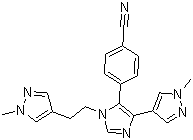
Physicochemical Properties
| Molecular Formula | C20H19N7 |
| Molecular Weight | 357.41 |
| Exact Mass | 357.17 |
| CAS # | 1665195-94-7 |
| PubChem CID | 91654625 |
| Appearance | Off-white to light yellow solid powder |
| Density | 1.3±0.1 g/cm3 |
| Boiling Point | 632.8±55.0 °C at 760 mmHg |
| Flash Point | 336.5±31.5 °C |
| Vapour Pressure | 0.0±1.9 mmHg at 25°C |
| Index of Refraction | 1.685 |
| LogP | 2.06 |
| Hydrogen Bond Donor Count | 0 |
| Hydrogen Bond Acceptor Count | 4 |
| Rotatable Bond Count | 5 |
| Heavy Atom Count | 27 |
| Complexity | 538 |
| Defined Atom Stereocenter Count | 0 |
| InChi Key | RRZVGDGTWNQAPW-UHFFFAOYSA-N |
| InChi Code | InChI=1S/C20H19N7/c1-25-12-16(10-23-25)7-8-27-14-22-19(18-11-24-26(2)13-18)20(27)17-5-3-15(9-21)4-6-17/h3-6,10-14H,7-8H2,1-2H3 |
| Chemical Name | 4-[5-(1-methylpyrazol-4-yl)-3-[2-(1-methylpyrazol-4-yl)ethyl]imidazol-4-yl]benzonitrile |
| Synonyms | BAZ2-ICR BAZ2 ICR BAZ2ICR |
| HS Tariff Code | 2934.99.9001 |
| Storage |
Powder-20°C 3 years 4°C 2 years In solvent -80°C 6 months -20°C 1 month |
| Shipping Condition | Room temperature (This product is stable at ambient temperature for a few days during ordinary shipping and time spent in Customs) |
Biological Activity
| ln Vitro | Using GFP-tagged BAZ2A full-length protein transfected into human osteosarcoma cells (U2OS), the fluorescence recovery after photobleaching (FRAP) test was used to examine whether BAZ2-ICR (compound 13) may substitute the BAZ2 bromodomain in the chromatin of living cells. ..It was confirmed that BAZ2-ICR inhibits BAZ2A in cells when 1 μM BAZ2-ICR reduced the recovery time of the wild-type (wt) construct to a level comparable to that of the dominant-negative mutant [1]. |
| ln Vivo | BAZ2-ICR (chemical 13) exhibits both oral and intravenous delivery due to its very high solubility (25 mM in DO), observed log D of 1.05, great stability in mouse microsomes, and permeability in the CaCo-2 model. BAZ2-ICR (5 mg/kg) has a volume of distribution of 70% and a modest clearance (about 50% of mouse liver blood flow) [1]. |
| References |
[1]. Structure enabled design of BAZ2-ICR, a chemical probe targeting the bromodomains of BAZ2A and BAZ2B. J Med Chem. 2015 Mar 12;58(5):2553-9. |
Solubility Data
| Solubility (In Vitro) |
DMF : 20 mg/mL (~55.96 mM) DMSO : ~10 mg/mL (~27.98 mM) |
| Solubility (In Vivo) |
Solubility in Formulation 1: ≥ 2.5 mg/mL (6.99 mM) (saturation unknown) in 10% DMSO + 40% PEG300 + 5% Tween80 + 45% Saline (add these co-solvents sequentially from left to right, and one by one), clear solution. For example, if 1 mL of working solution is to be prepared, you can add 100 μL of 25.0 mg/mL clear DMSO stock solution to 400 μL PEG300 and mix evenly; then add 50 μL Tween-80 to the above solution and mix evenly; then add 450 μL normal saline to adjust the volume to 1 mL. Preparation of saline: Dissolve 0.9 g of sodium chloride in 100 mL ddH₂ O to obtain a clear solution. Solubility in Formulation 2: ≥ 2.5 mg/mL (6.99 mM) (saturation unknown) in 10% DMSO + 90% (20% SBE-β-CD in Saline) (add these co-solvents sequentially from left to right, and one by one), clear solution. For example, if 1 mL of working solution is to be prepared, you can add 100 μL of 25.0 mg/mL clear DMSO stock solution to 900 μL of 20% SBE-β-CD physiological saline solution and mix evenly. Preparation of 20% SBE-β-CD in Saline (4°C,1 week): Dissolve 2 g SBE-β-CD in 10 mL saline to obtain a clear solution. Solubility in Formulation 3: ≥ 2.5 mg/mL (6.99 mM) (saturation unknown) in 10% DMSO + 90% Corn Oil (add these co-solvents sequentially from left to right, and one by one), clear solution. For example, if 1 mL of working solution is to be prepared, you can add 100 μL of 25.0 mg/mL clear DMSO stock solution to 900 μL of corn oil and mix evenly. (Please use freshly prepared in vivo formulations for optimal results.) |
| Preparing Stock Solutions | 1 mg | 5 mg | 10 mg | |
| 1 mM | 2.7979 mL | 13.9895 mL | 27.9791 mL | |
| 5 mM | 0.5596 mL | 2.7979 mL | 5.5958 mL | |
| 10 mM | 0.2798 mL | 1.3990 mL | 2.7979 mL |