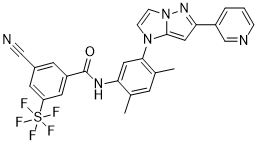
BAY-826 is a novel, highly potent, selective and orally available small molecule TIE-2 inhibitor with Kd of 1.6 nM, respectively. In syngeneic mouse glioma models, it enhances tumor control. Angiopoietin-1- or Na3 VO4-induced TIE-2 phosphorylation in glioma cells or lung extracts from BAY-826-treated mice is suppressed, indicating that BAY-826 inhibits TIE-2 phosphorylation both in vitro and in vivo. After receiving a single agent, two out of the four models (SMA-497 and SMA-540) showed a tendency toward longer survival, and one model (SMA-560) showed a significant survival benefit. One model (SMA-497) did not respond well to co-treatment with BAY-826 and radiation, but another model (SMA-560) showed synergistic survival prolongation. Both increased leukocyte infiltration and decreased vessel densities were noted; however, since these effects were also seen with single treatment modalities, it is possible that these processes are independent. These findings show that in highly vascularized tumors like glioblastoma, TIE-2 inhibition may enhance tumor response to therapy. In cases of glioblastoma, targeting the vascular endothelial growth factor signaling axis invariably results in tumor recurrence and an increasingly aggressive phenotype. As a result, additional angiogenic signaling pathways, such as the angiopoietin/tunica interna endothelial cell kinase (TIE) signaling axis, have been identified as potential therapeutic targets.
Physicochemical Properties
| Molecular Formula | C26H19F5N6OS |
| Molecular Weight | 558.525680780411 |
| Exact Mass | 558.53 |
| Elemental Analysis | C, 55.91; H, 3.43; F, 17.01; N, 15.05; O, 2.86; S, 5.74 |
| CAS # | 1448316-08-2 |
| Related CAS # | 1448316-08-2 |
| PubChem CID | 71623052 |
| Appearance | White to yellow solid powder |
| LogP | 6.9 |
| Hydrogen Bond Donor Count | 1 |
| Hydrogen Bond Acceptor Count | 9 |
| Rotatable Bond Count | 4 |
| Heavy Atom Count | 39 |
| Complexity | 991 |
| Defined Atom Stereocenter Count | 0 |
| InChi Key | MPASHPJAIUOWCK-UHFFFAOYSA-N |
| InChi Code | InChI=1S/C26H19F5N6OS/c1-16-8-17(2)24(36-6-7-37-25(36)13-23(35-37)19-4-3-5-33-15-19)12-22(16)34-26(38)20-9-18(14-32)10-21(11-20)39(27,28,29,30)31/h3-13,15H,1-2H3,(H,34,38) |
| Chemical Name | 3-cyano-N-[2,4-dimethyl-5-(6-pyridin-3-ylimidazo[1,2-b]pyrazol-1-yl)phenyl]-5-(pentafluoro-lambda6-sulfanyl)benzamide |
| Synonyms | BAY826; BAY 826; BAY-826 |
| HS Tariff Code | 2934.99.03.00 |
| Storage |
Powder-20°C 3 years 4°C 2 years In solvent -80°C 6 months -20°C 1 month |
| Shipping Condition | Room temperature (This product is stable at ambient temperature for a few days during ordinary shipping and time spent in Customs) |
Biological Activity
| Targets |
Tie2 (Kd = 1.6 nM) BAY-826 is a selective and potent inhibitor of TIE-2 (dissociation constant = 1.6 nM). It binds similarly highly to only 4 out of 456 tested kinases (dissociation constant = 0.9, 0.4, 1.3, and 5.9 nM), which are TIE-1, DDR1, DDR2, and Serine/threonine-protein kinase 10 (LOK).With an EC50 of roughly 1.3 nM for the inhibition of TIE-2 autophosphorylation in human umbilical vein endothelial cells, the high biochemical affinity for TIE-2 translates into very strong cellular mechanistic activity. Using all four mouse glioma cell lines, the acute growth inhibitory and anti-clonogenic effects of the TIE-2 inhibitor BAY-826 are evaluated. The effects of BAY-826 on VEGF-stimulated proliferation of HUVEC are limited to μM concentrations, and it exhibits high selectivity against other angiogenic kinases such as VEGFR, fibroblast growth factor receptor (FGFR), or platelet-derived growth factor receptor (PDGFR). |
| ln Vitro |
BAY-826 is a selective and potent inhibitor of TIE-2 (dissociation constant = 1.6 nM). It binds similarly highly to only 4 out of 456 tested kinases (dissociation constant = 0.9, 0.4, 1.3, and 5.9 nM), which are TIE-1, DDR1, DDR2, and Serine/threonine-protein kinase 10 (LOK).With an EC50 of roughly 1.3 nM for the inhibition of TIE-2 autophosphorylation in human umbilical vein endothelial cells, the high biochemical affinity for TIE-2 translates into very strong cellular mechanistic activity. Using all four mouse glioma cell lines, the acute growth inhibitory and anti-clonogenic effects of the TIE-2 inhibitor BAY-826 are evaluated. The effects of BAY-826 on VEGF-stimulated proliferation of HUVEC are limited to μM concentrations, and it exhibits high selectivity against other angiogenic kinases such as VEGFR, fibroblast growth factor receptor (FGFR), or platelet-derived growth factor receptor (PDGFR). BAY-826 potently inhibits TIE-2 autophosphorylation in human umbilical vein endothelial cells (HUVEC) with a cellular mechanistic EC50 of about 1.3 nM. [1] In four mouse glioma cell lines (SMA-497, SMA-540, SMA-560, GL-261), acute exposure to BAY-826 at concentrations up to 100 µM for 72 hours did not affect cell metabolic activity (MTT assay). Similarly, exposure in clonogenic survival assays for more than 10 days did not affect the survival of any glioma cell line at concentrations known to specifically inhibit cellular TIE-2 (1 nM) and higher. [1] Flow cytometry analysis (Annexin V/PI staining) over 72 hours of exposure to BAY-826 revealed no induction of apoptotic or necrotic cell death and no changes in cell cycle progression in mouse glioma cells. [1] In SMA-497 cells, BAY-826 (1 µM) inhibited both Na3VO4- and COMP-ANG-1-induced TIE-2 autophosphorylation, as assessed by immunoprecipitation followed by immunoblot. [1] Combination studies in clonogenic assays showed that BAY-826 neither antagonized nor synergized with temozolomide (1-1000 µM) or irradiation (1, 3, 9 Gy) in SMA-497 and SMA-560 cells. [1] |
| ln Vivo |
BAY-826 (oral gavage; 25 mg/kg,50 mg/kg,100 mg/k) inhibits TIE-2 autophosphorylation induced by ANG-1 in the murine lungs of female CB17/scid mice with a strong potency[1]. In mouse models of syngeneic gliomas, BAY-826 enhances tumor control. In one model (SMA-497), co-treatment with BAY-826 and radiation is ineffective; however, in another model (SMA-560), it has a synergistic effect of prolonging cell survival. In highly vascularized tumors like glioblastoma, TIE- 2 inhibition may enhance the tumor response to treatment[1]. In syngeneic mouse glioma models (SMA-497, SMA-540, SMA-560, GL-261), daily oral administration of BAY-826 (100 mg/kg) starting from day 7 post-implantation showed a trend toward prolonged survival in SMA-497 and SMA-540 models, and a significant (though minor) survival benefit in the SMA-560 model. No survival benefit was observed in the GL-261 model. [1] BAY-826 treatment decreased intra-tumoral vascular TIE-2 protein levels (assessed by immunofluorescence intensity) in three of four models (SMA-497, SMA-560, GL-261). [1] BAY-826 treatment significantly reduced CD31+ microvessel density in SMA-560 and GL-261 tumors, which had the highest baseline vessel densities. [1] BAY-826 treatment significantly increased the number of tumor-infiltrating CD11b+ monocytes/macrophages in SMA-497 and SMA-540 tumors. [1] BAY-826 treatment did not affect tumor cell proliferation rates (Ki-67 labeling) or final tumor volumes in any of the four single-agent treatment models. [1] In combination with a single dose of whole-brain irradiation (12 Gy), BAY-826 co-treatment did not provide a statistically significant survival benefit over monotreatments in the SMA-497 model. In the SMA-560 model, the combination was superior to solvent control and showed a trend compared to either monotreatment alone. [1] In the SMA-560 combination model, co-treatment with BAY-826 and irradiation significantly reduced tumor volume, whereas monotreatments did not. [1] A single oral dose of BAY-826 (25, 50, or 100 mg/kg) potently inhibited recombinant human ANG-1-stimulated TIE-2 autophosphorylation in the lungs of CB17/scid mice. [1] |
| Enzyme Assay |
The biochemical affinity of BAY-826 for various kinases was determined using the KINOMEscan™ screening platform, which measures dissociation constants (Kd). [1] A cell-based TIE-2 autophosphorylation assay was performed using SMA-497 glioma cells. Cells were pre-incubated with BAY-826 or vehicle, then stimulated with Na3VO4 or COMP-ANG-1 to induce phosphorylation. Cells were lysed, and TIE-2 was immunoprecipitated from the lysates. Phosphorylated TIE-2 (pTIE-2) and total TIE-2 levels were then analyzed by immunoblotting to assess inhibition. [1] |
| Cell Assay |
In mouse models of syngeneic gliomas, BAY-826 enhances tumor control. In one model (SMA-497), co-treatment with BAY-826 and radiation is ineffective; however, in another model (SMA-560), it has a synergistic effect of prolonging cell survival. In highly vascularized tumors like glioblastoma, TIE- 2 inhibition may enhance the tumor response to treatment[1].Glioma cells from SMA-497, SMA-540, SMA-560, and GL-261 in mice are utilized.Typically, the cells are grown as adherent monolayers in Dulbecco's modified Eagle medium, which is enhanced with 2 mM glutamine and 10% heat-inactivated fetal calf serum. In a coradiation source, cells receive radiation at 1, 3, and 9 Gy. The cells are pre-incubated for 10 minutes at 37°C with either 1μM BAY-826 or 0.1% DMSO as the control. For 20 minutes, 400 ng/mL COMP-ANG-1 or 4 mM Na3VO4 are used to induce TIE-2 autophosphorylation in the presence of either 0.1% DMSO or 1 μM BAY-826[1]. For acute viability assays, mouse glioma cells were seeded in 96-well plates and allowed to attach. Cells were then exposed to BAY-826 (1-100 µM) in serum-free medium for 72 hours. Cell metabolic activity was assessed using the MTT assay. [1] For clonogenic survival assays, 100-200 cells were seeded per well in 96-well plates. After adherence, cells were exposed to increasing concentrations of BAY-826 in serum-free medium. Fetal calf serum was added back 24 hours later, and cells were observed for at least 10 days. Metabolic activity was assessed by MTT assay. For combination studies, cells were exposed to BAY-826 for 6 hours before adding temozolomide or applying irradiation. [1] Apoptosis and necrosis were assessed by flow cytometry. Cells treated with BAY-826 in serum-free medium were washed, resuspended in buffer, and stained with FITC-labeled Annexin V and propidium iodide (PI). Fluorescence was recorded to quantify AnxV+/PI- (early apoptotic), AnxV+/PI+ (late apoptotic/necrotic), and AnxV-/PI+ (necrotic) populations. [1] For cell cycle analysis, cells treated with BAY-826 were harvested, fixed, permeabilized in ethanol, treated with RNase A, and stained with PI. DNA content was analyzed by flow cytometry. [1] Gene expression of Angiopoietin ligands (Ang1, Ang2, Ang3) and receptors (Tie1, Tie2) in mouse glioma cell lines was analyzed by real-time PCR (RT-PCR). Total mRNA was extracted from cells incubated in serum-free medium. SYBR Green Master Mix and specific primers were used. Relative quantification was performed using the ΔCt method, normalized to the housekeeping gene Hprt1. [1] TIE-2 protein expression in glioma cells was assessed by immunoprecipitation of total cell lysates followed by immunoblotting with an anti-TIE-2 antibody. [1] |
| Animal Protocol |
A burr hole is drilled into the skull 2 mm lateral to the bregma after anesthesia. A Hamilton syringe's needle is inserted three millimeters below the surface. A single cell suspension in PBS, containing 2 μL, is gradually injected into the right striatum. 5×10 3 SMA glioma cells are implanted in female and male VM/Dk mice (house husbandry), while 2×10⁴ GL-261 cells are implanted in female C57Bl/6 mice (Charles River) (n = 10 per group). The mice used are heavier than twenty grams. Systemic treatment with BAY-826 is administered orally at a dose of 100 mg/kg body weight per day, orally with a solvent mixture of 10% ethanol, 40% sorbitol, and 50% water, respectively[1]. For efficacy studies in syngeneic glioma models, female/male VM/Dk mice were intracranially implanted with SMA-497, SMA-540, or SMA-560 cells. Female C57BL/6 mice were implanted with GL-261 cells. Systemic treatment with BAY-826 was administered by oral gavage at a dose of 100 mg/kg body weight daily, formulated in 10% ethanol, 40% Solutol, and 50% water. Treatment typically started on day 5 or 7 post-implantation. Control animals received the solvent vehicle. [1] For combination studies with irradiation, mice bearing SMA-497 or SMA-560 tumors received a single dose of 12 Gy whole-brain radiotherapy on day 7 post-implantation, using a customized shielding device and an X-ray unit. BAY-826 or vehicle was administered as described above. [1] Mice were monitored daily and euthanized upon development of neurological symptoms for survival analysis. A subset of mice was pre-randomized and euthanized when the first animal in the experiment became symptomatic for early histological assessment. [1] For the TIE-2 pharmacodynamic assay, female CB17/scid mice were treated with a single oral dose of BAY-826 (25, 50, or 100 mg/kg) or vehicle. Three hours after dosing, TIE-2 phosphorylation was induced by intravenous administration of recombinant human ANG-1. Mice were euthanized 15 minutes later, lungs were immediately dissected and snap-frozen for subsequent analysis of TIE-2 phosphorylation by immunoprecipitation and immunoblotting. [1] |
| ADME/Pharmacokinetics |
The manuscript states that BAY-826 is orally available. [1] Exposure to BAY-826 in treated mice was confirmed by LC-MS analysis of cardiac blood collected at endpoint. [1] |
| References |
[1]. J Neurochem. 2017 Jan; 140(1):170-182. doi: 10.1111/jnc.13877. Epub 2016 Dec 12.Novel TIE-2 inhibitor BAY-826 displays in vivo efficacy in experimental syngeneic murine glioma models. |
| Additional Infomation |
BAY-826 is a secondary carboxamide resulting from the formal condensation of the carboxy group of 3-cyano-5-(pentafluoro-lambda(6)-sulfanyl)benzoic acid with the amino group of 2,4-dimethyl-5-[6-(pyridin-3-yl)-1H-imidazo[1,2-b]pyrazol-1-yl]aniline. It is a potent TIE-2 inhibitor (Kd = 1.6 nM) which displays in vivo efficacy in some murine glioma models. It has a role as an EC 2.7.10.1 (receptor protein-tyrosine kinase) inhibitor and an antineoplastic agent. It is a member of pyridines, an imidazopyrazole, a member of benzamides, a secondary carboxamide, a nitrile, an organofluorine compound and an organosulfur compound. BAY-826 is a novel, orally available small-molecule inhibitor of the TIE-2 receptor tyrosine kinase. It was developed from a hit identified in a high-throughput screening campaign, followed by structure-based design and optimization of an imidazopyrazole chemical class. [1] The study explores TIE-2 inhibition as a therapeutic strategy for glioblastoma, based on the rationale that the angiopoietin/TIE signaling axis may serve as an escape mechanism following anti-VEGF therapy, contributing to tumor recurrence and a more aggressive phenotype. [1] The data suggest that TIE-2 inhibition by BAY-826 may not directly act on glioma tumor cells but rather affects the host cell compartment (e.g., reducing vessel density, modulating immune cell infiltration). The combination of TIE-2 inhibition with anti-VEGF regimens is proposed as a potentially more promising approach than combination with radiotherapy. [1] |
Solubility Data
| Solubility (In Vitro) | DMSO: ~100 mg/mL (~179.0 mM) |
| Solubility (In Vivo) |
Solubility in Formulation 1: ≥ 1 mg/mL (1.79 mM) (saturation unknown) in 10% DMSO + 40% PEG300 + 5% Tween80 + 45% Saline (add these co-solvents sequentially from left to right, and one by one), clear solution. For example, if 1 mL of working solution is to be prepared, you can add 100 μL of 10.0 mg/mL clear DMSO stock solution to 400 μL of PEG300 and mix evenly; then add 50 μL of Tween-80 to the above solution and mix evenly; then add 450 μL of normal saline to adjust the volume to 1 mL. Preparation of saline: Dissolve 0.9 g of sodium chloride in 100 mL ddH₂ O to obtain a clear solution. Solubility in Formulation 2: ≥ 1 mg/mL (1.79 mM) (saturation unknown) in 10% DMSO + 90% (20% SBE-β-CD in Saline) (add these co-solvents sequentially from left to right, and one by one), clear solution. For example, if 1 mL of working solution is to be prepared, you can add 100 μL of 10.0 mg/mL clear DMSO stock solution to 900 μL of 20% SBE-β-CD physiological saline solution and mix evenly. Preparation of 20% SBE-β-CD in Saline (4°C,1 week): Dissolve 2 g SBE-β-CD in 10 mL saline to obtain a clear solution. Solubility in Formulation 3: ≥ 1 mg/mL (1.79 mM) (saturation unknown) in 10% DMSO + 90% Corn Oil (add these co-solvents sequentially from left to right, and one by one), clear solution. For example, if 1 mL of working solution is to be prepared, you can add 100 μL of 10.0 mg/mL clear DMSO stock solution to 900 μL of corn oil and mix evenly. (Please use freshly prepared in vivo formulations for optimal results.) |
| Preparing Stock Solutions | 1 mg | 5 mg | 10 mg | |
| 1 mM | 1.7904 mL | 8.9521 mL | 17.9041 mL | |
| 5 mM | 0.3581 mL | 1.7904 mL | 3.5808 mL | |
| 10 mM | 0.1790 mL | 0.8952 mL | 1.7904 mL |