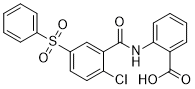
BAY-8002 is a novel, potent, selective, and orally bioactive inhibitor of monocarboxylate transporter 1 (MCT1) with an IC50 of 85 nM in the MCT1-expressing DLD-1 cells, it displays excellent selectivity against MCT4. Anti-tumor activity. The lactate transporter SLC16A1/monocarboxylate transporter 1 (MCT1) plays a central role in tumor cell energy homeostasis. BAY-8002 potently suppress bidirectional lactate transport. BAY-8002 significantly increased intratumor lactate levels and transiently modulated pyruvate levels.
Physicochemical Properties
| Molecular Formula | C20H14CLNO5S |
| Molecular Weight | 415.8469 |
| Exact Mass | 415.028 |
| CAS # | 724440-27-1 |
| PubChem CID | 992293 |
| Appearance | White to off-white solid powder |
| LogP | 4.3 |
| Hydrogen Bond Donor Count | 2 |
| Hydrogen Bond Acceptor Count | 5 |
| Rotatable Bond Count | 5 |
| Heavy Atom Count | 28 |
| Complexity | 671 |
| Defined Atom Stereocenter Count | 0 |
| SMILES | ClC1C=CC(=CC=1C(NC1=CC=CC=C1C(=O)O)=O)S(C1C=CC=CC=1)(=O)=O |
| InChi Key | CLAUJSRBKSRTGQ-UHFFFAOYSA-N |
| InChi Code | InChI=1S/C20H14ClNO5S/c21-17-11-10-14(28(26,27)13-6-2-1-3-7-13)12-16(17)19(23)22-18-9-5-4-8-15(18)20(24)25/h1-12H,(H,22,23)(H,24,25) |
| Chemical Name | 2-(2-chloro-5-(phenylsulfonyl)benzamido)benzoic acid |
| Synonyms | BAY-8002; BAY 8002; BAY8002 |
| HS Tariff Code | 2934.99.9001 |
| Storage |
Powder-20°C 3 years 4°C 2 years In solvent -80°C 6 months -20°C 1 month |
| Shipping Condition | Room temperature (This product is stable at ambient temperature for a few days during ordinary shipping and time spent in Customs) |
Biological Activity
| Targets | The MCT1 inhibitor BAY-8002 exhibits good selectivity for MCT4 (IC50 >50 μM in EVSA-T cells) and an IC50 of 85 nM in MCT1-expressing DLD-1 cells [1]. |
| ln Vitro |
The MCT1 inhibitor BAY-8002 exhibits good selectivity for MCT4 (IC50 >50 μM in EVSA-T cells) and an IC50 of 85 nM in MCT1-expressing DLD-1 cells [1]. BAY-8002 inhibits bidirectional lactate transport in MCT1‑expressing cells. It blocks lactate import (IC₅₀ ≈ 85 nM in DLD‑1 cells) and reduces lactate efflux (≈60% efficacy) in multiple cell lines. It decreases extracellular acidification rate (ECAR) and inhibits proliferation of MCT1‑expressing Burkitt lymphoma cells (Raji, Daudi) with IC₅₀ values in the nanomolar range. No significant off‑target activity was observed in a panel of 68 channels, transporters, and other proteins. [1] |
| ln Vivo |
In Raji tumor-bearing mice, BAY-8002 (80 and 160 mg/kg, orally, twice daily for more than 26 days) effectively suppressed tumor growth [1]. In Raji Burkitt lymphoma xenograft models, oral administration of BAY-8002 (80 and 160 mg/kg twice daily) significantly inhibited tumor growth but did not cause regression. Intratumor lactate levels increased significantly (3 and 6 h post‑dose), while pyruvate levels showed a transient decrease. Similar effects were observed with AZD3965. In WSU‑DLCL2 (DLBCL) and Colo320DM (colorectal) models, no significant antitumor efficacy was observed despite intratumor lactate accumulation. [1] |
| Enzyme Assay |
Lactate transport inhibition was measured using a pH‑dependent SNARF‑5 fluorescence assay. DLD‑1 cells (MCT1‑high) and 786‑O cells (MCT4‑high) were seeded in 384‑well plates, loaded with SNARF‑5 AM ester, treated with compound, and lactate‑induced acidification was monitored fluorometrically. IC₅₀ values were calculated from the fluorescence change between 7 and 32 seconds after lactate addition. [1] Radio‑ligand binding assays were performed using cell membranes from MCT1‑expressing lines. Membranes were incubated with tritiated BAY-8002 or AZD3965, and specific binding was determined by filtration and scintillation counting. Competition experiments used unlabeled compounds to calculate Kᵢ values. [1] |
| Cell Assay |
Proliferation assays: Cells were seeded in 96‑well plates, treated with serial dilutions of BAY-8002 or DMSO, and viability was measured after 72 h using a cell‑titer glow assay. IC₅₀ and maximal growth inhibition were determined. [1] Lactate uptake assays: Cells were incubated in glucose‑free buffer, treated with compound, and exposed to ¹⁴C‑L‑lactate. Uptake was stopped by washing, cells were lysed, and radioactivity was quantified by scintillation counting. [1] Extracellular flux analysis: ECAR and OCR were measured using a Seahorse XF analyzer. Cells were plated in XF plates, treated with compounds, and real‑time metabolic rates were recorded. [1] Western blot and qPCR: Protein and mRNA levels of MCT isoforms were analyzed using standard Western blot and TaqMan qPCR protocols. [1] |
| Animal Protocol |
Animal/Disease Models: Female NOD SCID (severe combined immunodeficient) mouse (7-10 weeks old) bearing Raji cells [1] Doses: 80 and 160 mg/kg Route of Administration: Orally, twice (two times) daily for more than 26 days Experimental Results: Inhibition of tumor growth, There was no significant weight loss, but it had no effect on tumor regression. Immunocompromised female mice were implanted subcutaneously with tumor cells (e.g., Raji, WSU‑DLCL2, Daudi, Colo320DM). When tumors reached a defined size, mice were stratified by tumor volume and assigned to treatment or vehicle groups. BAY-8002 or AZD3965 were administered orally (by gavage) twice daily at doses of 40, 80, or 160 mg/kg (BAY‑8002) or 50 mg/kg (AZD3965). Tumor dimensions and body weight were measured at least twice weekly. At study end, tumors were harvested for weight measurement and metabolite analysis. [1] |
| ADME/Pharmacokinetics |
Plasma protein binding of BAY-8002 is very high. Pharmacokinetic studies in mice showed that oral dosing (40, 80, 160 mg/kg twice daily) achieved plasma concentrations above the protein‑binding‑corrected IC₅₀ for prolonged periods. Unbound plasma concentration‑time profiles were simulated using non‑parametric superpositioning. [1] |
| Toxicity/Toxicokinetics |
In vivo treatments with BAY-8002 (up to 160 mg/kg twice daily) were well tolerated; no significant body weight loss or overt toxicity was reported in the xenograft studies. [1] |
| References |
[1]. Preclinical Efficacy of the Novel Monocarboxylate Transporter 1 Inhibitor BAY-8002 and Associated Markers of Resistance. Mol Cancer Ther. 2018 Nov;17(11):2285-2296. |
| Additional Infomation |
BAY-8002 represents a novel structural class of MCT1 inhibitors distinct from AZD3965. It was identified through a dedicated cell‑based high‑throughput screen using a pH‑sensitive fluorescent readout. Sensitivity to MCT1 inhibition correlates with low MCT4 expression, low PHLDA2, and high PELI1 expression, but no single marker reliably predicts response. Acquired resistance can occur via upregulation of MCT4 (even under normoxia) and/or a metabolic shift toward oxidative phosphorylation. The limited tumor regression in vivo suggests that combination therapies (e.g., with oxidative phosphorylation inhibitors) may be required for improved efficacy. [1] |
Solubility Data
| Solubility (In Vitro) | DMSO : ~125 mg/mL (~300.59 mM) |
| Solubility (In Vivo) |
Solubility in Formulation 1: ≥ 2.08 mg/mL (5.00 mM) (saturation unknown) in 10% DMSO + 40% PEG300 + 5% Tween80 + 45% Saline (add these co-solvents sequentially from left to right, and one by one), clear solution. For example, if 1 mL of working solution is to be prepared, you can add 100 μL of 20.8 mg/mL clear DMSO stock solution to 400 μL PEG300 and mix evenly; then add 50 μL Tween-80 to the above solution and mix evenly; then add 450 μL normal saline to adjust the volume to 1 mL. Preparation of saline: Dissolve 0.9 g of sodium chloride in 100 mL ddH₂ O to obtain a clear solution. Solubility in Formulation 2: 2.08 mg/mL (5.00 mM) in 10% DMSO + 90% (20% SBE-β-CD in Saline) (add these co-solvents sequentially from left to right, and one by one), suspension solution; with ultrasonication. For example, if 1 mL of working solution is to be prepared, you can add 100 μL of 20.8 mg/mL clear DMSO stock solution to 900 μL of 20% SBE-β-CD physiological saline solution and mix evenly. Preparation of 20% SBE-β-CD in Saline (4°C,1 week): Dissolve 2 g SBE-β-CD in 10 mL saline to obtain a clear solution. Solubility in Formulation 3: ≥ 2.08 mg/mL (5.00 mM) (saturation unknown) in 10% DMSO + 90% Corn Oil (add these co-solvents sequentially from left to right, and one by one), clear solution. For example, if 1 mL of working solution is to be prepared, you can add 100 μL of 20.8 mg/mL clear DMSO stock solution to 900 μL of corn oil and mix evenly. (Please use freshly prepared in vivo formulations for optimal results.) |
| Preparing Stock Solutions | 1 mg | 5 mg | 10 mg | |
| 1 mM | 2.4047 mL | 12.0236 mL | 24.0471 mL | |
| 5 mM | 0.4809 mL | 2.4047 mL | 4.8094 mL | |
| 10 mM | 0.2405 mL | 1.2024 mL | 2.4047 mL |