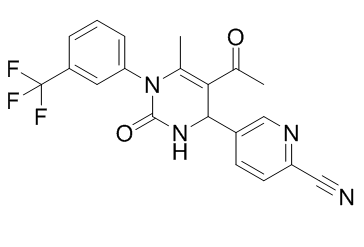
BAY-678 racemate is a racemate of BAY-678 which is a novel, potent, orally bioavailable, selective and cell-permeable inhibitor of human neutrophil elastase (HNE) with an IC50 of 20 nM. Human neutrophil elastase (HNE) is a key protease for matrix degradation. High HNE activity is observed in inflammatory diseases. Accordingly, HNE is a potential target for the treatment of pulmonary diseases such as chronic obstructive pulmonary disease (COPD), acute lung injury (ALI), acute respiratory distress syndrome (ARDS), bronchiectasis (BE), and pulmonary hypertension (PH). HNE inhibitors should reestablish the protease-anti-protease balance. BAY-678 is also nominated as a chemical probe to the public via the Structural Genomics Consortium (SGC). BAY-678 has a favorable pharmacokinetic profile. The cell based activity of BAY-678 on HNE is not relevant and has not been measured. Efficacy was demonstrated in acute in vivo models, for example, protease-induced acute lung injury (ALI) in mice, where exogenous HNE in the mouse lung was inhibited with Ki = 15 nM after oral administration.
Physicochemical Properties
| Molecular Formula | C20H15F3N4O2 |
| Molecular Weight | 400.353914499283 |
| Exact Mass | 400.114 |
| CAS # | 675103-35-2 |
| Related CAS # | BAY-677;2117404-84-7;BAY-678;675103-36-3 |
| PubChem CID | 59218311 |
| Appearance | Light yellow to yellow solid powder |
| LogP | 2.5 |
| Hydrogen Bond Donor Count | 1 |
| Hydrogen Bond Acceptor Count | 7 |
| Rotatable Bond Count | 3 |
| Heavy Atom Count | 29 |
| Complexity | 755 |
| Defined Atom Stereocenter Count | 0 |
| SMILES | C1(C#N)=NC=C(C2C(C(C)=O)=C(C)N(C3=CC=CC(C(F)(F)F)=C3)C(=O)N2)C=C1 |
| InChi Key | PGIVGIFOWOVINL-GOSISDBHSA-N |
| InChi Code | InChI=1S/C20H15F3N4O2/c1-11-17(12(2)28)18(13-6-7-15(9-24)25-10-13)26-19(29)27(11)16-5-3-4-14(8-16)20(21,22)23/h3-8,10,18H,1-2H3,(H,26,29)/t18-/m1/s1 |
| Chemical Name | (R)-5-(5-acetyl-6-methyl-2-oxo-1-(3-(trifluoromethyl)phenyl)-1,2,3,4-tetrahydropyrimidin-4-yl)picolinonitrile |
| Synonyms | BAY-678 racemate; BAY678 racemate; BAY 678 racemate. |
| HS Tariff Code | 2934.99.9001 |
| Storage |
Powder-20°C 3 years 4°C 2 years In solvent -80°C 6 months -20°C 1 month |
| Shipping Condition | Room temperature (This product is stable at ambient temperature for a few days during ordinary shipping and time spent in Customs) |
Biological Activity
| ln Vitro | BAY-678 while maintaining outstanding target selectivity, picomolar potency was achieved by locking the bioactive conformation of these inhibitors with a strategically positioned methyl sulfone substituent. An induced-fit binding mode allowed tight interactions with the S2 and S1 pockets of HNE.[1] |
| Enzyme Assay | To confirm the exceptionally high potency of BAY-678 and BAY 85-8501 , we measured enzyme reaction velocities with different substrate concentrations at various inhibitor concentrations and extrapolated the inhibition constants (Ki) from Dixon plots. Both compounds revealed (substrate) competitive inhibition, further confirming their binding into the active site of the enzyme. However, the Ki values toward rodent orthologous enzymes were about two orders of magnitude higher than toward HNE. Beneficially, BAY-678 and BAY 85-8501 revealed no inhibition against 21 related serine proteases, up to an inhibitor concentration of 30 μm .[1] |
| References |
[1]. Freezing the Bioactive Conformation to Boost Potency: The Identification of BAY 85-8501, a Selective and Potent Inhibitor of Human Neutrophil Elastase for Pulmonary Diseases. ChemMedChem. 2015 Jul;10(7):1163-73. |
Solubility Data
| Solubility (In Vitro) | DMSO : ≥ 150 mg/mL (~374.67 mM) |
| Solubility (In Vivo) |
Solubility in Formulation 1: ≥ 2.5 mg/mL (6.24 mM) (saturation unknown) in 10% DMSO + 40% PEG300 + 5% Tween80 + 45% Saline (add these co-solvents sequentially from left to right, and one by one), clear solution. For example, if 1 mL of working solution is to be prepared, you can add 100 μL of 25.0 mg/mL clear DMSO stock solution to 400 μL PEG300 and mix evenly; then add 50 μL Tween-80 to the above solution and mix evenly; then add 450 μL normal saline to adjust the volume to 1 mL. Preparation of saline: Dissolve 0.9 g of sodium chloride in 100 mL ddH₂ O to obtain a clear solution. Solubility in Formulation 2: 2.5 mg/mL (6.24 mM) in 10% DMSO + 90% (20% SBE-β-CD in Saline) (add these co-solvents sequentially from left to right, and one by one), suspension solution; with ultrasonication. For example, if 1 mL of working solution is to be prepared, you can add 100 μL of 25.0 mg/mL clear DMSO stock solution to 900 μL of 20% SBE-β-CD physiological saline solution and mix evenly. Preparation of 20% SBE-β-CD in Saline (4°C,1 week): Dissolve 2 g SBE-β-CD in 10 mL saline to obtain a clear solution. Solubility in Formulation 3: 2.5 mg/mL (6.24 mM) in 10% DMSO + 90% Corn Oil (add these co-solvents sequentially from left to right, and one by one), clear solution. For example, if 1 mL of working solution is to be prepared, you can add 100 μL of 25.0 mg/mL clear DMSO stock solution to 900 μL of corn oil and mix evenly. (Please use freshly prepared in vivo formulations for optimal results.) |
| Preparing Stock Solutions | 1 mg | 5 mg | 10 mg | |
| 1 mM | 2.4978 mL | 12.4891 mL | 24.9781 mL | |
| 5 mM | 0.4996 mL | 2.4978 mL | 4.9956 mL | |
| 10 mM | 0.2498 mL | 1.2489 mL | 2.4978 mL |