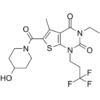
BAY-545 is a novel, potent and selective antagonist of A2B adenosine receptor with an IC50 of 59 nM. Additionally, BAY-545 shows a Ki of 97 nM for the human A2B adenosine receptor, which is more selective than the A1, A2A, and A3 adenosine receptors. The IC50s for the human, mouse, and rat A2B adenosine receptor in cells are 66, 400, and 280 nM, respectively. The four members of the adenosine receptor family are A1, A2A, A2B, and A3. The G protein-coupled A2B receptor is one of these receptors. While under the circumstances of an acute insult, adenosine-mediated A2B receptor signaling reduces acute inflammation, promotes tissue adaptation to hypoxia, and increases ischemia tolerance, persistently elevated adenosine levels and A2B receptor signaling are features of several chronic disease states.
Physicochemical Properties
| Molecular Formula | C18H22F3N3O4S |
| Molecular Weight | 433.445193767548 |
| Exact Mass | 433.13 |
| Elemental Analysis | C, 49.88; H, 5.12; F, 13.15; N, 9.69; O, 14.76; S, 7.40 |
| CAS # | 1699717-32-2 |
| PubChem CID | 118016229 |
| Appearance | Solid powder |
| LogP | 2.7 |
| Hydrogen Bond Donor Count | 1 |
| Hydrogen Bond Acceptor Count | 8 |
| Rotatable Bond Count | 4 |
| Heavy Atom Count | 29 |
| Complexity | 669 |
| Defined Atom Stereocenter Count | 0 |
| InChi Key | NTYVAKNEYLJAPT-UHFFFAOYSA-N |
| InChi Code | InChI=1S/C18H22F3N3O4S/c1-3-23-14(26)12-10(2)13(15(27)22-7-4-11(25)5-8-22)29-16(12)24(17(23)28)9-6-18(19,20)21/h11,25H,3-9H2,1-2H3 |
| Chemical Name | 3-ethyl-6-(4-hydroxypiperidine-1-carbonyl)-5-methyl-1-(3,3,3-trifluoropropyl)thieno[2,3-d]pyrimidine-2,4-dione |
| Synonyms | BAY-545; BAY 545; BAY545 |
| HS Tariff Code | 2934.99.9001 |
| Storage |
Powder-20°C 3 years 4°C 2 years In solvent -80°C 6 months -20°C 1 month |
| Shipping Condition | Room temperature (This product is stable at ambient temperature for a few days during ordinary shipping and time spent in Customs) |
Biological Activity
| Targets |
A2B adenosine receptor ( IC50 = 59 nM ); Human A2B adenosine receptor ( IC50 = 66 nM ); Mouse A2B adenosine receptor ( IC50 = 400 nM ); Rat A2B adenosine receptor ( IC50 = 280 nM ); Human A1 adenosine receptor ( IC50 = 1300 nM ); Human A2A adenosine receptor ( IC50 = 820 nM ); Mouse A2A adenosine receptor ( IC50 = 470 nM ); Rat A2A adenosine receptor ( IC50 = 750 nM ); A2B adenosine receptor ( Ki = 97 nM ) |
| ln Vitro | BAY-545 exhibits selectivity towards the A2B adenosine receptor, as opposed to the A1, A2A, and A3 adenosine receptors. The IC50 values for the human A1 adenosine receptor, human A2A adenosine receptor, mouse A2A adenosine receptor, and rat A2A adenosine receptor are 1300 nM, 820 nM, and 750 nM, respectively. |
| References |
[1]. Novel non-xanthine antagonist of the A2B adenosine receptor: From HTS hit to lead structure. Eur J Med Chem. 2019 Feb 1;163:763-778. |
Solubility Data
| Solubility (In Vitro) |
DMSO: ~87 mg/mL (~200.7 mM) Ethanol: ~87 mg/mL |
| Solubility (In Vivo) |
Solubility in Formulation 1: ≥ 2.5 mg/mL (5.77 mM) (saturation unknown) in 10% DMSO + 40% PEG300 + 5% Tween80 + 45% Saline (add these co-solvents sequentially from left to right, and one by one), clear solution. For example, if 1 mL of working solution is to be prepared, you can add 100 μL of 25.0 mg/mL clear DMSO stock solution to 400 μL PEG300 and mix evenly; then add 50 μL Tween-80 to the above solution and mix evenly; then add 450 μL normal saline to adjust the volume to 1 mL. Preparation of saline: Dissolve 0.9 g of sodium chloride in 100 mL ddH₂ O to obtain a clear solution. Solubility in Formulation 2: ≥ 2.5 mg/mL (5.77 mM) (saturation unknown) in 10% DMSO + 90% (20% SBE-β-CD in Saline) (add these co-solvents sequentially from left to right, and one by one), clear solution. For example, if 1 mL of working solution is to be prepared, you can add 100 μL of 25.0 mg/mL clear DMSO stock solution to 900 μL of 20% SBE-β-CD physiological saline solution and mix evenly. Preparation of 20% SBE-β-CD in Saline (4°C,1 week): Dissolve 2 g SBE-β-CD in 10 mL saline to obtain a clear solution. Solubility in Formulation 3: ≥ 2.5 mg/mL (5.77 mM) (saturation unknown) in 10% DMSO + 90% Corn Oil (add these co-solvents sequentially from left to right, and one by one), clear solution. For example, if 1 mL of working solution is to be prepared, you can add 100 μL of 25.0 mg/mL clear DMSO stock solution to 900 μL of corn oil and mix evenly. (Please use freshly prepared in vivo formulations for optimal results.) |
| Preparing Stock Solutions | 1 mg | 5 mg | 10 mg | |
| 1 mM | 2.3071 mL | 11.5354 mL | 23.0707 mL | |
| 5 mM | 0.4614 mL | 2.3071 mL | 4.6141 mL | |
| 10 mM | 0.2307 mL | 1.1535 mL | 2.3071 mL |