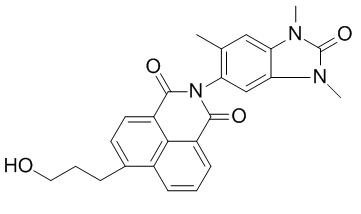
BAY-299 (BAY299) is a novel, highly potent, and selective dual inhibitor of BRD1 and TAF1 with important biological activity. It inhibits BRPF2 bromodomains (BD), TAF1 BD2 and TAF1L BD2 with IC50s of 67 nM, 8 nM, and 106 nM, respectively. Bromodomains (BD) are readers of lysine acetylation marks present in numerous proteins associated with chromatin. The substituted benzoisoquinolinedione series was identified by high-throughput screening, and subsequent structure-activity relationship optimization allowed generation of low nanomolar BRPF2 BD inhibitors with strong selectivity against BRPF1 and BRPF3 BDs. In addition, a strong inhibition of TAF1/TAF1L BD2 was measured for most derivatives. The best compound of the series was BAY-299, which is a very potent, dual inhibitor with an IC50 of 67 nM for BRPF2 BD, 8 nM for TAF1 BD2, and 106 nM for TAF1L BD2. Importantly, no activity was measured for BRD4 BDs. Furthermore, cellular activity was evidenced using a BRPF2- or TAF1-histone H3.3 or H4 interaction assay.
Physicochemical Properties
| Exact Mass | 429.168 |
| CAS # | 2080306-23-4 |
| PubChem CID | 122705990 |
| Appearance | Light yellow to yellow solid powder |
| Density | 1.4±0.1 g/cm3 |
| Boiling Point | 688.7±55.0 °C at 760 mmHg |
| Flash Point | 370.3±31.5 °C |
| Vapour Pressure | 0.0±2.3 mmHg at 25°C |
| Index of Refraction | 1.697 |
| LogP | 2.3 |
| Hydrogen Bond Donor Count | 1 |
| Hydrogen Bond Acceptor Count | 4 |
| Rotatable Bond Count | 4 |
| Heavy Atom Count | 32 |
| Complexity | 787 |
| Defined Atom Stereocenter Count | 0 |
| InChi Key | OFWWWKWUCDUISA-UHFFFAOYSA-N |
| InChi Code | InChI=1S/C25H23N3O4/c1-14-12-20-21(27(3)25(32)26(20)2)13-19(14)28-23(30)17-8-4-7-16-15(6-5-11-29)9-10-18(22(16)17)24(28)31/h4,7-10,12-13,29H,5-6,11H2,1-3H3 |
| Chemical Name | 6-(3-Hydroxypropyl)-2-(1,3,6-trimethyl-2-oxo-2,3-dihydro-1H-benzimidazol-5-yl)-1H-benzo[de]isoquinoline-1,3(2H)-dione |
| Synonyms | BAY299; BAY 299; BAY-299. |
| HS Tariff Code | 2934.99.9001 |
| Storage |
Powder-20°C 3 years 4°C 2 years In solvent -80°C 6 months -20°C 1 month |
| Shipping Condition | Room temperature (This product is stable at ambient temperature for a few days during ordinary shipping and time spent in Customs) |
Biological Activity
| ln Vitro | BAY-299 functions as a dual inhibitor, targeting both the TATA box-binding protein-associated factors TAF1 and TAF1L as well as the bromodomain and PHD finger (BRPF) family member BRPF2. With an IC50 of 67 nM and a selectivity that is 47 and 83 times greater than that of BRPF1 and BRPF3 BD, respectively, the TR-FRET test demonstrated that BAY-299 is a strong inhibitor of BRPF2 BD. The AlphaScreen test provided additional confirmation of BAY-299's properties. An IC50 of 97 nM was found, suggesting 23- and 25-fold selectivity over BRPF1 and BRPF3 BD, respectively. With IC50 values of 575 and 825 nM, respectively, BAY-299 inhibits the interaction of BRPF2 BD with histones H4 and H3.3, according to NanoBRET studies. The IC50 values for TAF1 BD2 were 970 and 1400 nM, in that order. At doses up to 10 μM, BAY-299 showed no inhibitory effect on the interaction between BRPF1 or BRD4 and histone H4. The MOLM-13, MV4-11, 769-P, Jurkat, NCI-H526, CHL-1, and 5637 cell growth is inhibited by BAY-299, with corresponding GI50 values of 1060, 2630, 3210, 3900, 6860, 7400, and 7980 nM [1]. |
| ln Vivo | Research on the pharmacokinetic characteristics of BAY-299 in rats reveals that the drug has a large steady-state volume of distribution, a long to very long terminal half-life (t1/2=10 hours), a low blood clearance rate (about 17% of hepatic blood flow), and a high bioavailability (F=73%). Although in vivo blood clearance was less than anticipated based on hepatocyte data, it was in line with estimates based on rat liver microsomal values [1]. |
| References |
[1]. Benzoisoquinolinediones as Potent and Selective Inhibitors of BRPF2 and TAF1/TAF1L Bromodomains. J Med Chem. 2017 May 11;60(9):4002-4022. |
Solubility Data
| Solubility (In Vitro) | DMSO : ~25 mg/mL (~58.21 mM) |
| Solubility (In Vivo) |
Solubility in Formulation 1: ≥ 2.5 mg/mL (5.82 mM) (saturation unknown) in 10% DMSO + 40% PEG300 + 5% Tween80 + 45% Saline (add these co-solvents sequentially from left to right, and one by one), clear solution. For example, if 1 mL of working solution is to be prepared, you can add 100 μL of 25.0 mg/mL clear DMSO stock solution to 400 μL PEG300 and mix evenly; then add 50 μL Tween-80 to the above solution and mix evenly; then add 450 μL normal saline to adjust the volume to 1 mL. Preparation of saline: Dissolve 0.9 g of sodium chloride in 100 mL ddH₂ O to obtain a clear solution. Solubility in Formulation 2: ≥ 2.5 mg/mL (5.82 mM) (saturation unknown) in 10% DMSO + 90% Corn Oil (add these co-solvents sequentially from left to right, and one by one), clear solution. For example, if 1 mL of working solution is to be prepared, you can add 100 μL of 25.0 mg/mL clear DMSO stock solution to 900 μL of corn oil and mix evenly. (Please use freshly prepared in vivo formulations for optimal results.) |