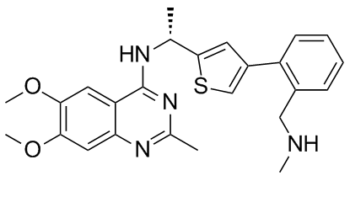
BAY-293 (BAY293) is a novel, potent, cell-active small-molecule SOS1 inhibitor with anticancer activity. It functions by preventing RAS activation by interfering with the RAS-SOS1 interaction, with an IC50 of 21 nM. Using a KRASG12C–SOS1cat NMR fragment-based screening assay, BAY-293 was discovered, and it effectively interferes with the interaction of KRAS and its exchange factor SOS1. Since the late 1980s, it has been known that significant oncogenes with a high frequency of occurrence in human cancers are mutations in the RAS genes. Due to these mutations, the small GTPase RAS is less able to hydrolyze GTP, which maintains this molecular switch in a constitutively active GTP-bound form that uncontrollably triggers oncogenic downstream signaling. Guanine nucleotide exchange factors, which enable RAS to cycle from the inactive GDP-bound state to the active GTP-bound form, are one tactic to lower the levels of active RAS. Using the crystal structures of KRASG12C-SOS1, SOS1, and SOS2, the binding sites, mechanism of action, and selectivity were determined. These inhibitors inhibit the reloading of KRAS with GTP, which results in antiproliferative activity, by preventing the formation of the KRAS-SOS1 complex. With an IC50 of 21 nM, compound 23 (BAY-293) is the last one to selectively inhibit the KRAS-SOS1 interaction. It is a useful chemical probe for further studies.
Physicochemical Properties
| Molecular Formula | C25H28N4O2S |
| Molecular Weight | 448.5804 |
| Exact Mass | 448.19 |
| Elemental Analysis | C, 66.94; H, 6.29; N, 12.49; O, 7.13; S, 7.15 |
| CAS # | 2244904-70-7 |
| Related CAS # | (S)-BAY-293; 2244904-69-4 |
| PubChem CID | 137322663 |
| Appearance | White to light yellow solid powder |
| LogP | 4.8 |
| Hydrogen Bond Donor Count | 2 |
| Hydrogen Bond Acceptor Count | 7 |
| Rotatable Bond Count | 8 |
| Heavy Atom Count | 32 |
| Complexity | 584 |
| Defined Atom Stereocenter Count | 1 |
| SMILES | CC1=NC2=CC(=C(C=C2C(=N1)N[C@H](C)C3=CC(=CS3)C4=CC=CC=C4CNC)OC)OC |
| InChi Key | WEGLOYDTDILXDA-OAHLLOKOSA-N |
| InChi Code | InChI=1S/C25H28N4O2S/c1-15(24-10-18(14-32-24)19-9-7-6-8-17(19)13-26-3)27-25-20-11-22(30-4)23(31-5)12-21(20)28-16(2)29-25/h6-12,14-15,26H,13H2,1-5H3,(H,27,28,29)/t15-/m1/s1 |
| Chemical Name | 6,7-dimethoxy-2-methyl-N-[(1R)-1-[4-[2-(methylaminomethyl)phenyl]thiophen-2-yl]ethyl]quinazolin-4-amine |
| Synonyms | BAY293; BAY 293; BAY-293 |
| HS Tariff Code | 2934.99.9001 |
| Storage |
Powder-20°C 3 years 4°C 2 years In solvent -80°C 6 months -20°C 1 month |
| Shipping Condition | Room temperature (This product is stable at ambient temperature for a few days during ordinary shipping and time spent in Customs) |
Biological Activity
| Targets | KRAS-SOS1 ( IC50 = 21 nM ) |
| ln Vitro |
BAY-293 suppresses the activation of RAS in HeLa cells with IC50 values in the submicromolar range[1]. BAY-293 (595 nM-3580 nM; 72 hours) demonstrates efficient antiproliferative activity against KRAS cell lines carrying the wild-type mutation (K-562, MOLM-13) as well as those carrying the KRASG12C mutation (NCI-H358, Calu-1)[1]. BAY-293 effectively reduces the levels of pERK in K-562 cells without changing the amount of ERK protein overall[1]. |
| ln Vivo | BAY-293, an SOS1/Ras inhibitor was discovered to suppress colony formation and proliferation in resistant and BCR-ABL independent chronic myeloid leukemia cells. |
| Cell Assay |
Cell Line: K-562, MOLM-13, H358 and Calu-1 cell lines Concentration: 595-3580 nM Incubation Time: 72 hours Result: IC50s of 1,090±170 nM, 995±400 nM, 3,480±100 nM and 3,190±50 nM for K-562, MOLM-13, H358 and Calu-1 cells, respectively. |
| References |
[1]. Discovery of potent SOS1 inhibitors that block RAS activation via disruption of the RAS-SOS1interaction. Proc Natl Acad Sci U S A. 2019 Feb 12;116(7):2551-2560. |
Solubility Data
| Solubility (In Vitro) |
DMSO: ~90 mg/mL (~200.6 mM) Ethanol: ~90 mg/mL |
| Solubility (In Vivo) |
Solubility in Formulation 1: ≥ 2.08 mg/mL (4.64 mM) (saturation unknown) in 10% DMSO + 40% PEG300 + 5% Tween80 + 45% Saline (add these co-solvents sequentially from left to right, and one by one), clear solution. For example, if 1 mL of working solution is to be prepared, you can add 100 μL of 20.8 mg/mL clear DMSO stock solution to 400 μL PEG300 and mix evenly; then add 50 μL Tween-80 to the above solution and mix evenly; then add 450 μL normal saline to adjust the volume to 1 mL. Preparation of saline: Dissolve 0.9 g of sodium chloride in 100 mL ddH₂ O to obtain a clear solution. Solubility in Formulation 2: ≥ 2.08 mg/mL (4.64 mM) (saturation unknown) in 10% DMSO + 90% Corn Oil (add these co-solvents sequentially from left to right, and one by one), clear solution. For example, if 1 mL of working solution is to be prepared, you can add 100 μL of 20.8 mg/mL clear DMSO stock solution to 900 μL of corn oil and mix evenly. (Please use freshly prepared in vivo formulations for optimal results.) |
| Preparing Stock Solutions | 1 mg | 5 mg | 10 mg | |
| 1 mM | 2.2293 mL | 11.1463 mL | 22.2926 mL | |
| 5 mM | 0.4459 mL | 2.2293 mL | 4.4585 mL | |
| 10 mM | 0.2229 mL | 1.1146 mL | 2.2293 mL |