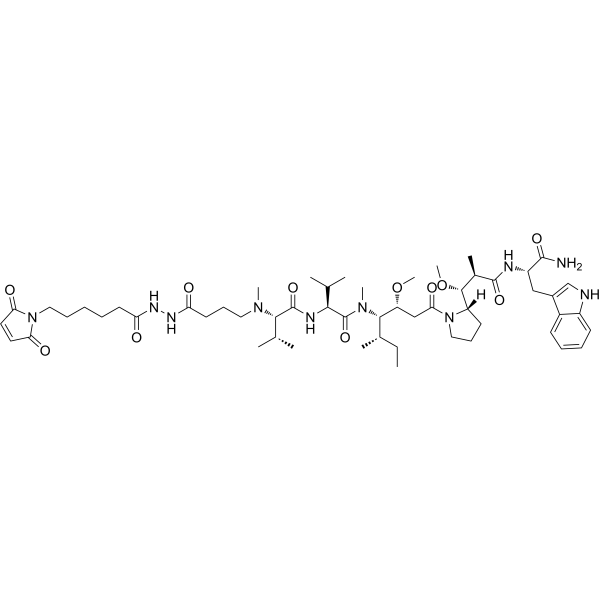
Physicochemical Properties
| Molecular Formula | C55H86N10O11 |
| Molecular Weight | 1063.33175420761 |
| CAS # | 1404071-37-9 |
| PubChem CID | 86678384 |
| Appearance | White to off-white solid powder |
| Hydrogen Bond Donor Count | 6 |
| Hydrogen Bond Acceptor Count | 12 |
| Rotatable Bond Count | 31 |
| Heavy Atom Count | 76 |
| Complexity | 2000 |
| Defined Atom Stereocenter Count | 9 |
| SMILES | C(C1=CNC2=CC=CC=C12)[C@@H](C(=O)N)NC(=O)[C@H](C)[C@H]([C@]1([H])CCCN1C(=O)C[C@@H](OC)[C@]([H])([C@@H](C)CC)N(C)C(=O)[C@H](C(C)C)NC(=O)[C@H](C(C)C)N(C)CCCC(=O)NNC(=O)CCCCCN1C(C=CC1=O)=O)OC |
| HS Tariff Code | 2934.99.9001 |
| Storage |
Powder-20°C 3 years 4°C 2 years In solvent -80°C 6 months -20°C 1 month |
| Shipping Condition | Room temperature (This product is stable at ambient temperature for a few days during ordinary shipping and time spent in Customs) |
Biological Activity
| ln Vitro | The protein C4.4A (LYPD3) is largely absent from normal tissues and is expressed in non-small cell lung cancer (NSCLC) [1]. One possible synthetic variant of BAY 1135626 is BAY 1129980 (C4.4A-ADC), which has potent anti-proliferative properties on cell lines that express C4.4A [1]. The proliferation of the A549 lung cancer cell line transfected with C4.4A is inhibited by BAY 1129980 (0.001-100 nM; 72 h) [1]. When tested in vitro against hC4.4A:A549 cells, BAY 1129980 (0.001-100 nM; 72 h) demonstrates a highly selective effectiveness [1]. |
| ln Vivo | Mice's tumor growth is inhibited by BAY 1129980 (1.9-7.5 mg/kg; intravenous injection; 20 days) [1]. Treatment sensitivity remained unchanged and the repeated intravenous administration of BAY 1129980 (15 mg/kg) was well tolerated [1]. The first cycle lasted for 21 days, while the second cycle lasted for 57 days. |
| Cell Assay |
Cytotoxicity assay[1] Cell Types: hC4.4A:A549 lung cancer cells Tested Concentrations: 0.001-100 nM Incubation Duration: 72 hrs (hours) Experimental Results: High potency in the subnanomolar range with an IC50 value of 0.05 nM. Selectivity for hC4.4A:A549 was over 1,000-fold higher compared to mock:A549 cells. Cell viability assay[1] Cell Types: NCI-H292, FaDu, NCI-H322, SCaBER, SCC-4 Tested Concentrations: 0.001-100 nM Incubation Duration: 72 hrs (hours) Experimental Results: Inhibition of cancer cell growth in a dose-dependent manner. |
| Animal Protocol |
Animal/Disease Models: C4.4A-positive NCI-H292 NSCLC xenograft mouse model [1] Doses: 1.9, 3.75, 7.5 mg/kg Route of Administration: intravenous (iv) (iv)injection; intravenous (iv) (iv)injection. 20-day Experimental Results: Tumor growth ceased on day 20 in a dose-dependent manner, with a minimum effective dose (MED) of 1.9 mg/kg as monotherapy. Animal/Disease Models: C4.4A positive NCI-H292 NSCLC xenograft mouse model [1] Doses: 15 mg/kg Route of Administration: intravenous (iv) (iv)injection; the first cycle treatment group is 21 days, the second cycle treatment group is 57 days. Experimental Results: Tumor volume is diminished and tumor growth is Dramatically delayed. It was shown to be well tolerated, but regenerated tumors remained sensitive to treatment. |
| References |
[1]. Preclinical Antitumor Efficacy of BAY 1129980-a Novel Auristatin-Based Anti-C4.4A (LYPD3) Antibody-Drug Conjugate for the Treatment of Non-Small Cell Lung Cancer. Mol Cancer Ther. 2017 May. 16(5):893-904. |
Solubility Data
| Solubility (In Vitro) | May dissolve in DMSO (in most cases), if not, try other solvents such as H2O, Ethanol, or DMF with a minute amount of products to avoid loss of samples |
| Solubility (In Vivo) |
Note: Listed below are some common formulations that may be used to formulate products with low water solubility (e.g. < 1 mg/mL), you may test these formulations using a minute amount of products to avoid loss of samples. Injection Formulations (e.g. IP/IV/IM/SC) Injection Formulation 1: DMSO : Tween 80: Saline = 10 : 5 : 85 (i.e. 100 μL DMSO stock solution → 50 μL Tween 80 → 850 μL Saline) *Preparation of saline: Dissolve 0.9 g of sodium chloride in 100 mL ddH ₂ O to obtain a clear solution. Injection Formulation 2: DMSO : PEG300 :Tween 80 : Saline = 10 : 40 : 5 : 45 (i.e. 100 μL DMSO → 400 μLPEG300 → 50 μL Tween 80 → 450 μL Saline) Injection Formulation 3: DMSO : Corn oil = 10 : 90 (i.e. 100 μL DMSO → 900 μL Corn oil) Example: Take the Injection Formulation 3 (DMSO : Corn oil = 10 : 90) as an example, if 1 mL of 2.5 mg/mL working solution is to be prepared, you can take 100 μL 25 mg/mL DMSO stock solution and add to 900 μL corn oil, mix well to obtain a clear or suspension solution (2.5 mg/mL, ready for use in animals). Injection Formulation 4: DMSO : 20% SBE-β-CD in saline = 10 : 90 [i.e. 100 μL DMSO → 900 μL (20% SBE-β-CD in saline)] *Preparation of 20% SBE-β-CD in Saline (4°C,1 week): Dissolve 2 g SBE-β-CD in 10 mL saline to obtain a clear solution. Injection Formulation 5: 2-Hydroxypropyl-β-cyclodextrin : Saline = 50 : 50 (i.e. 500 μL 2-Hydroxypropyl-β-cyclodextrin → 500 μL Saline) Injection Formulation 6: DMSO : PEG300 : castor oil : Saline = 5 : 10 : 20 : 65 (i.e. 50 μL DMSO → 100 μLPEG300 → 200 μL castor oil → 650 μL Saline) Injection Formulation 7: Ethanol : Cremophor : Saline = 10: 10 : 80 (i.e. 100 μL Ethanol → 100 μL Cremophor → 800 μL Saline) Injection Formulation 8: Dissolve in Cremophor/Ethanol (50 : 50), then diluted by Saline Injection Formulation 9: EtOH : Corn oil = 10 : 90 (i.e. 100 μL EtOH → 900 μL Corn oil) Injection Formulation 10: EtOH : PEG300:Tween 80 : Saline = 10 : 40 : 5 : 45 (i.e. 100 μL EtOH → 400 μLPEG300 → 50 μL Tween 80 → 450 μL Saline) Oral Formulations Oral Formulation 1: Suspend in 0.5% CMC Na (carboxymethylcellulose sodium) Oral Formulation 2: Suspend in 0.5% Carboxymethyl cellulose Example: Take the Oral Formulation 1 (Suspend in 0.5% CMC Na) as an example, if 100 mL of 2.5 mg/mL working solution is to be prepared, you can first prepare 0.5% CMC Na solution by measuring 0.5 g CMC Na and dissolve it in 100 mL ddH2O to obtain a clear solution; then add 250 mg of the product to 100 mL 0.5% CMC Na solution, to make the suspension solution (2.5 mg/mL, ready for use in animals). Oral Formulation 3: Dissolved in PEG400 Oral Formulation 4: Suspend in 0.2% Carboxymethyl cellulose Oral Formulation 5: Dissolve in 0.25% Tween 80 and 0.5% Carboxymethyl cellulose Oral Formulation 6: Mixing with food powders Note: Please be aware that the above formulations are for reference only. InvivoChem strongly recommends customers to read literature methods/protocols carefully before determining which formulation you should use for in vivo studies, as different compounds have different solubility properties and have to be formulated differently. (Please use freshly prepared in vivo formulations for optimal results.) |
| Preparing Stock Solutions | 1 mg | 5 mg | 10 mg | |
| 1 mM | 0.9404 mL | 4.7022 mL | 9.4044 mL | |
| 5 mM | 0.1881 mL | 0.9404 mL | 1.8809 mL | |
| 10 mM | 0.0940 mL | 0.4702 mL | 0.9404 mL |