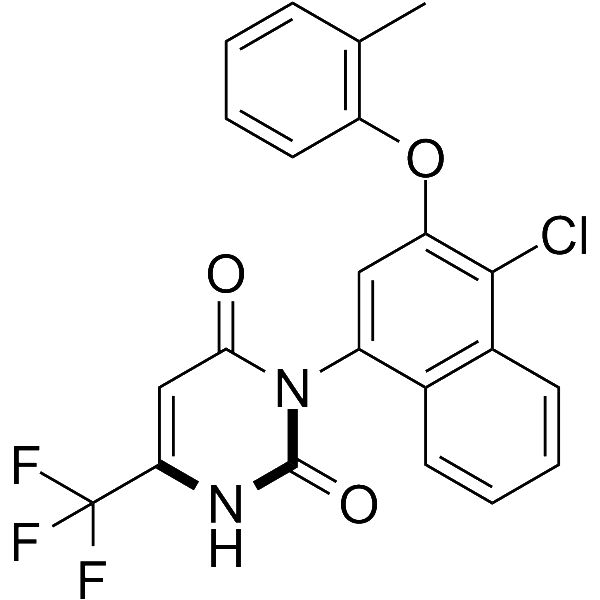
Physicochemical Properties
| Molecular Formula | C22H14CLF3N2O3 |
| Molecular Weight | 446.81 |
| Exact Mass | 446.064 |
| CAS # | 2639638-66-5 |
| Related CAS # | BAY-252;2639638-67-6;BAY-5000;2639435-48-4 |
| PubChem CID | 155555842 |
| Appearance | White to off-white solid powder |
| LogP | 5.4 |
| Hydrogen Bond Donor Count | 1 |
| Hydrogen Bond Acceptor Count | 6 |
| Rotatable Bond Count | 3 |
| Heavy Atom Count | 31 |
| Complexity | 744 |
| Defined Atom Stereocenter Count | 0 |
| SMILES | C1=CC=CC(OC2C=C(C3C(=CC=CC=3)C=2Cl)N2C(=O)C=C(NC2=O)C(F)(F)F)=C1C |
| InChi Key | UNSHMXUHOHBLIQ-UHFFFAOYSA-N |
| InChi Code | InChI=1S/C22H14ClF3N2O3/c1-12-6-2-5-9-16(12)31-17-10-15(13-7-3-4-8-14(13)20(17)23)28-19(29)11-18(22(24,25)26)27-21(28)30/h2-11H,1H3,(H,27,30) |
| Chemical Name | 3-[4-chloro-3-(2-methylphenoxy)naphthalen-1-yl]-6-(trifluoromethyl)-1H-pyrimidine-2,4-dione |
| HS Tariff Code | 2934.99.9001 |
| Storage |
Powder-20°C 3 years 4°C 2 years In solvent -80°C 6 months -20°C 1 month |
| Shipping Condition | Room temperature (This product is stable at ambient temperature for a few days during ordinary shipping and time spent in Customs) |
Biological Activity
| Targets | IC50: 31 nM (BCAT1), 153 nM (BCAT2)[1] |
| ln Vitro | Compound 36a, BAY-069 (70 nM–50 μM; 72 h), inhibits MDA-MB-231 and U-87 cell proliferation[1]. |
| ln Vivo | Following incubation with human liver microsomes (CLblood = 0.11 L/h/kg), BAY-069 demonstrates high metabolic stability; following incubation with rat hepatocytes (CLblood = 1.8 L/h/kg), it displays moderate metabolic stability. Additionally, BAY-069 demonstrates high permeability through Caco-2 cell monolayers without any evidence of efflux[1]. With low blood clearance (CLblood), a moderate volume of distribution at steady state (Vss), and an intermediate terminal half-life (t1/2), BAY-069 (0.3 mg/kg for iv; 0.6 mg/kg for po; single dosage) displays a favorable pharmacokinetic profile following iv dosing. |
| Cell Assay |
Cell Proliferation Assay[1] Cell Types: U-87 and MDA-MB -231 Tested Concentrations: 70 nM-50 μM Incubation Duration: 72 h Experimental Results: Inhibited cell proliferation of U-87 and MDA-MB-231 with IC50s of 358 nM and 874 nM, respectively. |
| Animal Protocol |
Animal/Disease Models: Male Wistar rats[1] Doses: 0.3 mg/kg for iv; 0.6 mg/kg for po Route of Administration: iv or po ; single dosage Experimental Results: pharmacokinetic/PK Parameters of BAY-069 in male Wistar rats[1]. CLblood (L/h/kg) Vss (L/kg) t1/2 (h), iv AUCnorm (kg·h/L), iv AUCnorm (kg·h/L), po F (%), po 0.64 0.25 1.6 2.9 2.5 89 |
| References |
[1]. BAY-069, a Novel (Trifluoromethyl)pyrimidinedione-Based BCAT1/2 Inhibitor and Chemical Probe. J Med Chem. 2022 Oct 19. |
Solubility Data
| Solubility (In Vitro) | DMSO: 200 mg/mL (447.62 mM) |
| Solubility (In Vivo) |
Solubility in Formulation 1: ≥ 5 mg/mL (11.19 mM) (saturation unknown) in 10% DMSO + 40% PEG300 + 5% Tween80 + 45% Saline (add these co-solvents sequentially from left to right, and one by one), clear solution. For example, if 1 mL of working solution is to be prepared, you can add 100 μL of 50.0 mg/mL clear DMSO stock solution to 400 μL PEG300 and mix evenly; then add 50 μL Tween-80 to the above solution and mix evenly; then add 450 μL normal saline to adjust the volume to 1 mL. Preparation of saline: Dissolve 0.9 g of sodium chloride in 100 mL ddH₂ O to obtain a clear solution. Solubility in Formulation 2: ≥ 5 mg/mL (11.19 mM) (saturation unknown) in 10% DMSO + 90% Corn Oil (add these co-solvents sequentially from left to right, and one by one), clear solution. For example, if 1 mL of working solution is to be prepared, you can add 100 μL of 50.0 mg/mL clear DMSO stock solution to 900 μL of corn oil and mix evenly. (Please use freshly prepared in vivo formulations for optimal results.) |
| Preparing Stock Solutions | 1 mg | 5 mg | 10 mg | |
| 1 mM | 2.2381 mL | 11.1904 mL | 22.3809 mL | |
| 5 mM | 0.4476 mL | 2.2381 mL | 4.4762 mL | |
| 10 mM | 0.2238 mL | 1.1190 mL | 2.2381 mL |