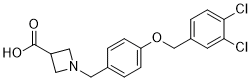
Physicochemical Properties
| Molecular Formula | C18H17CL2NO3 |
| Molecular Weight | 366.238 |
| Exact Mass | 365.058 |
| CAS # | 1240308-45-5 |
| PubChem CID | 46872626 |
| Appearance | White to off-white solid powder |
| Density | 1.4±0.1 g/cm3 |
| Boiling Point | 520.0±50.0 °C at 760 mmHg |
| Flash Point | 268.3±30.1 °C |
| Vapour Pressure | 0.0±1.4 mmHg at 25°C |
| Index of Refraction | 1.636 |
| LogP | 3.71 |
| Hydrogen Bond Donor Count | 1 |
| Hydrogen Bond Acceptor Count | 4 |
| Rotatable Bond Count | 6 |
| Heavy Atom Count | 24 |
| Complexity | 423 |
| Defined Atom Stereocenter Count | 0 |
| InChi Key | WAAWETUDFSIYSD-UHFFFAOYSA-N |
| InChi Code | InChI=1S/C18H17Cl2NO3/c19-16-6-3-13(7-17(16)20)11-24-15-4-1-12(2-5-15)8-21-9-14(10-21)18(22)23/h1-7,14H,8-11H2,(H,22,23) |
| Chemical Name | 1-(4-((3,4-Dichlorobenzyl)oxy)benzyl)azetidine-3-carboxylic Acid |
| Synonyms | A 971432 A971432A‑971432 |
| HS Tariff Code | 2934.99.9001 |
| Storage |
Powder-20°C 3 years 4°C 2 years In solvent -80°C 6 months -20°C 1 month |
| Shipping Condition | Room temperature (This product is stable at ambient temperature for a few days during ordinary shipping and time spent in Customs) |
Biological Activity
| ln Vitro | A-971432 (compound 29) (0-10 µM) exhibits selectivity for S1P1, S1P3, and S1P5, with corresponding IC50 values of 0.006 µM, >10, and 0.362 µM [1]. In HEK cells, A-971432 (0.1-1000 nM) causes complete agonism, with EC50 values of 5.7 nM and 4.1 nM, respectively [1]. |
| ln Vivo | A-971432 (1, 2 mg/kg; oral) exhibits good oral bioavailability and PK characteristics [1]. Pro-cognitive benefits are dose-dependent and are demonstrated by A-971432 (0.1 mg/kg; oral; daily for 21 days) [1]. A-971432 (i.p., 0.1 mg/kg) administered to 11-week R6/2 mice raises phosphorylation of AKT and ERK and boosts BDNF levels in the cortex [2]. Blood-brain barrier (BBB) homeostasis is preserved and CNS Accumulation of mHtt in systemic blood vessels is reduced by A-971432 (0.1 mg/kg; i.p.) attenuating typical progressive BBB leakage and FITC-albumin extravasation in the striatal parenchyma [2]. A-971432 (0.1 mg/kg; intraperitoneal; once daily for 4 weeks) keeps symptomatic R6/2 mice's motor impairments from getting worse after a prolonged infusion [2]. Pharmacokinetic characteristics of A-971432 in cynomolgus monkeys, beagle dogs, SD rats, and Balb/C mice [1]. IV PO Type Dose (mg/kg) Analyzed Sample) Protein Binding (%) t1/2 (h) AUC (ng.h/mL) VL (L/h/kg) Vss (L/kg) t1/2 (h ) ) tmax (h) Cmax (ng/mL) AUC (ng.h/mL) F(%) BALB/C mouse 2 plasma 93 7.6 8500 0.24 1.9 7.4 2.0 300 4800 57 BALB/C mouse 2 brain nd 9.8 3200 (Cmax =133 ng/nL) nd nd 10 2-24 43 1600 56 SD rat 1 plasma 93 9.0 6400 0.16 1.3 14 4.3 400 8700 >100 SD rat 2 brain 99.5 nd nd nd nd 15 8 120 3100 nd small Hound 1 Plasma 96 9.3 12000 0.09 1.2 10 1.5 690 11000 92 Cynomolgus monkey 1 Plasma 97 3.5 6400 0.16 0.82 6.7 1.7 650 5500 86 Balb/C mice, SD rats, beagles, cynomolgus monkeys; oral or intravenous injection ; Balb/C mice, SD rats 2mg/kg; SD rats, beagle dogs, cynomolgus monkeys 1mg/kg[1]. |
| Animal Protocol |
Animal/Disease Models: balb/c (Bagg ALBino) mouse, SD rats, beagle dogs, cynomolgus monkeys [1] Doses: 1, 2 mg/kg Route of Administration: Po or iv Experimental Results: High oral bioavailability, high exposure, Low clearance rate and long half-life. Animal/Disease Models: Male C57BL6J mice [1] Doses: 0.1 mg/kg Route of Administration: Po; one time/day for 21 days Experimental Results: Demonstrated dose-dependent pro-cognitive effects. Animal/Disease Models: 7-week R6/2 mice[2] Doses: 0.1 mg/kg Route of Administration: intraperitoneal (ip) injection; one time/day for 4 weeks Experimental Results: Normal motor function was restored within the first week of treatment, and The gradual motor deficits that usually occur during the disease are avoided throughout the treatment period. Animal/Disease Models: 4-week R6/2 mice [2] Doses: 0.1 mg/kg Route of Administration: intraperitoneal (ip) injection, one time/day for 2 weeks Experimental Results: Preserved BBB integrity and delayed motor symptoms in R6/2 mice seizures, and inhibits mHtt accumulation in central nervous system vessels in R6/2 mice. |
| References |
[1]. Discovery of A-971432, An Orally Bioavailable Selective Sphingosine-1-Phosphate Receptor 5 (S1P5) Agonist for the Potential Treatment of Neurodegenerative Disorders. J Med Chem. 2015 Dec 10;58(23):9154-70. [2]. Stimulation of S1PR5 with A-971432, a selective agonist, preserves blood-brain barrier integrity and exerts therapeutic effect in an animal model of Huntington's disease. Hum Mol Genet. 2018 Jul 15;27(14):2490-2501. |
Solubility Data
| Solubility (In Vitro) | May dissolve in DMSO (in most cases), if not, try other solvents such as H2O, Ethanol, or DMF with a minute amount of products to avoid loss of samples |
| Solubility (In Vivo) |
Note: Listed below are some common formulations that may be used to formulate products with low water solubility (e.g. < 1 mg/mL), you may test these formulations using a minute amount of products to avoid loss of samples. Injection Formulations (e.g. IP/IV/IM/SC) Injection Formulation 1: DMSO : Tween 80: Saline = 10 : 5 : 85 (i.e. 100 μL DMSO stock solution → 50 μL Tween 80 → 850 μL Saline) *Preparation of saline: Dissolve 0.9 g of sodium chloride in 100 mL ddH ₂ O to obtain a clear solution. Injection Formulation 2: DMSO : PEG300 :Tween 80 : Saline = 10 : 40 : 5 : 45 (i.e. 100 μL DMSO → 400 μLPEG300 → 50 μL Tween 80 → 450 μL Saline) Injection Formulation 3: DMSO : Corn oil = 10 : 90 (i.e. 100 μL DMSO → 900 μL Corn oil) Example: Take the Injection Formulation 3 (DMSO : Corn oil = 10 : 90) as an example, if 1 mL of 2.5 mg/mL working solution is to be prepared, you can take 100 μL 25 mg/mL DMSO stock solution and add to 900 μL corn oil, mix well to obtain a clear or suspension solution (2.5 mg/mL, ready for use in animals). Injection Formulation 4: DMSO : 20% SBE-β-CD in saline = 10 : 90 [i.e. 100 μL DMSO → 900 μL (20% SBE-β-CD in saline)] *Preparation of 20% SBE-β-CD in Saline (4°C,1 week): Dissolve 2 g SBE-β-CD in 10 mL saline to obtain a clear solution. Injection Formulation 5: 2-Hydroxypropyl-β-cyclodextrin : Saline = 50 : 50 (i.e. 500 μL 2-Hydroxypropyl-β-cyclodextrin → 500 μL Saline) Injection Formulation 6: DMSO : PEG300 : castor oil : Saline = 5 : 10 : 20 : 65 (i.e. 50 μL DMSO → 100 μLPEG300 → 200 μL castor oil → 650 μL Saline) Injection Formulation 7: Ethanol : Cremophor : Saline = 10: 10 : 80 (i.e. 100 μL Ethanol → 100 μL Cremophor → 800 μL Saline) Injection Formulation 8: Dissolve in Cremophor/Ethanol (50 : 50), then diluted by Saline Injection Formulation 9: EtOH : Corn oil = 10 : 90 (i.e. 100 μL EtOH → 900 μL Corn oil) Injection Formulation 10: EtOH : PEG300:Tween 80 : Saline = 10 : 40 : 5 : 45 (i.e. 100 μL EtOH → 400 μLPEG300 → 50 μL Tween 80 → 450 μL Saline) Oral Formulations Oral Formulation 1: Suspend in 0.5% CMC Na (carboxymethylcellulose sodium) Oral Formulation 2: Suspend in 0.5% Carboxymethyl cellulose Example: Take the Oral Formulation 1 (Suspend in 0.5% CMC Na) as an example, if 100 mL of 2.5 mg/mL working solution is to be prepared, you can first prepare 0.5% CMC Na solution by measuring 0.5 g CMC Na and dissolve it in 100 mL ddH2O to obtain a clear solution; then add 250 mg of the product to 100 mL 0.5% CMC Na solution, to make the suspension solution (2.5 mg/mL, ready for use in animals). Oral Formulation 3: Dissolved in PEG400 Oral Formulation 4: Suspend in 0.2% Carboxymethyl cellulose Oral Formulation 5: Dissolve in 0.25% Tween 80 and 0.5% Carboxymethyl cellulose Oral Formulation 6: Mixing with food powders Note: Please be aware that the above formulations are for reference only. InvivoChem strongly recommends customers to read literature methods/protocols carefully before determining which formulation you should use for in vivo studies, as different compounds have different solubility properties and have to be formulated differently. (Please use freshly prepared in vivo formulations for optimal results.) |
| Preparing Stock Solutions | 1 mg | 5 mg | 10 mg | |
| 1 mM | 2.7304 mL | 13.6522 mL | 27.3045 mL | |
| 5 mM | 0.5461 mL | 2.7304 mL | 5.4609 mL | |
| 10 mM | 0.2730 mL | 1.3652 mL | 2.7304 mL |