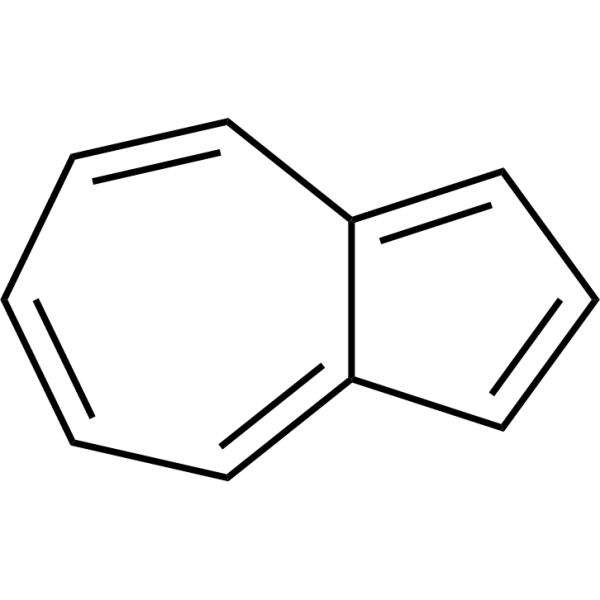
Physicochemical Properties
| Molecular Formula | C10H8 |
| Molecular Weight | 128.17 |
| Exact Mass | 128.062 |
| CAS # | 275-51-4 |
| Related CAS # | 82451-56-7 |
| PubChem CID | 9231 |
| Appearance | Purple to blue solid powder |
| Density | 1.0±0.1 g/cm3 |
| Boiling Point | 220.7±7.0 °C at 760 mmHg |
| Melting Point | 98-100 °C(lit.) |
| Flash Point | 76.7±8.9 °C |
| Vapour Pressure | 0.2±0.2 mmHg at 25°C |
| Index of Refraction | 1.632 |
| LogP | 3.45 |
| Hydrogen Bond Donor Count | 0 |
| Hydrogen Bond Acceptor Count | 0 |
| Rotatable Bond Count | 0 |
| Heavy Atom Count | 10 |
| Complexity | 94.6 |
| Defined Atom Stereocenter Count | 0 |
| InChi Key | CUFNKYGDVFVPHO-UHFFFAOYSA-N |
| InChi Code | InChI=1S/C10H8/c1-2-5-9-7-4-8-10(9)6-3-1/h1-8H |
| Chemical Name | azulene |
| HS Tariff Code | 2934.99.9001 |
| Storage |
Powder-20°C 3 years 4°C 2 years In solvent -80°C 6 months -20°C 1 month |
| Shipping Condition | Room temperature (This product is stable at ambient temperature for a few days during ordinary shipping and time spent in Customs) |
Biological Activity
| ln Vitro | Because it resembles a number of other bicyclic aromatic compounds that are frequently found in pharmaceuticals, the azulene ring is an intriguing scaffold in medicinal chemistry. The structural isomer of naphthalene, chamomilene, is a bicyclic aromatic hydrocarbon that is non-benzene and has a dipole moment because of two different rings: one with seven electrons deficient and the other with five electrons abundant [1]. |
| ADME/Pharmacokinetics |
Metabolism / Metabolites PAH metabolism occurs in all tissues, usually by cytochrome P-450 and its associated enzymes. PAHs are metabolized into reactive intermediates, which include epoxide intermediates, dihydrodiols, phenols, quinones, and their various combinations. The phenols, quinones, and dihydrodiols can all be conjugated to glucuronides and sulfate esters; the quinones also form glutathione conjugates. (L10) |
| Toxicity/Toxicokinetics |
Toxicity Summary The ability of PAH's to bind to blood proteins such as albumin allows them to be transported throughout the body. Many PAH's induce the expression of cytochrome P450 enzymes, especially CYP1A1, CYP1A2, and CYP1B1, by binding to the aryl hydrocarbon receptor or glycine N-methyltransferase protein. These enzymes metabolize PAH's into their toxic intermediates. The reactive metabolites of PAHs (epoxide intermediates, dihydrodiols, phenols, quinones, and their various combinations) covalently bind to DNA and other cellular macromolecules, initiating mutagenesis and carcinogenesis. (L10, L23, A27, A32) Toxicity Data LD50: >4000 mg/kg (Oral, Rat) (L912) LD50: 180 mg/kg (Intraperitoneal, Rat) (L912) LD50: 520 mg/kg (Subcutaneous, Rat) (L912) |
| References |
[1]. Azulene-based Compounds for Targeting Orexin Receptors. Eur J Med Chem. 2018 Sep 5;157:88-100. [2]. Antiretroviral (HIV-1) Activity of Azulene Derivatives. Bioorg Med Chem. 2016 Apr 15;24(8):1653-7. [3]. A new synthesis of substituted azulenes. Journal of the American Chemical Society, 111(1), 389-391. |
| Additional Infomation |
Azulene is a mancude carbobicyclic parent consisting of a cycloheptatriene and cyclopentadiene rings. It has a role as a plant metabolite and a volatile oil component. It is an ortho-fused bicyclic arene, a member of azulenes and a mancude carbobicyclic parent. Azulene has been reported in Achillea asiatica, Basella alba, and other organisms with data available. Azulene is one of over 100 different polycyclic aromatic hydrocarbons (PAHs). PAHs are chemicals that are formed during the incomplete burning organic substances, such as fossil fuels. They are usually found as a mixture containing two or more of these compounds. (L10) |
Solubility Data
| Solubility (In Vitro) | DMSO : ~100 mg/mL (~780.21 mM) |
| Solubility (In Vivo) |
Solubility in Formulation 1: ≥ 2.5 mg/mL (19.51 mM) (saturation unknown) in 10% DMSO + 40% PEG300 + 5% Tween80 + 45% Saline (add these co-solvents sequentially from left to right, and one by one), clear solution. For example, if 1 mL of working solution is to be prepared, you can add 100 μL of 25.0 mg/mL clear DMSO stock solution to 400 μL PEG300 and mix evenly; then add 50 μL Tween-80 to the above solution and mix evenly; then add 450 μL normal saline to adjust the volume to 1 mL. Preparation of saline: Dissolve 0.9 g of sodium chloride in 100 mL ddH₂ O to obtain a clear solution. Solubility in Formulation 2: ≥ 2.5 mg/mL (19.51 mM) (saturation unknown) in 10% DMSO + 90% (20% SBE-β-CD in Saline) (add these co-solvents sequentially from left to right, and one by one), clear solution. For example, if 1 mL of working solution is to be prepared, you can add 100 μL of 25.0 mg/mL clear DMSO stock solution to 900 μL of 20% SBE-β-CD physiological saline solution and mix evenly. Preparation of 20% SBE-β-CD in Saline (4°C,1 week): Dissolve 2 g SBE-β-CD in 10 mL saline to obtain a clear solution. Solubility in Formulation 3: ≥ 2.5 mg/mL (19.51 mM) (saturation unknown) in 10% DMSO + 90% Corn Oil (add these co-solvents sequentially from left to right, and one by one), clear solution. For example, if 1 mL of working solution is to be prepared, you can add 100 μL of 25.0 mg/mL clear DMSO stock solution to 900 μL of corn oil and mix evenly. (Please use freshly prepared in vivo formulations for optimal results.) |
| Preparing Stock Solutions | 1 mg | 5 mg | 10 mg | |
| 1 mM | 7.8021 mL | 39.0107 mL | 78.0214 mL | |
| 5 mM | 1.5604 mL | 7.8021 mL | 15.6043 mL | |
| 10 mM | 0.7802 mL | 3.9011 mL | 7.8021 mL |