Physicochemical Properties
| Molecular Formula | C12H11CLN6O2S2 |
| Molecular Weight | 370.8377 |
| Exact Mass | 370.007 |
| CAS # | 27589-33-9 |
| PubChem CID | 2273 |
| Appearance | White to off-white solid powder |
| Density | 1.661g/cm3 |
| Boiling Point | 671.1ºC at 760mmHg |
| Melting Point | 219.5 °C |
| Flash Point | 359.6ºC |
| Vapour Pressure | 7.19E-18mmHg at 25°C |
| Index of Refraction | 1.709 |
| LogP | 3.695 |
| Hydrogen Bond Donor Count | 3 |
| Hydrogen Bond Acceptor Count | 8 |
| Rotatable Bond Count | 5 |
| Heavy Atom Count | 23 |
| Complexity | 504 |
| Defined Atom Stereocenter Count | 0 |
| InChi Key | HMEDEBAJARCKCT-UHFFFAOYSA-N |
| InChi Code | InChI=1S/C12H11ClN6O2S2/c13-9-5-10(15-6-7-2-1-3-22-7)8(12-16-18-19-17-12)4-11(9)23(14,20)21/h1-5,15H,6H2,(H2,14,20,21)(H,16,17,18,19) |
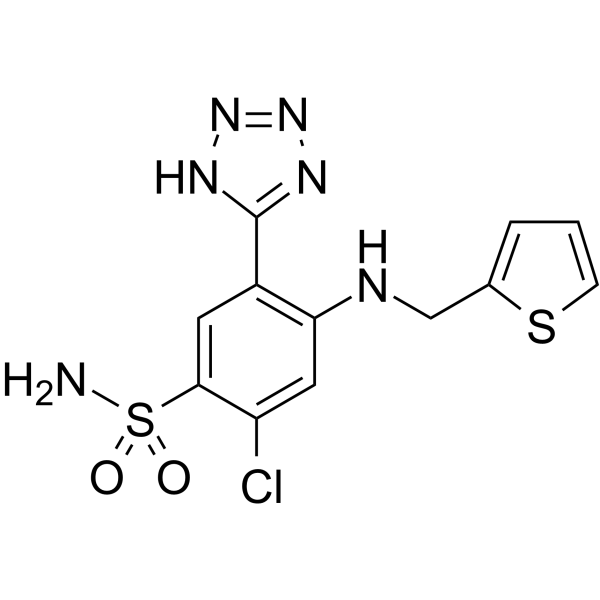
| Chemical Name | 2-chloro-5-(2H-tetrazol-5-yl)-4-(thiophen-2-ylmethylamino)benzenesulfonamide |
| HS Tariff Code | 2934.99.9001 |
| Storage |
Powder-20°C 3 years 4°C 2 years In solvent -80°C 6 months -20°C 1 month |
| Shipping Condition | Room temperature (This product is stable at ambient temperature for a few days during ordinary shipping and time spent in Customs) |
Biological Activity
| ln Vitro | Azosemide inhibits hNKCC1A and hNKCC1B, the human variants of the sodium-potassium chloride cotransporter[1]. |
| ln Vivo | Azosemide showed smaller AUC (81.9% decrease), shorter terminal half-life (50.9% decrease) and MRT (64.1% decrease), faster CL (454% increase), CLR (853% increase) and CLNR (307% increase) for NAR[2]. |
| Animal Protocol |
Animal/Disease Models: 9weeks old male SD (SD (Sprague-Dawley)) rat (control rat, body weight 310345 g) and NAR (body weight 220315 g) [2] Doses: 10 mg/kg (pharmacokinetic/PK/PK analysis) Route of Administration: via the neck intravenous (iv) (iv)infusion over 1 minute (iv) Experimental Results: demonstrated smaller AUC (81.9% decrease), shorter terminal half-life (50.9% decrease) and MRT (64.1% decrease), faster CL (454% increase) ), CLR (853% increase) and CLNR NAR (307% increase). |
| ADME/Pharmacokinetics |
Absorption, Distribution and Excretion Peak plasma concentrations are achieved in 3-4 hours when azosemide is administered to healthy humans in a fasting state. There is an absorption lag time of approximately 1 hour. Oral bioavailability estimated to be 20.4% Total body clearance 112ml/min. Renal clearance 41.6ml/min. Actively secreted in the renal proximal tubule of humans. This may or may not involve a nonspecific organic acid secretory pathway. There is thus a potential for disease states and other organic acids such as NSAIDs which affect the organic acid transport pathway to affect the efficacy of azosemide. Poor affinity for human tissue. Small apparent post-pseudodistribution Vd of 0.262 l/kg. Metabolism / Metabolites Considerable first pass metabolism which makes parentral administration more effective than oral administration. Eleven metabolites of azosemide were found in rats, but only azosemide and its glucuronide were detected in humans. Biological Half-Life Terminal half life 2-3 hours. |
| Toxicity/Toxicokinetics |
Protein Binding > 95% 4% protein binding to 4% human serum albumin at azosemide concentrations of 10-100ug/ml, using equilibrium dialysis. |
| References |
[1]. Azosemide is more potent than bumetanide and various other loop diuretics to inhibit the sodium-potassium-chloride-cotransporter human variants hNKCC1A and hNKCC1B. Sci Rep. 2018 Jun 29;8(1):9877. [2]. Pharmacokinetics and pharmacodynamics of intravenous azosemide in mutant Nagaseanalbuminemic rats. Drug Metab Dispos. 2003 Feb;31(2):194-201. |
| Additional Infomation |
Azosemide is a sulfonamide that is benzenesulfonamide which is substituted at positions 2, 4, and 5 by chlorine, (2-thienylmethyl)amino and 1H-tetrazol-5-yl groups, respectively. It is a diuretic that has been used in the management of oedema and hypertension. It has a role as a loop diuretic. It is a member of tetrazoles, a member of monochlorobenzenes, a sulfonamide and a member of thiophenes. Azosemide is a loop diuretic used to treat hypertension, edema, and ascites. Azosemide is a monosulfamyl belonging to the class of loop diuretics. Azosemide inhibits sodium and chloride reabsorption throughout the thick ascending limb of the loop of Henle. Mechanism of Action Exact mechanism of action is unclear. However, it acts primarily on the loop of Henle, in both the medullary and cortical segments of the thick ascending limb. Pharmacodynamics Diuretic affects upon oral administration match those of furosemide. However, upon intravenous administration azosemide displays 5.5 to 8 times greater effect. |
Solubility Data
| Solubility (In Vitro) | DMSO : ~250 mg/mL (~674.15 mM) |
| Solubility (In Vivo) |
Solubility in Formulation 1: ≥ 2.17 mg/mL (5.85 mM) (saturation unknown) in 10% DMSO + 40% PEG300 + 5% Tween80 + 45% Saline (add these co-solvents sequentially from left to right, and one by one), clear solution. For example, if 1 mL of working solution is to be prepared, you can add 100 μL of 21.7 mg/mL clear DMSO stock solution to 400 μL PEG300 and mix evenly; then add 50 μL Tween-80 to the above solution and mix evenly; then add 450 μL normal saline to adjust the volume to 1 mL. Preparation of saline: Dissolve 0.9 g of sodium chloride in 100 mL ddH₂ O to obtain a clear solution. Solubility in Formulation 2: ≥ 2.17 mg/mL (5.85 mM) (saturation unknown) in 10% DMSO + 90% Corn Oil (add these co-solvents sequentially from left to right, and one by one), clear solution. For example, if 1 mL of working solution is to be prepared, you can add 100 μL of 21.7 mg/mL clear DMSO stock solution to 900 μL of corn oil and mix evenly. Solubility in Formulation 3: ≥ 2.08 mg/mL (5.61 mM) (saturation unknown) in 10% DMSO + 90% (20% SBE-β-CD in Saline) (add these co-solvents sequentially from left to right, and one by one), clear solution. For example, if 1 mL of working solution is to be prepared, you can add 100 μL of 20.8 mg/mL clear DMSO stock solution to 900 μL of 20% SBE-β-CD physiological saline solution and mix evenly. Preparation of 20% SBE-β-CD in Saline (4°C,1 week): Dissolve 2 g SBE-β-CD in 10 mL saline to obtain a clear solution. (Please use freshly prepared in vivo formulations for optimal results.) |
| Preparing Stock Solutions | 1 mg | 5 mg | 10 mg | |
| 1 mM | 2.6966 mL | 13.4829 mL | 26.9658 mL | |
| 5 mM | 0.5393 mL | 2.6966 mL | 5.3932 mL | |
| 10 mM | 0.2697 mL | 1.3483 mL | 2.6966 mL |