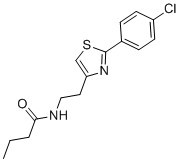
Azoramide is a small-molecule modulator of the unfolded protein response (UPR) and an ER stress alleviator that is reported to have antidiabetic activity. It can improve ER protein-folding ability and activates ER chaperone capacity to protect cells against ER stress. Azoramide also displayed potent antidiabetic efficacy in two mouse models with obesity by improving by improving peripheral insulin sensitivity and pancreatic β-cell function. Therefore, azoramide has the potential to be developed as a drug for type 2 diabete. In addition, a recent study showed that azoramide may serve as an antagonist against GLP-1R in MSC (mesenchymal stem cells) lineage determination, and azoramide favors adipogenesis against osteogenesis through inhibiting the GLP-1 receptor-PKA-β-catenin pathway.
Physicochemical Properties
| Molecular Formula | C15H17CLN2OS | |
| Molecular Weight | 308.83 | |
| Exact Mass | 308.075 | |
| Elemental Analysis | C, 58.34; H, 5.55; Cl, 11.48; N, 9.07; O, 5.18; S, 10.38 | |
| CAS # | 932986-18-0 | |
| Related CAS # |
|
|
| PubChem CID | 7518316 | |
| Appearance | White to off-white solid powder | |
| Density | 1.2±0.1 g/cm3 | |
| Index of Refraction | 1.574 | |
| LogP | 3.97 | |
| Hydrogen Bond Donor Count | 1 | |
| Hydrogen Bond Acceptor Count | 3 | |
| Rotatable Bond Count | 6 | |
| Heavy Atom Count | 20 | |
| Complexity | 308 | |
| Defined Atom Stereocenter Count | 0 | |
| SMILES | O=C(CCC)NCCC1=CSC(C2C=CC(Cl)=CC=2)=N1 |
|
| InChi Key | VYBFWKKCWTXCQX-UHFFFAOYSA-N | |
| InChi Code | InChI=1S/C15H17ClN2OS/c1-2-3-14(19)17-9-8-13-10-20-15(18-13)11-4-6-12(16)7-5-11/h4-7,10H,2-3,8-9H2,1H3,(H,17,19) | |
| Chemical Name | N-[2-[2-(4-chlorophenyl)-1,3-thiazol-4-yl]ethyl]butanamide | |
| Synonyms |
|
|
| HS Tariff Code | 2934.99.9001 | |
| Storage |
Powder-20°C 3 years 4°C 2 years In solvent -80°C 6 months -20°C 1 month |
|
| Shipping Condition | Room temperature (This product is stable at ambient temperature for a few days during ordinary shipping and time spent in Customs) |
Biological Activity
| Targets | UPR | ||
| ln Vitro |
|
||
| ln Vivo |
|
||
| Cell Assay | In either the absence or presence of 20 mM azoramide, INS1 cells are treated for 60 hours with 25 mM glucose and 500 mM palmitate (G/P). Using the CellTiter-Glo cell viability assay system, viability is evaluated after incubation. | ||
| Animal Protocol |
|
||
| References |
[1]. Phenotypic assays identify azoramide as a small-molecule modulator of the unfolded protein response with antidiabetic activity. Sci Transl Med. 2015 Jun 17;7(292):292ra98. [2]. Azoramide protects iPSC-derived dopaminergic neurons with PLA2G6 D331Y mutation through restoring ER function and CREB signaling. Cell Death Dis. 2020 Feb 18;11(2):130. |
Solubility Data
| Solubility (In Vitro) |
|
|||
| Solubility (In Vivo) |
Solubility in Formulation 1: ≥ 2.5 mg/mL (8.10 mM) (saturation unknown) in 10% DMSO + 40% PEG300 + 5% Tween80 + 45% Saline (add these co-solvents sequentially from left to right, and one by one), clear solution. For example, if 1 mL of working solution is to be prepared, you can add 100 μL of 25.0 mg/mL clear DMSO stock solution to 400 μL PEG300 and mix evenly; then add 50 μL Tween-80 to the above solution and mix evenly; then add 450 μL normal saline to adjust the volume to 1 mL. Preparation of saline: Dissolve 0.9 g of sodium chloride in 100 mL ddH₂ O to obtain a clear solution. Solubility in Formulation 2: ≥ 2.5 mg/mL (8.10 mM) (saturation unknown) in 10% DMSO + 90% (20% SBE-β-CD in Saline) (add these co-solvents sequentially from left to right, and one by one), clear solution. For example, if 1 mL of working solution is to be prepared, you can add 100 μL of 25.0 mg/mL clear DMSO stock solution to 900 μL of 20% SBE-β-CD physiological saline solution and mix evenly. Preparation of 20% SBE-β-CD in Saline (4°C,1 week): Dissolve 2 g SBE-β-CD in 10 mL saline to obtain a clear solution. Solubility in Formulation 3: ≥ 2.5 mg/mL (8.10 mM) (saturation unknown) in 10% DMSO + 90% Corn Oil (add these co-solvents sequentially from left to right, and one by one), clear solution. For example, if 1 mL of working solution is to be prepared, you can add 100 μL of 25.0 mg/mL clear DMSO stock solution to 900 μL of corn oil and mix evenly. (Please use freshly prepared in vivo formulations for optimal results.) |
| Preparing Stock Solutions | 1 mg | 5 mg | 10 mg | |
| 1 mM | 3.2380 mL | 16.1901 mL | 32.3803 mL | |
| 5 mM | 0.6476 mL | 3.2380 mL | 6.4761 mL | |
| 10 mM | 0.3238 mL | 1.6190 mL | 3.2380 mL |