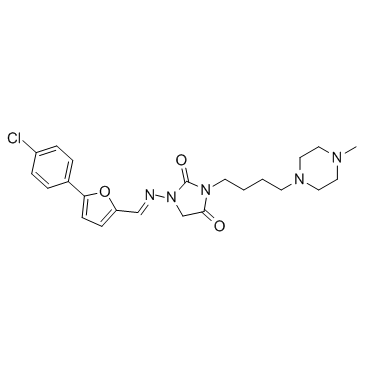
Azimilide (NE-10064) is a class III antiarrhythmic agent acting as a potassium channel blocker. It can be potentially used for the treatment of arrhythmia. Azimilide inhibits I(Ks) and I(Kr) in guinea-pig cardiac myocytes and I(Ks) (minK) channels expressed in Xenopus oocytes.
Physicochemical Properties
| Molecular Formula | C23H28N5O3CL |
| Molecular Weight | 457.95312 |
| Exact Mass | 457.188 |
| CAS # | 149908-53-2 |
| Related CAS # | Azimilide dihydrochloride;149888-94-8 |
| PubChem CID | 9571004 |
| Appearance | Typically exists as solid at room temperature |
| Density | 1.32 g/cm3 |
| Boiling Point | 594.9ºC at 760 mmHg |
| Flash Point | 313.6ºC |
| LogP | 2.977 |
| Hydrogen Bond Donor Count | 0 |
| Hydrogen Bond Acceptor Count | 6 |
| Rotatable Bond Count | 8 |
| Heavy Atom Count | 32 |
| Complexity | 677 |
| Defined Atom Stereocenter Count | 0 |
| SMILES | O=C1N(CCCCN2CCN(C)CC2)C(CN1/N=C/C3=CC=C(C4=CC=C(Cl)C=C4)O3)=O |
| InChi Key | MREBEPTUUMTTIA-PCLIKHOPSA-N |
| InChi Code | InChI=1S/C23H28ClN5O3/c1-26-12-14-27(15-13-26)10-2-3-11-28-22(30)17-29(23(28)31)25-16-20-8-9-21(32-20)18-4-6-19(24)7-5-18/h4-9,16H,2-3,10-15,17H2,1H3/b25-16+ |
| Chemical Name | 1-[(E)-[5-(4-chlorophenyl)furan-2-yl]methylideneamino]-3-[4-(4-methylpiperazin-1-yl)butyl]imidazolidine-2,4-dione |
| HS Tariff Code | 2934.99.9001 |
| Storage |
Powder-20°C 3 years 4°C 2 years In solvent -80°C 6 months -20°C 1 month |
| Shipping Condition | Room temperature (This product is stable at ambient temperature for a few days during ordinary shipping and time spent in Customs) |
Biological Activity
| ADME/Pharmacokinetics |
Absorption, Distribution and Excretion Excellent oral absorption. Metabolism / Metabolites The metabolic fate of azimilide in man is unusual as it undergoes a cleavage in vivo resulting in the formation of two classes of structurally distinct metabolites. One study has shown that a cleaved metabolite, 4-chloro-2-phenyl furoic acid was present at high concentration in plasma, while other plasma metabolites, azimilide N-oxide, and a cleaved hydantoin metabolite were present at lower concentrations than azimilide. In urine, the cleaved metabolites were the major metabolites, (> 35% of the dose) along with phenols (as conjugates, 7%-8%), azimilide N-oxide (4%-10%), a butanoic acid metabolite (2%-3%), and desmethyl azimilide (2%). A limited investigation of fecal metabolites indicated that azimilide (3%-5%), desmethyl azimilide (1%-3%), and the butanoic acid metabolite (< 1%) were present. Contributing pathways for metabolism of azimilide, identified through in vitro and in-vivo studies, were CYPs 1A1 (est. 28%), 3A4/5 (est. 20%), 2D6 (< 1%), FMO (est. 14%), and cleavage (35%). Enzyme(s) involved in the cleavage of azimilide were not identified. Azimilide has known human metabolites that include 1-[(Z)-[5-(4-chlorophenyl)furan-2-yl]methylideneamino]-3-[4-(4-methyl-4-oxidopiperazin-4-ium-1-yl)butyl]imidazolidine-2,4-dione and 1-[(E)-[5-(4-Chlorophenyl)furan-2-yl]methylideneamino]-3-(4-piperazin-1-ylbutyl)imidazolidine-2,4-dione. |
| References |
[1].Busch AE, et al. Blockade of HERG channels by the class III antiarrhythmic azimilide: mode of action. Br J Pharmacol. 1998 Jan;123(1):23-30. [2].Yao JA, et al. Azimilide (NE-10064) can prolong or shorten the action potential duration in canine ventricular myocytes: dependence on blockade of K, Ca, and Na channels. J Cardiovasc Electrophysiol. 1997 Feb;8(2):184-98. [3].Fermini B, et al. Use-dependent effects of the class III antiarrhythmic agent NE-10064 (azimilide) on cardiac repolarization: block of delayed rectifier potassium and L-type calcium currents. J Cardiovasc Pharmacol. 1995 Aug;26(2):259-71. |
| Additional Infomation |
Azimilide is an imidazolidine-2,4-dione. Azimilide is an investigational class III anti-arrhythmic drug that blocks fast and slow components of the delayed rectifier cardiac potassium channels. It is not approved for use in any country, but is currently in clinical trials in the United States. Drug Indication Investigated for use/treatment in arrhythmia and atrial fibrillation. Mechanism of Action The mechanism of action of azimilide is to block both the slowly conducting (I(Ks)) and rapidly conducting (I(Kr)) rectifier potassium currents in cardiac cells. This differs from other class III agents that block I(Kr) exclusively or in combination with sodium, calcium, or transient outward (I(to)) potassium current channels. It also has blocking effects on sodium (I(Na)) and calcium currents (I(CaL)). Its effects on reentrant circuits in infarct border zones causing ventricular tachyarrhythmias are unknown. Pharmacodynamics Azimilide is a new class III anti-arrhythmic agent. It is distinguished by a relative lack of reverse use-dependence, excellent oral absorption, no need for dose titration, an option for out-patient initiation, no need for adjustment associated with renal or liver failure and a lack of interaction with warfarin or digoxin. It carries some risk of torsade de pointes and rarely, neutropoenia. |
Solubility Data
| Solubility (In Vitro) | May dissolve in DMSO (in most cases), if not, try other solvents such as H2O, Ethanol, or DMF with a minute amount of products to avoid loss of samples |
| Solubility (In Vivo) |
Note: Listed below are some common formulations that may be used to formulate products with low water solubility (e.g. < 1 mg/mL), you may test these formulations using a minute amount of products to avoid loss of samples. Injection Formulations (e.g. IP/IV/IM/SC) Injection Formulation 1: DMSO : Tween 80: Saline = 10 : 5 : 85 (i.e. 100 μL DMSO stock solution → 50 μL Tween 80 → 850 μL Saline) *Preparation of saline: Dissolve 0.9 g of sodium chloride in 100 mL ddH ₂ O to obtain a clear solution. Injection Formulation 2: DMSO : PEG300 :Tween 80 : Saline = 10 : 40 : 5 : 45 (i.e. 100 μL DMSO → 400 μLPEG300 → 50 μL Tween 80 → 450 μL Saline) Injection Formulation 3: DMSO : Corn oil = 10 : 90 (i.e. 100 μL DMSO → 900 μL Corn oil) Example: Take the Injection Formulation 3 (DMSO : Corn oil = 10 : 90) as an example, if 1 mL of 2.5 mg/mL working solution is to be prepared, you can take 100 μL 25 mg/mL DMSO stock solution and add to 900 μL corn oil, mix well to obtain a clear or suspension solution (2.5 mg/mL, ready for use in animals). Injection Formulation 4: DMSO : 20% SBE-β-CD in saline = 10 : 90 [i.e. 100 μL DMSO → 900 μL (20% SBE-β-CD in saline)] *Preparation of 20% SBE-β-CD in Saline (4°C,1 week): Dissolve 2 g SBE-β-CD in 10 mL saline to obtain a clear solution. Injection Formulation 5: 2-Hydroxypropyl-β-cyclodextrin : Saline = 50 : 50 (i.e. 500 μL 2-Hydroxypropyl-β-cyclodextrin → 500 μL Saline) Injection Formulation 6: DMSO : PEG300 : castor oil : Saline = 5 : 10 : 20 : 65 (i.e. 50 μL DMSO → 100 μLPEG300 → 200 μL castor oil → 650 μL Saline) Injection Formulation 7: Ethanol : Cremophor : Saline = 10: 10 : 80 (i.e. 100 μL Ethanol → 100 μL Cremophor → 800 μL Saline) Injection Formulation 8: Dissolve in Cremophor/Ethanol (50 : 50), then diluted by Saline Injection Formulation 9: EtOH : Corn oil = 10 : 90 (i.e. 100 μL EtOH → 900 μL Corn oil) Injection Formulation 10: EtOH : PEG300:Tween 80 : Saline = 10 : 40 : 5 : 45 (i.e. 100 μL EtOH → 400 μLPEG300 → 50 μL Tween 80 → 450 μL Saline) Oral Formulations Oral Formulation 1: Suspend in 0.5% CMC Na (carboxymethylcellulose sodium) Oral Formulation 2: Suspend in 0.5% Carboxymethyl cellulose Example: Take the Oral Formulation 1 (Suspend in 0.5% CMC Na) as an example, if 100 mL of 2.5 mg/mL working solution is to be prepared, you can first prepare 0.5% CMC Na solution by measuring 0.5 g CMC Na and dissolve it in 100 mL ddH2O to obtain a clear solution; then add 250 mg of the product to 100 mL 0.5% CMC Na solution, to make the suspension solution (2.5 mg/mL, ready for use in animals). Oral Formulation 3: Dissolved in PEG400 Oral Formulation 4: Suspend in 0.2% Carboxymethyl cellulose Oral Formulation 5: Dissolve in 0.25% Tween 80 and 0.5% Carboxymethyl cellulose Oral Formulation 6: Mixing with food powders Note: Please be aware that the above formulations are for reference only. InvivoChem strongly recommends customers to read literature methods/protocols carefully before determining which formulation you should use for in vivo studies, as different compounds have different solubility properties and have to be formulated differently. (Please use freshly prepared in vivo formulations for optimal results.) |
| Preparing Stock Solutions | 1 mg | 5 mg | 10 mg | |
| 1 mM | 2.1836 mL | 10.9182 mL | 21.8364 mL | |
| 5 mM | 0.4367 mL | 2.1836 mL | 4.3673 mL | |
| 10 mM | 0.2184 mL | 1.0918 mL | 2.1836 mL |