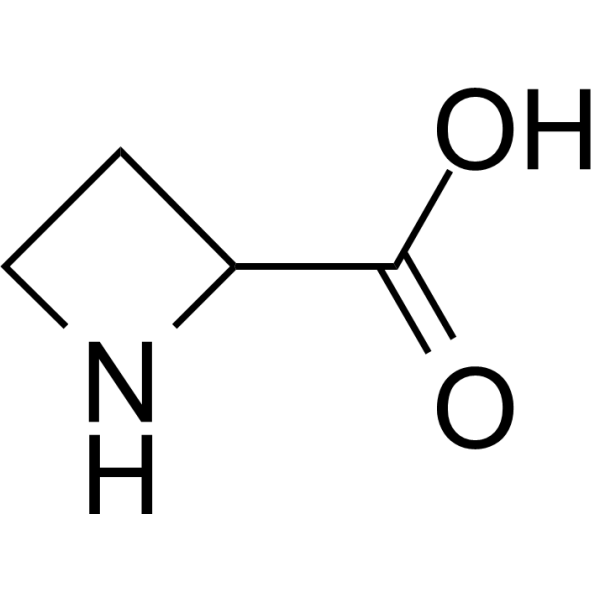
Physicochemical Properties
| Molecular Formula | C4H7NO2 |
| Molecular Weight | 101.1039 |
| Exact Mass | 101.047 |
| CAS # | 2517-04-6 |
| PubChem CID | 17288 |
| Appearance | White to off-white solid powder |
| Density | 1.3±0.1 g/cm3 |
| Boiling Point | 242.0±33.0 °C at 760 mmHg |
| Melting Point | 217°C (rough estimate) |
| Flash Point | 100.1±25.4 °C |
| Vapour Pressure | 0.0±1.0 mmHg at 25°C |
| Index of Refraction | 1.499 |
| LogP | -0.83 |
| Hydrogen Bond Donor Count | 2 |
| Hydrogen Bond Acceptor Count | 3 |
| Rotatable Bond Count | 1 |
| Heavy Atom Count | 7 |
| Complexity | 91.7 |
| Defined Atom Stereocenter Count | 0 |
| InChi Key | IADUEWIQBXOCDZ-UHFFFAOYSA-N |
| InChi Code | InChI=1S/C4H7NO2/c6-4(7)3-1-2-5-3/h3,5H,1-2H2,(H,6,7) |
| Chemical Name | azetidine-2-carboxylic acid |
| HS Tariff Code | 2934.99.9001 |
| Storage |
Powder-20°C 3 years 4°C 2 years In solvent -80°C 6 months -20°C 1 month Note: Please store this product in a sealed and protected environment, avoid exposure to moisture. |
| Shipping Condition | Room temperature (This product is stable at ambient temperature for a few days during ordinary shipping and time spent in Customs) |
Biological Activity
| Targets | Proline-binding sites in protein synthesis [1][2][3] |
| ln Vitro |
Azetidine-2-carboxylic acid (375-5oo μg/day) was integrated into collagen produced in vitro from chick embryo cartilage [3]. In cultured chick embryo skin fibroblasts, Azetidine-2-carboxylic acid competitively substituted proline in newly synthesized collagen. At equimolar concentration (5 mM) with proline, its incorporation rate reached 32% of proline uptake, resulting in collagen with reduced thermal stability (melting point decreased by 8°C) and disrupted tertiary structure [3] In neuronal cell cultures, Azetidine-2-carboxylic acid (1-10 mM) inhibited proline incorporation into proteins in a concentration-dependent manner. At 10 mM, proline incorporation was reduced by 58%, leading to misfolded protein accumulation in the endoplasmic reticulum and increased expression of ER stress markers (GRP78 upregulated by 2.3-fold, CHOP upregulated by 1.8-fold) [2] |
| ln Vivo |
In 3-day-old chick embryos, Azetidine-2-carboxylic acid (10 mg/egg via yolk sac injection) arrested collagen accumulation in skin, bone, and connective tissues. By day 7, embryonic growth was retarded by 40%, with skin collagen content reduced by 62% compared to controls. Surviving embryos showed skeletal deformities (shortened limbs, abnormal rib cages) due to defective extracellular matrix [3] In rats fed a diet containing 0.5% w/w Azetidine-2-carboxylic acid for 4 weeks, the compound was detected in liver (12.3 μg/g tissue), kidney (8.7 μg/g tissue), brain (4.2 μg/g tissue), and muscle (2.1 μg/g tissue), indicating systemic distribution [1] A hypothesis suggests dietary intake of Azetidine-2-carboxylic acid leads to misincorporation into human myelin proteins. This causes myelin instability and demyelination, a key pathological feature of multiple sclerosis [2] |
| Cell Assay |
Chick embryo skin fibroblasts were cultured in DMEM supplemented with essential amino acids. Azetidine-2-carboxylic acid (1-10 mM) and [3H]-proline were added to the medium. After 24-hour incubation, collagen was extracted via salt precipitation, and radioactivity was measured to calculate incorporation efficiency. Thermal stability of collagen was analyzed by monitoring absorbance at 230 nm during temperature elevation (25-60°C) [3] Neuronal cells were cultured in neurobasal medium. Azetidine-2-carboxylic acid (1-10 mM) was added, and cells were incubated for 48 hours. Proteins were extracted, and misfolded proteins were detected by SDS-PAGE and western blot. ER stress markers (GRP78, CHOP) were quantified using sandwich ELISA, and apoptotic cells were identified by Annexin V-FITC/PI staining [2] |
| Animal Protocol |
3-day-old chick embryos were randomly divided into control and treatment groups. Azetidine-2-carboxylic acid was dissolved in physiological saline (10 mg/mL), and 1 mL (10 mg/egg) was injected into the yolk sac of treatment embryos. Control embryos received 1 mL of saline. All embryos were incubated at 37°C with 50% relative humidity and harvested on day 7 to measure collagen content, tissue morphology, and embryonic growth parameters [3] Adult Sprague-Dawley rats (200-250 g) were assigned to control and treatment groups (n=6 per group). Treatment rats were fed a diet containing 0.5% w/w Azetidine-2-carboxylic acid for 4 weeks, while control rats received a standard diet. Rats were euthanized, and liver, kidney, brain, and muscle tissues were collected to quantify the compound via HPLC [1] |
| ADME/Pharmacokinetics |
In rats, oral intake of Azetidine-2-carboxylic acid (0.5% diet) showed good oral bioavailability, with peak plasma concentration (1.8 μg/mL) reached at 2 hours post-feeding [1] The compound distributes widely to tissues, with the highest concentration in liver, followed by kidney, brain, and muscle. It undergoes minimal metabolism, with 65% of the administered dose excreted unchanged in urine within 24 hours [1] |
| Toxicity/Toxicokinetics |
In chick embryos, Azetidine-2-carboxylic acid (10 mg/egg) caused 25% embryonic lethality. Surviving embryos exhibited skeletal deformities and impaired connective tissue formation due to defective collagen [3] In rats treated with Azetidine-2-carboxylic acid (0.5% diet for 4 weeks), no significant changes in body weight, hematology, or liver/kidney function markers (ALT, AST, creatinine, BUN) were observed. Mild vacuolation of renal tubular cells was noted in histological examination [1] In neuronal cell cultures, Azetidine-2-carboxylic acid (10 mM for 72 hours) induced apoptosis, with apoptotic rate increased by 35% compared to control cells [2] |
| References |
[1]. Azetidine-2-carboxylic acid in the food chain. Phytochemistry. 2009 Jan;70(1):100-4. [2]. Misincorporation of the proline analog azetidine-2-carboxylic acid in the pathogenesis of multiple sclerosis: a hypothesis. J Neuropathol Exp Neurol. 2008 Nov;67(11):1035-40. [3]. Effect of the proline analogue azetidine-2-carboxylic acid on collagen synthesis in vivo. I. Arrest of collagen accumulation in growing chick embryos. Biochim Biophys Acta. 1971 Jun 29;236(3):517-27. |
| Additional Infomation |
Azetidine-2-carboxylic acid is an azetidinecarboxylic acid that is azetidine substituted by a carboxy group at position 2. It is a plant non-protein amino acid. It has a role as a plant metabolite and a teratogenic agent. It is an azetidinecarboxylic acid and an amino acid. Azetidine-2-carboxylate has been reported in Convallaria majalis, Clavulinopsis miyabeana, and other organisms with data available. A proline analog that acts as a stoichiometric replacement of proline. It causes the production of abnormal proteins with impaired biological activity. Azetidine-2-carboxylic acid is a non-proteinogenic amino acid and natural proline analog, predominantly found in plants of the Liliaceae family (e.g., lilies, tulips, onions) and some fungal species [1] Its core mechanism of action is competitive substitution of proline in protein synthesis, leveraging structural similarity to proline. This leads to synthesis of misfolded, functionally defective proteins [2][3] The compound enters the food chain through human consumption of contaminated plant products, representing a potential dietary exposure route [1] It is proposed that chronic dietary exposure to Azetidine-2-carboxylic acid may contribute to the pathogenesis of multiple sclerosis via myelin protein misincorporation, though this remains a hypothesis requiring further validation [2] |
Solubility Data
| Solubility (In Vitro) | H2O : ~50 mg/mL (~494.56 mM) |
| Solubility (In Vivo) |
Solubility in Formulation 1: 50 mg/mL (494.56 mM) in PBS (add these co-solvents sequentially from left to right, and one by one), clear solution; with sonication (<60°C). (Please use freshly prepared in vivo formulations for optimal results.) |
| Preparing Stock Solutions | 1 mg | 5 mg | 10 mg | |
| 1 mM | 9.8912 mL | 49.4560 mL | 98.9120 mL | |
| 5 mM | 1.9782 mL | 9.8912 mL | 19.7824 mL | |
| 10 mM | 0.9891 mL | 4.9456 mL | 9.8912 mL |